Request info
Want to know more before you sign up?
Send a short question and we will forward it directly to the provider.
We forward your question to TUC Yrkeshögskola. No spam, no third parties.
Send a short question and we will forward it directly to the provider.
We forward your question to TUC Yrkeshögskola. No spam, no third parties.
After completing the programme, the student should have knowledge of: 1. Environmental certification, energy efficiency and sustainability. 2. Energy audits and energy calculations. 3. Energy optimisation. 4. Project management, project methodology and tools. 5. Investment/operating cost, maintenance cost, Life Cycle Cost (LCC), models and key concepts in product and investment costing. 6. Construction contracts, technical documents and procurement. 7. Leadership and work supervision. 8. Building technology and building physics. 9. Drawing reading. 10. District heating and district cooling systems. 11. Solar energy, solar power technology. 12. Refrigeration and heat pump technology. 13. Ventilation technology. 14. Electrical engineering and applicable safety regulations. 15. Specialised control and regulation technology. 16. Installation technology, system structure and a systems perspective. 17. Professional English terms and expressions in the industry. 18. A scientific and critical approach. 19. Report writing with an English component, and oral presentation. 20. Presentation technique, constructive criticism and opposition. After completing the programme, the student should have the skills to: 1. Interpret directives and ordinances in environmental certification. 2. Carry out energy audits and energy calculations and evaluate the results. 3. Analyse and optimise energy consumption. 4. Plan, lead, carry out and evaluate a project. 5. Prepare financial accounts, follow-up and profitability calculations (LCC). 6. Interpret and apply laws and technical documents, and draw up contracts. 7. Lead and coach employees. 8. Identify and analyse building physics and building technology problems and solutions. 9. Interpret and produce drawings. 10. Size district heating and district cooling systems from an energy-saving perspective. 11. Calculate and size a solar cell and solar heating installation. 12. Size and install refrigeration units and heat pumps based on documentation and energy efficiency. 13. Calculate heat, ventilation and transmission losses. 14. Process and calculate collected measurement data and present, evaluate and follow up the results. 15. Distinguish flows and assess how they affect installations. After completing the programme, the student should have the competence to: 1. Independently assess relationships from a systems perspective and evaluate the environmental and economic consequences of different energy systems. 2. Independently carry out an energy audit according to the regulations and general advice of Energimyndigheten, analyse the results and submit proposals for energy-optimising measures. 3. Independently propose energy-saving measures from a sustainability perspective and present investment costs based on LCC. 4. After gaining work experience, take the certification exam to become an energy expert. 5. Lead, plan and carry out projects and evaluate the results. 6. Independently identify and analyse faults in installation and operation, correct them and present proposals for energy-saving measures. 7. Identify the choice of leadership style suited to leading individuals and groups based on the group's development phase, and take on supervisory responsibility. 8. Take responsibility for their own professional development and, based on research and new technology, develop proposals for change and development. 9. Obtain authorisation as an OVK inspector.
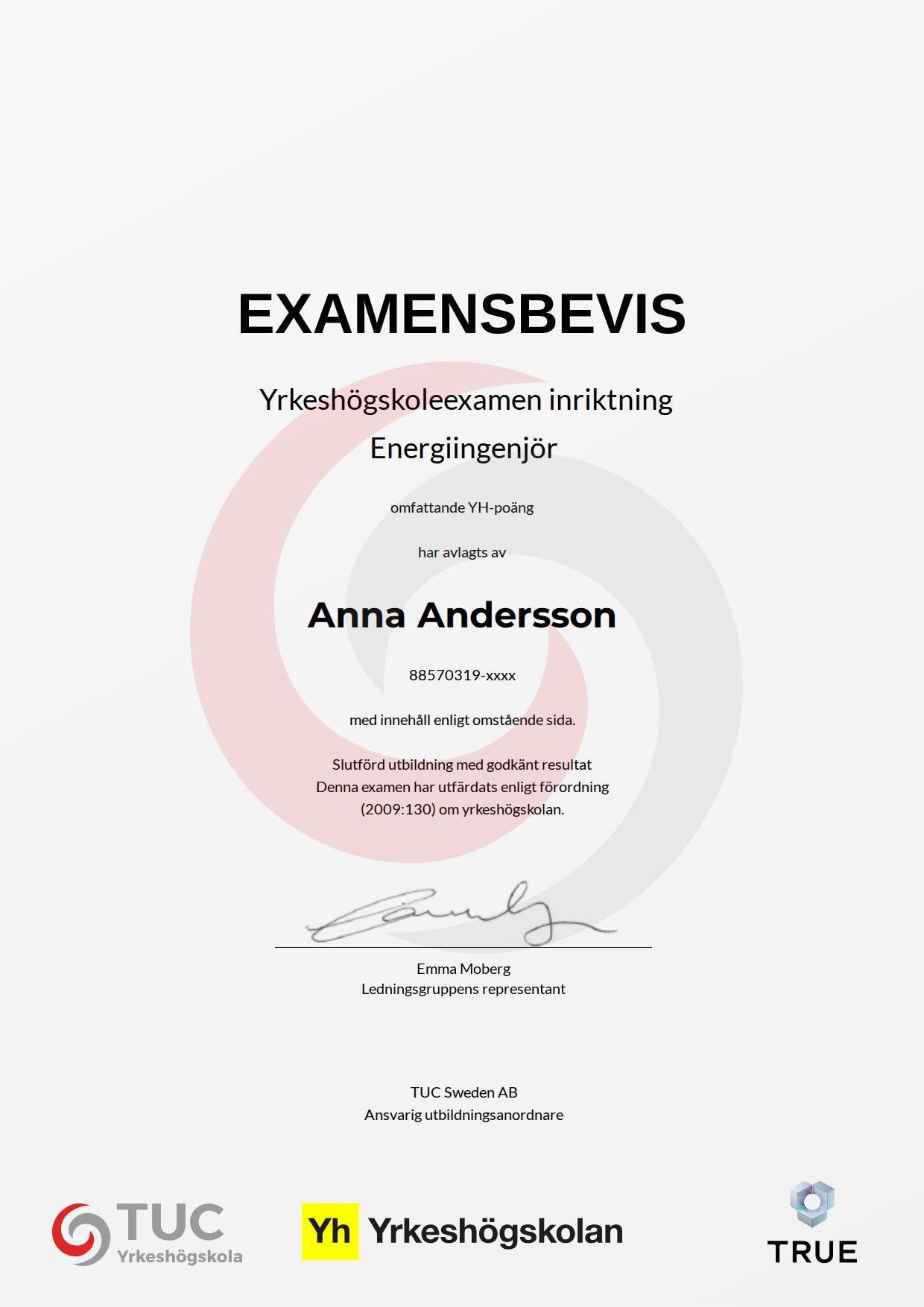
When you complete the course, TUC Yrkeshögskola issues your certificate. Your name, the course content and the issue date are encrypted and secured on blockchain, so it cannot be changed, and anyone can check that it is genuine.
Sample Credential with placeholder data. Each credential is issued with the recipient’s details and is verifiable with the provider.