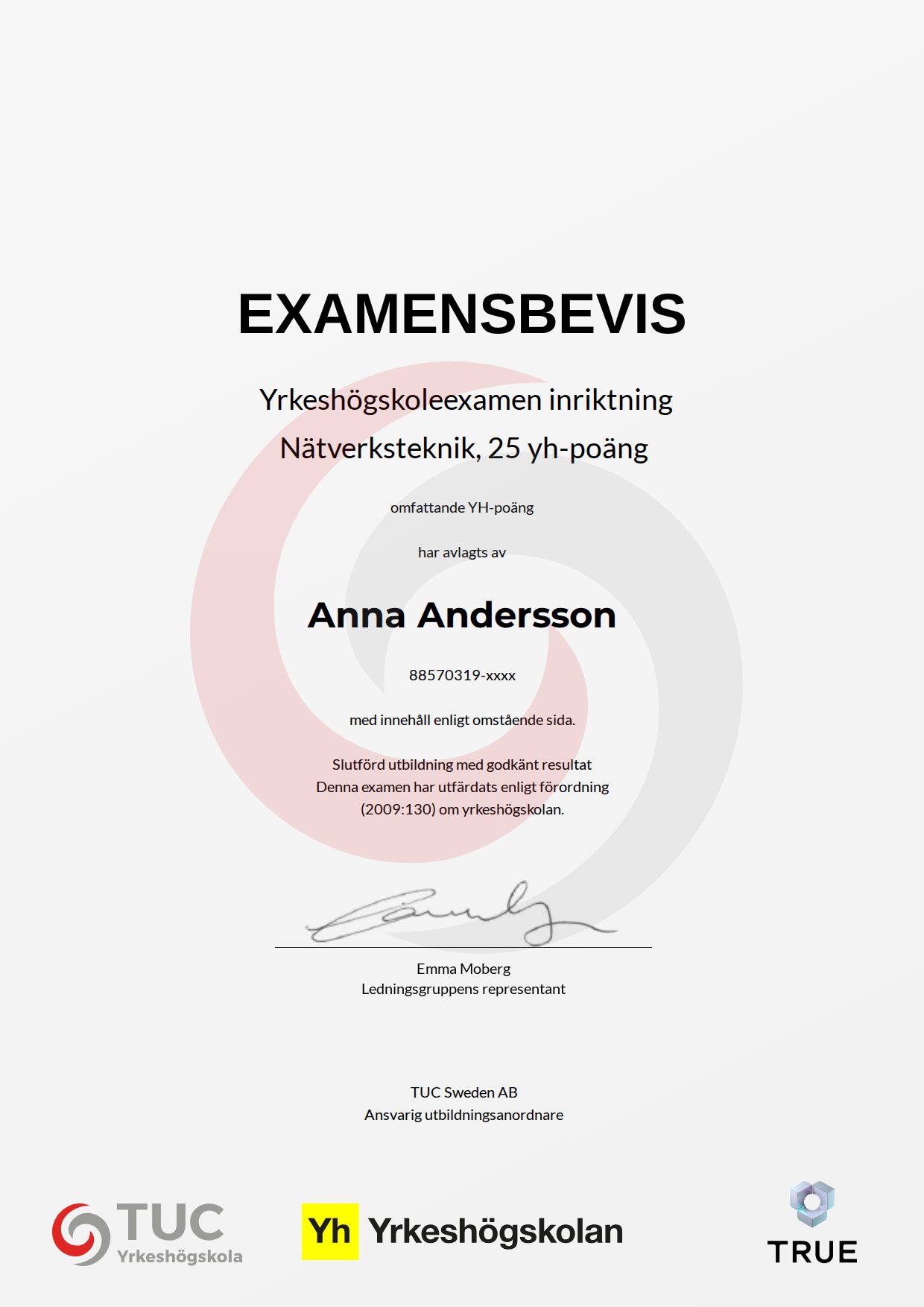
Part of a YH programme at TUC Yrkeshögskola. This course cannot be applied for on its own. Programme code: ITS25STO.
The Network technology course gives you the basics of configuring routers and switches for improved network security and of building a network from scratch. You learn to identify and fix weaknesses in Linux and Windows environments and to configure VLANs and access lists. The course also covers wireless networks, access points and security, as well as planning, configuring and troubleshooting networks. The course is part of TUC's YH programme for IT security specialists.
Duration: 20 weeks
Language: Swedish
Level: Beginner
CSN-eligible
Time commitment: 20 YH credits, about 4 weeks of full-time study
The course covers basic and advanced aspects of network configuration and
security. The focus is on practical application of theories about routers, switches, VLANs,
access lists and wireless networks. Students also gain skills in identifying and
fixing security flaws in Linux and Windows environments.
Teaching includes practical exercises and theoretical elements in access control,
configuration and troubleshooting. The course prepares students to plan, deploy and
maintain secure computer networks in the professional role of IT security specialist.
The course covers basic and advanced aspects of network configuration and
security. The focus is on practical application of theories about routers, switches, VLANs,
access lists and wireless networks. Students also gain skills in identifying and
fixing security flaws in Linux and Windows environments.
Teaching includes practical exercises and theoretical elements in access control,
configuration and troubleshooting. The course prepares students to plan, deploy and
maintain secure computer networks in the professional role of IT security specialist.
What you will learn
What you learn.
You can configure routers and switches for improved network security.
You can build a network from scratch.
You can identify and fix weaknesses in Linux and Windows environments.
You can configure VLANs and access lists.
You can install and configure wireless networks with the associated security.
You can plan, configure and troubleshoot a network.
Curriculum
How the course is built.
Routers and switches
Configuration for improved network security.
Building networks
Building a network from scratch and fixing weaknesses in Linux/Windows.
VLANs and access lists
Configuring switches and routers for VLANs and access control.
Wireless networks
Access points, security and configuration of wireless networks.
Target audience
Who is this for?
The course is aimed at you who are studying to become an IT security specialist and want to learn the basics of network technology and secure network configuration.
What "verified" means here
Verified credential.
When you complete the course, TUC Yrkeshögskola issues your certificate. Your name, the course content and the issue date are encrypted and secured on blockchain, so it cannot be changed, and anyone can check that it is genuine.
100% Verifiable certificates Secured on blockchain