The course gives you knowledge of how process data systems and vision technology are used to make production flows more efficient, and how information technology can be applied to troubleshooting in automated process plants. You learn to use process computer systems for data collection, control and monitoring and to apply IT communication systems for troubleshooting. The course also covers vision systems, programming safety functions and protecting industrial networks. After the course you can use vision systems and logged data for troubleshooting in your professional role.
Duration: 5 weeks
Language: Swedish
Level: Advanced
CSN-eligible
Time commitment: Equivalent to approx. 5 weeks of full-time study
In the course, the student learns how process data systems and vision technology are used to make production flows more efficient and how information technology can be applied to troubleshooting in automated process plants. Through theory and practical exercises, students learn to use process computer systems for data collection, control and monitoring, and to apply IT communication systems for troubleshooting. The course also covers choosing and using vision systems, programming safety functions and protecting industrial networks. After the course, the student can use vision systems and logged data in order to troubleshoot vision systems in their future professional role.
In the course, the student learns how process data systems and vision technology are used to make production flows more efficient and how information technology can be applied to troubleshooting in automated process plants. Through theory and practical exercises, students learn to use process computer systems for data collection, control and monitoring, and to apply IT communication systems for troubleshooting. The course also covers choosing and using vision systems, programming safety functions and protecting industrial networks. After the course, the student can use vision systems and logged data in order to troubleshoot vision systems in their future professional role.
What you will learn
What you learn.
You can use process computer systems for data collection, control and monitoring
You can apply IT communication systems for troubleshooting in process plants
You can choose and use vision systems for production flows
You can program safety functions in automated systems
You can protect industrial networks against intrusion
You can use logged data to troubleshoot vision systems
Curriculum
How the course is built.
Process data systems
Data collection, control and monitoring via process computer systems.
IT communication for troubleshooting
Applying IT communication systems in troubleshooting.
Vision technology
Choosing and using vision systems to make production flows more efficient.
Safety functions
Programming safety functions in automated plants.
Industrial networks
Protecting industrial networks against intrusion and faults.
Troubleshooting methodology
Methodical troubleshooting using logged data and vision systems.
Target audience
Who is this for?
Students in TUC's YH programme for automation engineers who want to deepen their knowledge of IT systems engineering and troubleshooting.
What "verified" means here
Verified credential.
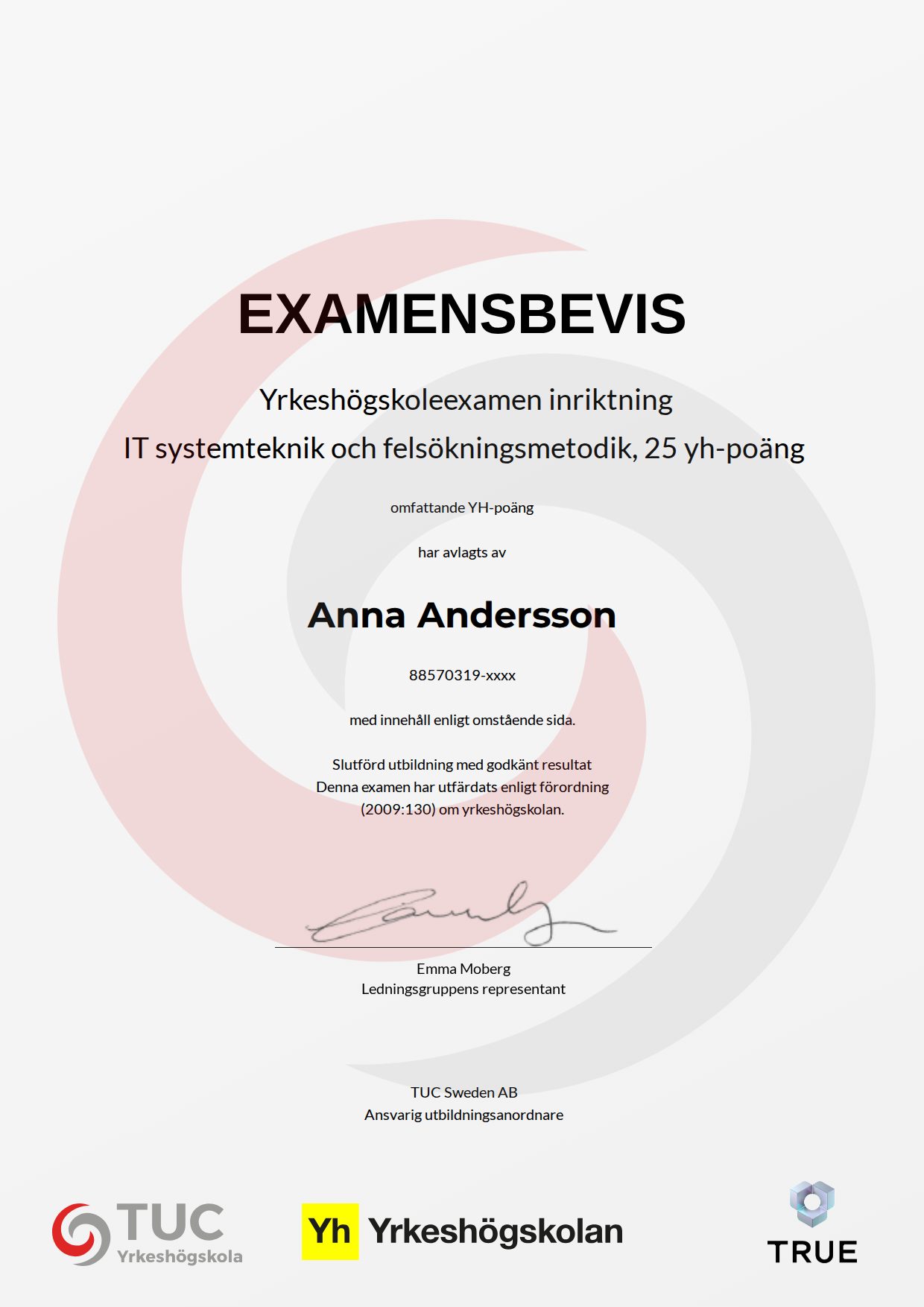
When you complete the course, TUC Yrkeshögskola issues your certificate. Your name, the course content and the issue date are encrypted and secured on blockchain, so it cannot be changed, and anyone can check that it is genuine.
100% Verifiable certificates Secured on blockchain