Part of the YH programme Data Manager at TUC Yrkeshögskola. This course cannot be applied for on its own. Programme code: DATA23STO.
Data Modelling and Design gives you specialised knowledge of creating data models to discover, analyse, represent and communicate an organisation's data requirements. Through theory and practical exercises you learn to produce conceptual, logical and physical data models that support business processes and to collaborate with requirement owners and model users. The course is part of TUC's YH programme in data and gives you tools for linking data models to the organisation's digitalisation strategy.
Duration: 6 weeks
Language: Swedish
Level: Advanced
CSN-eligible
Time commitment: 30 YH credits, about 6 weeks of full-time study
The course aims to give the student knowledge of how to create data models in order to implement digitalisation strategies for discovering, analysing, representing and communicating data requirements, and of how different data models and their components work in interaction with requirement owners and model users.
The goal is for the student, through theory and practical exercises, to develop specialised knowledge of data modelling as a means of analysing and defining data requirements that support business processes within the organisation's information systems. The student will also learn to collaborate with the requirement owners/model users when designing the model.
The student will develop skills in producing conceptual, logical and physical data models based on the organisation's data requirements. This includes skills in communicating with the requirement owners/model users to ensure that the data requirements can be met and that the model corresponds to the organisation's purpose.
The course aims to give the student knowledge of how to create data models in order to implement digitalisation strategies for discovering, analysing, representing and communicating data requirements, and of how different data models and their components work in interaction with requirement owners and model users.
The goal is for the student, through theory and practical exercises, to develop specialised knowledge of data modelling as a means of analysing and defining data requirements that support business processes within the organisation's information systems. The student will also learn to collaborate with the requirement owners/model users when designing the model.
The student will develop skills in producing conceptual, logical and physical data models based on the organisation's data requirements. This includes skills in communicating with the requirement owners/model users to ensure that the data requirements can be met and that the model corresponds to the organisation's purpose.
What you will learn
What you learn.
Can create data models to analyse and define an organisation's data requirements
Can produce conceptual, logical and physical data models
Has knowledge of how different data models interact with requirement owners and model users
Can communicate with requirement owners to ensure that the data requirements are sustainable
Understands how data modelling supports the organisation's digitalisation strategy
Curriculum
How the course is built.
Data modelling fundamentals
What a data model is and why it is needed to analyse data requirements.
Conceptual, logical and physical models
The different levels of data modelling and how they connect.
Collaboration with requirement owners
Communicating with the business to capture and verify data requirements.
Data modelling in the digitalisation strategy
How data models support the organisation's overall digitalisation work.
Target audience
Who is this for?
The course is aimed at you who are studying to become a data manager or want to work with data modelling, information systems and digitalisation strategies.
What "verified" means here
Verified credential.
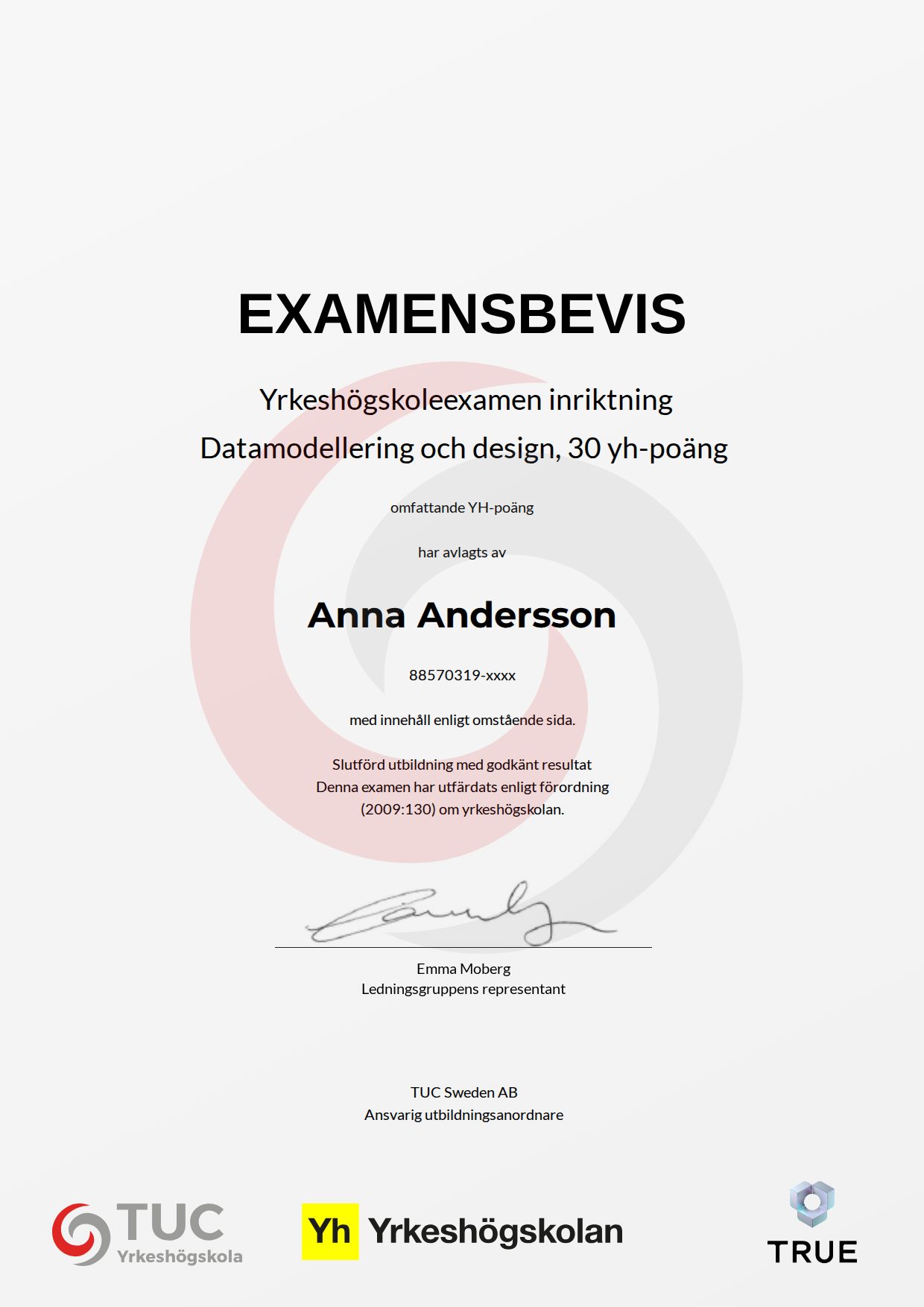
When you complete the course, TUC Yrkeshögskola issues your certificate. Your name, the course content and the issue date are encrypted and secured on blockchain, so it cannot be changed, and anyone can check that it is genuine.
100% Verifiable certificates Secured on blockchain