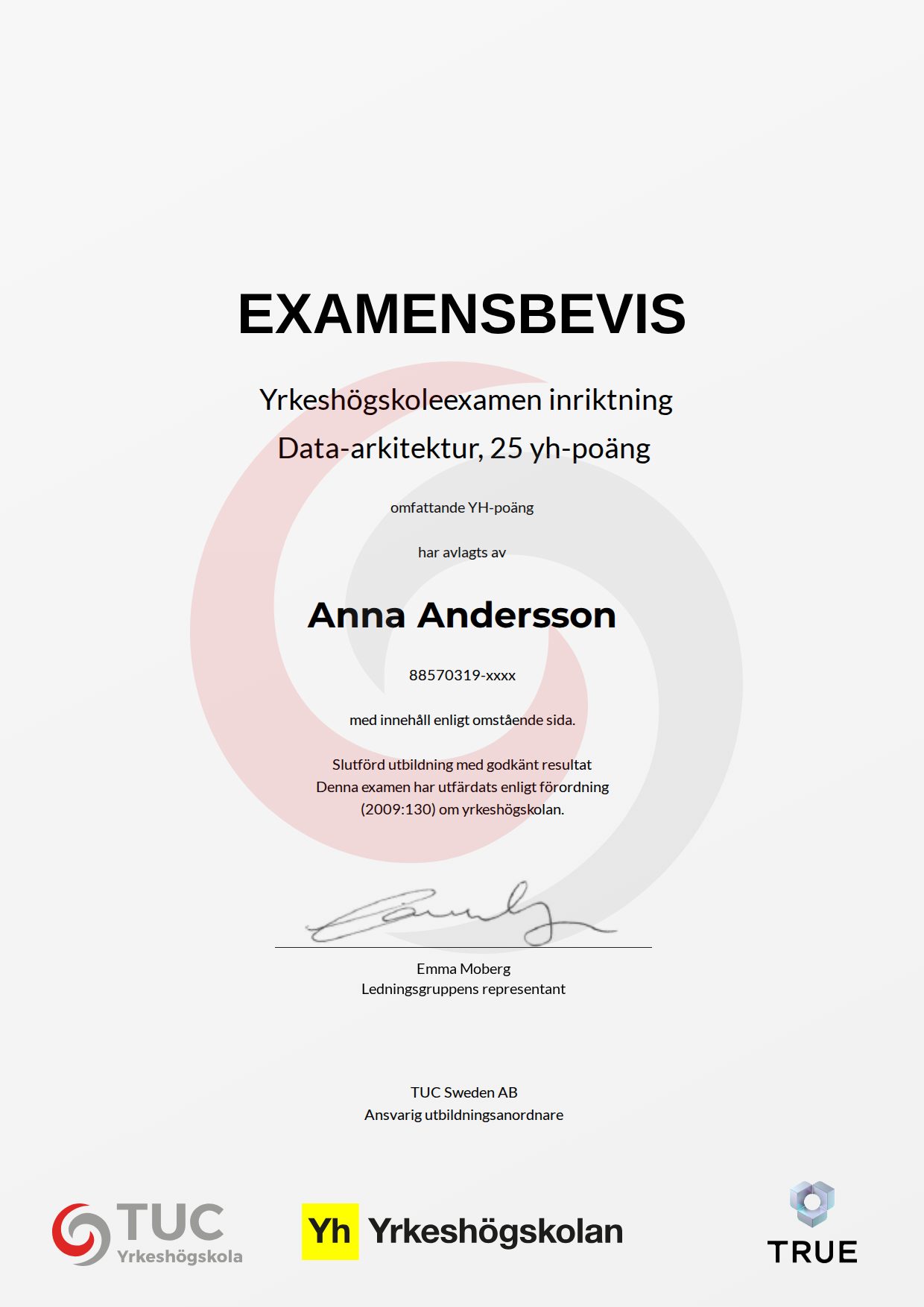
Part of the YH programme Data Manager at TUC Yrkeshögskola. This course cannot be applied for on its own. Programme code: DATA24STO.
Data Architecture is part of the YH programme Data Manager at TUC Yrkeshögskola, where TUC is the first in Sweden to offer a programme for the professional role of Data Manager. The course gives an in-depth understanding of how semantic information structures are defined in relation to the development of applications and IT systems. You learn to apply Domain-Driven Design (DDD) as an analysis and modelling methodology and to use relevant UML to describe and read models, flows and structures.
The course aims for the student to develop an in-depth understanding of how semantic information structures are defined in relation to the development of applications and IT systems. The structure and planning of most IT applications are typically oriented around data, so a Data Manager is expected to take a leading role here and be able to describe how the applications should be structured and how planning, production and delivery can be carried out.
After completing the course, the student should therefore be able to apply Domain-Driven Design (DDD) as an analysis and modelling methodology, in order to better integrate the planning and modelling of data structures and data flows in practical software development projects.
After completing the course, the student should be able to use relevant UML to describe and read models, flows and structures.
The course aims for the student to develop an in-depth understanding of how semantic information structures are defined in relation to the development of applications and IT systems. The structure and planning of most IT applications are typically oriented around data, so a Data Manager is expected to take a leading role here and be able to describe how the applications should be structured and how planning, production and delivery can be carried out.
After completing the course, the student should therefore be able to apply Domain-Driven Design (DDD) as an analysis and modelling methodology, in order to better integrate the planning and modelling of data structures and data flows in practical software development projects.
After completing the course, the student should be able to use relevant UML to describe and read models, flows and structures.
What you will learn
What you learn.
You can describe how semantic information structures are defined in relation to application development.
You can apply Domain-Driven Design (DDD) as an analysis and modelling methodology.
You can use relevant UML to describe and read models, flows and structures.
You have the knowledge of data architecture required in the professional role of data manager.
Curriculum
How the course is built.
Semantic information structures
How data is structured and planned ahead of developing applications and IT systems.
Domain-Driven Design (DDD)
DDD as a methodology for analysing and modelling data structures and data flows.
UML modelling
Describing and reading models, flows and structures with UML.
The role of the data architect
The role of the data manager/data architect in practical software development projects.
Target audience
Who is this for?
Students on the YH programme Data Manager who want to go deeper into data architecture, DDD and the modelling of data structures.
What "verified" means here
Verified credential.
When you complete the course, TUC Yrkeshögskola issues your certificate. Your name, the course content and the issue date are encrypted and secured on blockchain, so it cannot be changed, and anyone can check that it is genuine.
100% Verifiable certificates Secured on blockchain