This course is about how you can use the successive principle, a project management method for analysing uncertainty in a project and capturing complexities that traditional estimates often miss. We go through the theory behind the method and the principles for carrying out a cost and/or time analysis. You will learn how to use the result to assess the probability of meeting the project's budget and schedule and to compare different investment alternatives.
Format: On site
Language: Swedish
Request info
Want to know more before you sign up?
Send a short question and we will forward it directly to the provider.
We forward your question to Bonnier Akademi. No spam, no third parties.
About the course.
This course is about how you can use the successive principle, a project management method for analysing uncertainty in a project and capturing complexities that traditional estimates often miss. We go through the theory behind the method and the principles for carrying out a cost and/or time analysis. You will learn how to use the result to assess the probability of meeting the project's budget and schedule and to compare different investment alternatives.
What you will learn
What you learn.
Knowledge of the successive principle, an alternative to traditional estimates and schedules, and learning to make more realistic assessments and estimates
Learning how to carry out uncertainty analyses of time and cost
Knowledge of how you can handle the results of the uncertainty analyses and use them as decision support in the project process
Curriculum
How the course is built.
What the successive principle means and the theory behind it
The principles for carrying out a cost and time analysis according to the successive principle
How to assess the probability of meeting the project's budget
How to assess the probability of meeting the project's schedule
How the successive principle can be used as support for decisions in the project process
How to compare different investment alternatives, taking their uncertainties into account
How to choose a method for cost estimates based on the project's complexity and size
How you can simplify the successive principle for smaller projects where a full uncertainty analysis would be too expensive and time-consuming
Target audience
Who is this for?
Project managers and project members
Managers in client organisations
Contractors and others in the supply chain looking for an effective aid in tendering
Technical consultants who produce input for uncertainty analyses
What "verified" means here
Verified credential.
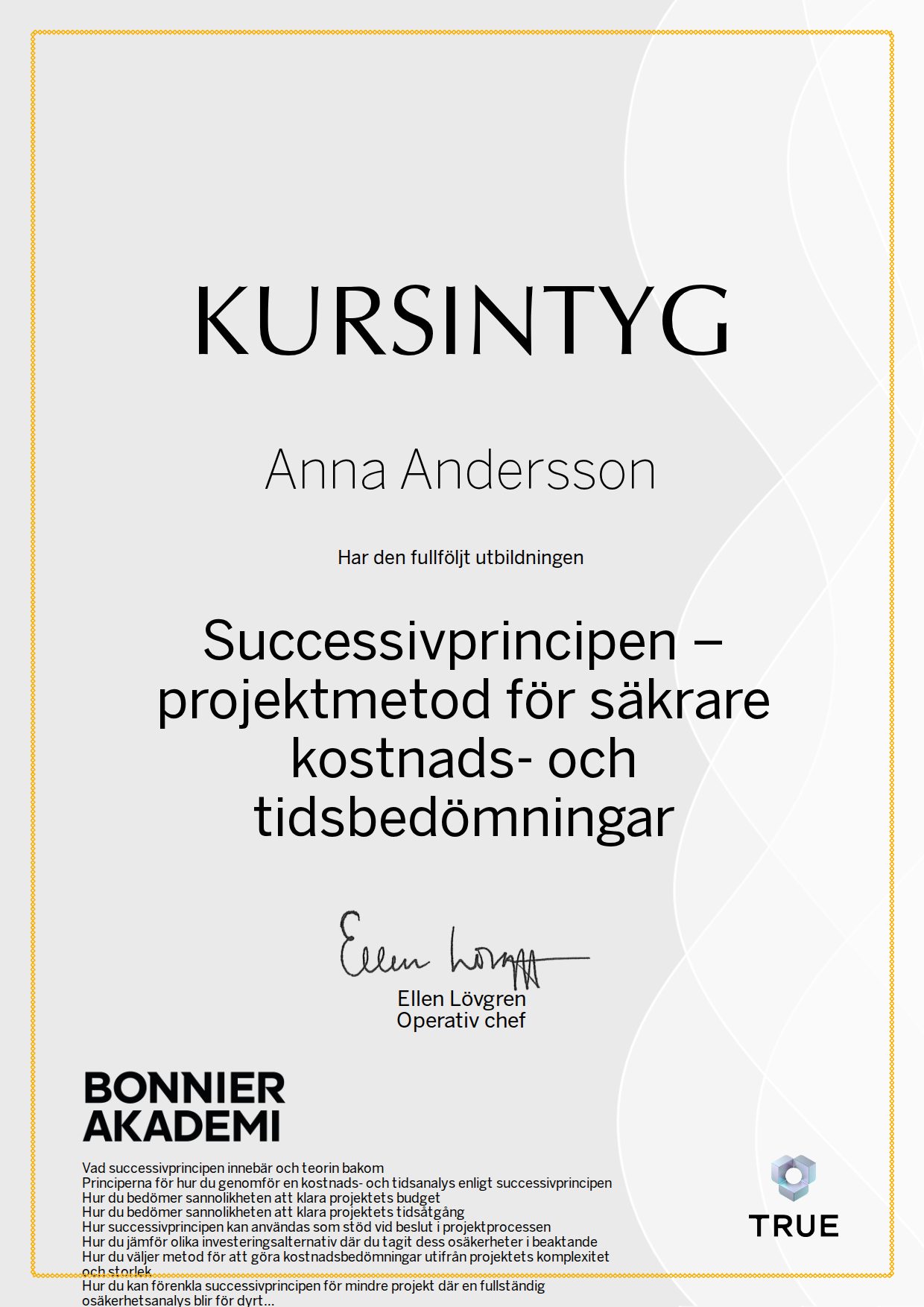
When you complete the course, Bonnier Akademi issues your certificate. Your name, the course content and the issue date are encrypted and secured on blockchain, so it cannot be changed, and anyone can check that it is genuine.
100% Verifiable certificates Secured on blockchain
 Bonnier Akademi under the brandsByggindustrin AkademiFastighetsnytt Akademi