Being able to calculate avoided emissions, outside the standards also called Scope 4, is becoming increasingly important for companies that want to show their climate benefit in a credible and transparent way. During this course you will learn how to assess, calculate and communicate avoided emissions according to established frameworks. This type of reporting is a good complement to climate accounts, especially for innovation companies and companies with product portfolios that contribute to the climate transition.
Format: On site
Language: Swedish
Request info
Want to know more before you sign up?
Send a short question and we will forward it directly to the provider.
We forward your question to Bonnier Akademi. No spam, no third parties.
About the course.
Being able to calculate avoided emissions, outside the standards also called Scope 4, is becoming increasingly important for companies that want to show their climate benefit in a credible and transparent way. During this course you will learn how to assess, calculate and communicate avoided emissions according to established frameworks. This type of reporting is a good complement to climate accounts, especially for innovation companies and companies with product portfolios that contribute to the climate transition.
Traditional climate calculations according to the GHG Protocol standards are about measuring and reporting the greenhouse gas emissions that arise in a company's value chain. These are important calculations, but they do not capture the climate benefit that arises when a company's products or services replace more emission-intensive alternatives.
This course is based on the methodology "Guidance on avoided emissions" from the World Business Council for Sustainable Development (WBCSD) and the main principles of the GHG Protocol, and is about how to calculate avoided greenhouse gas emissions.
COURSE OBJECTIVES:
That you as a participant gain knowledge and skills to:
- Calculate and report avoided emissions according to available frameworks and guidance
- Analyse avoided emissions when developing the business model and product portfolio
- Communicate avoided emissions in a correct and credible way
What you will learn
What you learn.
How to calculate avoided emissions according to "Guidance on avoided emissions" from the World Business Council for Sustainable Development and the GHG Protocol
Calculating the emissions from your own solution or product from a life cycle perspective
How to develop and calculate a reference scenario to compare with
Choosing and using emission factors
How to handle uncertainties, make reasonable assumptions and report them transparently
Which conclusions and claims can be made based on the results
How to communicate the results correctly in relation to laws and guidelines against greenwashing
Curriculum
How the course is built.
09.00 Welcome and introduction
09.10 Introduction to avoided emissions
- The role of innovations and products in the climate transition
- The need to be able to evaluate both emissions and climate benefit
- Alignment with other frameworks, for example the GHG Protocol, SBTi, CSRD
09.30 Methodology: how to calculate avoided emissions
Review of frameworks based on guidance from WBCSD and the GHG Protocol:
- Which criteria must be met for a project or solution to be classified as one that avoids emissions
- The emissions of the solution or product
- Choice of base year and reference scenario
- Choice of functional unit (for example kg CO₂ equivalents per product)
- Time horizon: the period over which emission savings are counted
- Rebound effects
- Assessment of market potential
- Assessment of product portfolios
10.30 Coffee
10:45 Practical exercise: company case in groups
11.15 Life cycle calculation of the solution or product
- LCA standards from the ISO family
- How the methodology and framework relate to LCA standards
- How to build a calculation model and choose emission factors
12.00 Lunch
13.00 Calculating and reporting avoided emissions
- Example of a calculation for a product or solution according to the methodology in the guidance
- Choice of method and scope: how is the result affected?
- How to present the result in a report
14:00 Practical exercise: calculations and reporting
15.15 Coffee break
15.30 Communicating avoided emissions
- Guidelines for communication, for example:
- The EU directive Empowering the Consumer in the green transition
- The Swedish Marketing Act (Marknadsföringslagen)
- The International Chamber of Commerce's marketing guidelines: the ICC Code
- Transparency: reporting avoided emissions separately from the climate accounts
- Opportunities in communicating avoided emissions
- Discussion
16.30 Summary
17.00 The course ends
Target audience
Who is this for?
Managers in manufacturing, the service sector, private companies and public administrations, for example:
- Environmental and sustainability managers
- Environmental analysts
- Consultants
- Investors who want to evaluate the climate benefit of their company portfolio
- Innovation companies and start-ups that want to quantify climate benefit
- People in marketing and product development
No prior knowledge is required for the course.
What "verified" means here
Verified credential.
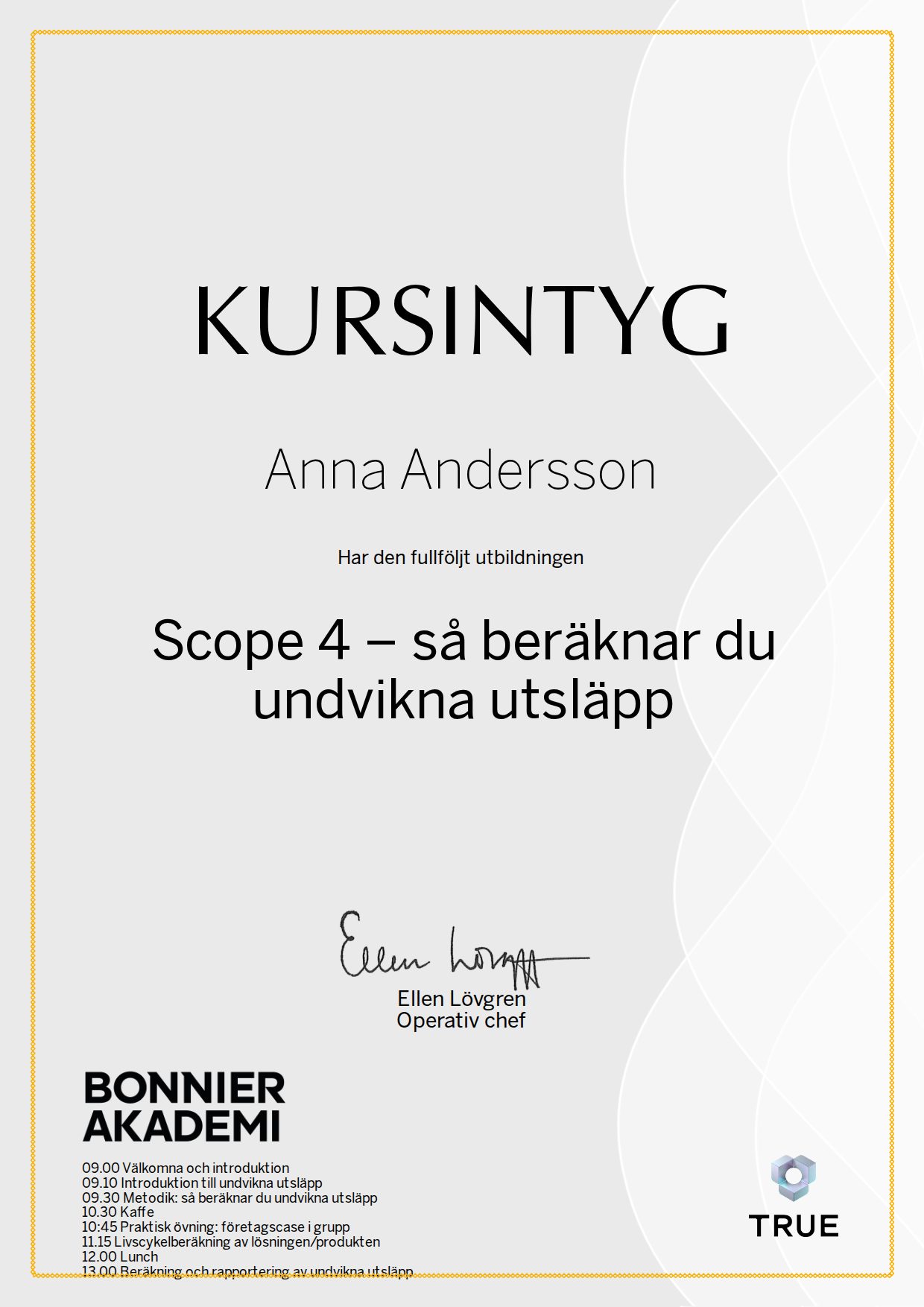
When you complete the course, Bonnier Akademi issues your certificate. Your name, the course content and the issue date are encrypted and secured on blockchain, so it cannot be changed, and anyone can check that it is genuine.
100% Verifiable certificates Secured on blockchain