The course gives you in-depth knowledge of industrial control and monitoring systems, with a focus on how SCADA/DCS and HMI are used to monitor, control and visualise processes. You learn to program PLC systems with different communication solutions and to connect process monitoring equipment to control engineering systems. The course is part of TUC's higher vocational education program for automation engineers and prepares you to solve problems in advanced, integrated control systems. After the course you can integrate administrative IT systems with industrial information and control systems.
Duration: 5 weeks
Language: Swedish
Level: Advanced
CSN-eligible
Time commitment: Equivalent to about 5 weeks of full-time study
In this course the student learns about industrial control systems and monitoring systems used in automation. The course covers theory and practical exercises in how SCADA/DCS and HMI are used to monitor, control and visualise processes. The course also includes programming PLC systems with different communication options and connecting process monitoring equipment to control engineering systems. At the end of the course, the student should be able to integrate traditional administrative IT systems with industrial information and control systems in order, in their future professional role as an automation engineer, to solve problems in advanced control systems, make different monitoring systems work together and configure fieldbuses and industrial networks.
In this course the student learns about industrial control systems and monitoring systems used in automation. The course covers theory and practical exercises in how SCADA/DCS and HMI are used to monitor, control and visualise processes. The course also includes programming PLC systems with different communication options and connecting process monitoring equipment to control engineering systems. At the end of the course, the student should be able to integrate traditional administrative IT systems with industrial information and control systems in order, in their future professional role as an automation engineer, to solve problems in advanced control systems, make different monitoring systems work together and configure fieldbuses and industrial networks.
What you will learn
What you learn.
You can use SCADA/DCS and HMI to monitor, control and visualise industrial processes
You can program PLC systems with different communication options
You can connect process monitoring equipment to control engineering systems
You can integrate administrative IT systems with industrial information and control systems
You can configure fieldbuses and industrial networks
You can make different monitoring systems work together in an integrated plant
Curriculum
How the course is built.
Industrial control and monitoring systems
Theory of SCADA/DCS and HMI in industrial automation.
Process monitoring and visualisation
Practical exercises in monitoring, controlling and visualising processes.
PLC programming and communication
Programming PLC systems with different communication options.
Control engineering systems
Connecting process monitoring equipment to control engineering.
IT integration
Integrating administrative IT systems with industrial control systems.
Fieldbuses and industrial networks
Configuring fieldbuses and networks between integrated systems.
Target audience
Who is this for?
Students on TUC's YH program for automation engineers who want to go deeper into integrated control and monitoring systems.
What "verified" means here
Verified credential.
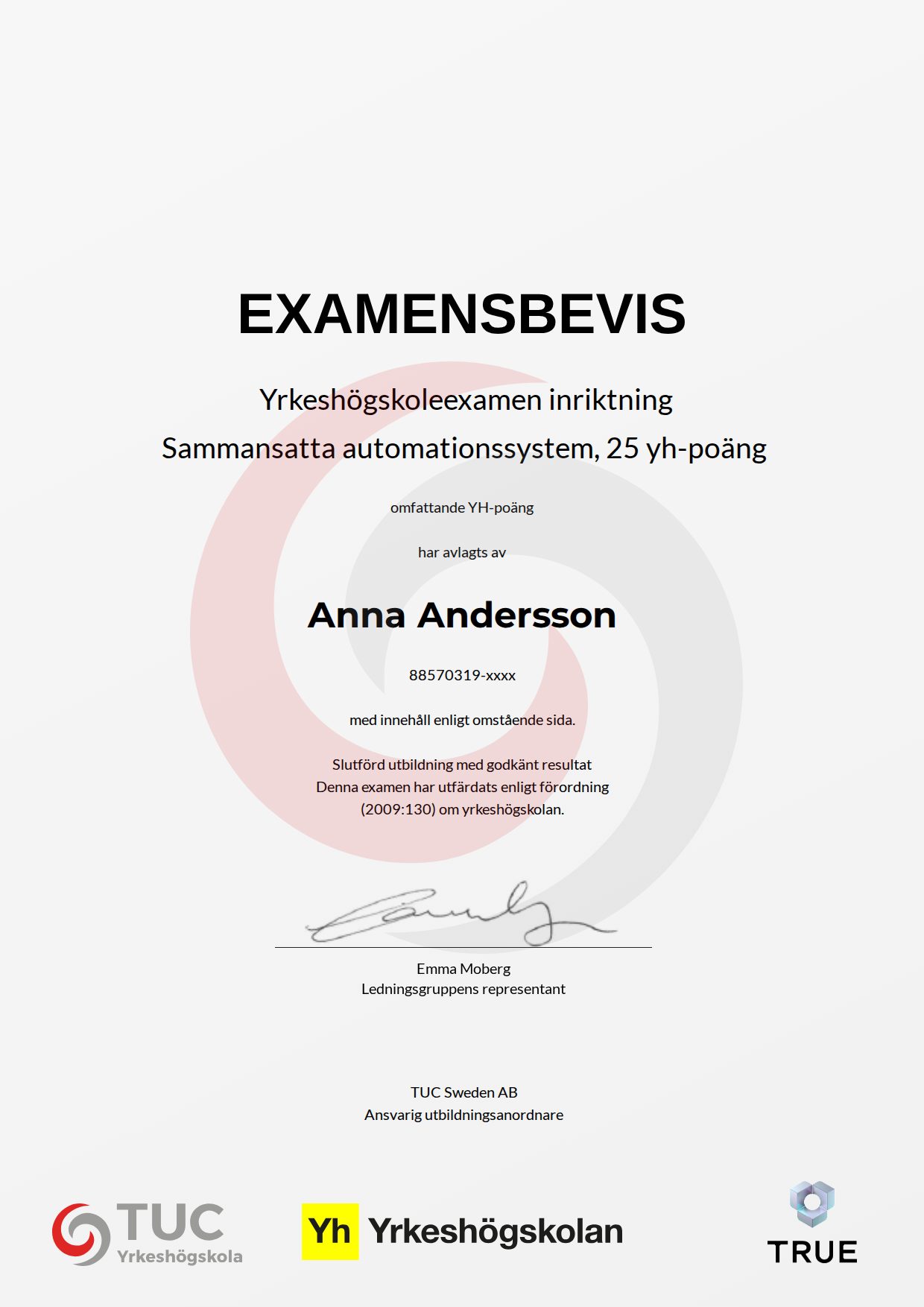
When you complete the course, TUC Yrkeshögskola issues your certificate. Your name, the course content and the issue date are encrypted and secured on blockchain, so it cannot be changed, and anyone can check that it is genuine.
100% Verifiable certificates Secured on blockchain