This course is about how you can get better at meeting and helping people with mental ill-health. You will learn about the most common mental illnesses and how you can communicate with those affected. We go through how to create a good relationship, set reasonable boundaries when needed, handle dissatisfaction, threats and aggression, and take care of yourself in the encounter. The goal is for you to take away the knowledge and skills you need to understand and be able to talk to everyone you meet.
Format: On site
Language: Swedish
Request info
Want to know more before you sign up?
Send a short question and we will forward it directly to the provider.
We forward your question to Bonnier Akademi. No spam, no third parties.
About the course.
This course is about how you can get better at meeting and helping people with mental ill-health. You will learn about the most common mental illnesses and how you can communicate with those affected. We go through how to create a good relationship, set reasonable boundaries when needed, handle dissatisfaction, threats and aggression, and take care of yourself in the encounter. The goal is for you to take away the knowledge and skills you need to understand and be able to talk to everyone you meet.
Everyone who meets people in their work comes into contact with people who are struggling mentally. For these encounters to go well and create a sense of security, you need knowledge of the most common forms of mental ill-health and how best to talk to people who are not doing well. This course gives you what you need to help the person affected and at the same time get something out of it for yourself. Feeling that you dare to meet everyone you encounter and are able to help the vast majority creates security and job satisfaction for yourself. Bring in whoever you like here to my room, I can handle it!
COURSE OBJECTIVES
That you as a participant:
- Gain knowledge of common mental illnesses, stress-related conditions and developmental disorders.
- Learn how to create good encounters with everyone affected.
- Get tools to communicate with and help people with mental ill-health.
- Learn how to balance the person's needs and your own in a way that works well for you both.
- Learn how you can help people with suicidal thoughts
What you will learn
What you learn.
About the most common mental illnesses (depression, anxiety, OCD, psychosis and more)
About the most common stress-related conditions (burnout, exhaustion disorder, crisis reaction, PTSD)
About developmental disorders (ADHD and autism)
About the most problematic personality disorders (narcissism, psychopathy, emotional instability)
How best to meet and create good relationships with people affected by mental ill-health
How to help a person in crisis
How to find out whether a person is at risk of suicide and, if so, how you can help them
How you can handle stress, dissatisfaction, threats and aggression
How to take care of yourself in the encounter and set limits on the other person's behaviour when needed
How you can take care of yourself to reduce the risk of being harmed or becoming ill from your work
Curriculum
How the course is built.
Introduction to psychiatry
The roots, extent and consequences of mental ill-health
Symptoms, diagnosis and treatment of mental ill-health
The most common conditions
How is care organised, and how do you get the right care?
Where to turn and sources of information
Encounters and the art of conversation
How do I talk to a person who is not doing well?
How I view the person who is not doing well and how that affects how I treat them
Identifying incorrect maps and unreasonable expectations
The necessary balance between integrity and adaptation
Stress-related ill-health from long-term overload
Burnout
Exhaustion disorder
Some tips for protecting yourself
Stress-related ill-health from acute loss and trauma
Grief and crisis reaction
Adjustment disorder
Acute and post-traumatic stress disorder
Meeting a person in crisis
Mood disorders
Depression
Bipolar disorder
What can I do to help the person affected?
Meeting a person with suicidal thoughts
Myths and facts about suicide
How do I assess how great the risk of suicide is?
How can I help the suicidal person?
The Compulsory Psychiatric Care Act
Can someone who is not doing well be forced to accept help against their will?
What does care under LPT mean?
Psychotic disorders
Delusional disorder
Schizophrenia
How I treat a psychotic person
Anxiety disorders and obsessive-compulsive disorder
Social anxiety
Specific phobia
Panic disorder
Generalised anxiety disorder
Obsessive-compulsive disorder
Developmental disorders
Intellectual disability
ADHD and DAMP
Autism
Personality disorders and self-harm
What do the terms mean?
How do I recognise a person with a personality disorder?
How do I recognise narcissistic, antisocial/psychopathic and emotionally unstable personality traits, and how can I then respond?
Self-harm
The difficult encounter
Dissatisfied, threatening and aggressive people
Querulous behaviour
Target audience
Who is this for?
Everyone who works with people and who therefore benefits from a better understanding of how we function, both in everyday life and when we are not feeling so well. If you want to learn to recognise the most common psychiatric conditions and increase your ability to talk to and help those affected, this is the course for you.
What "verified" means here
Verified credential.
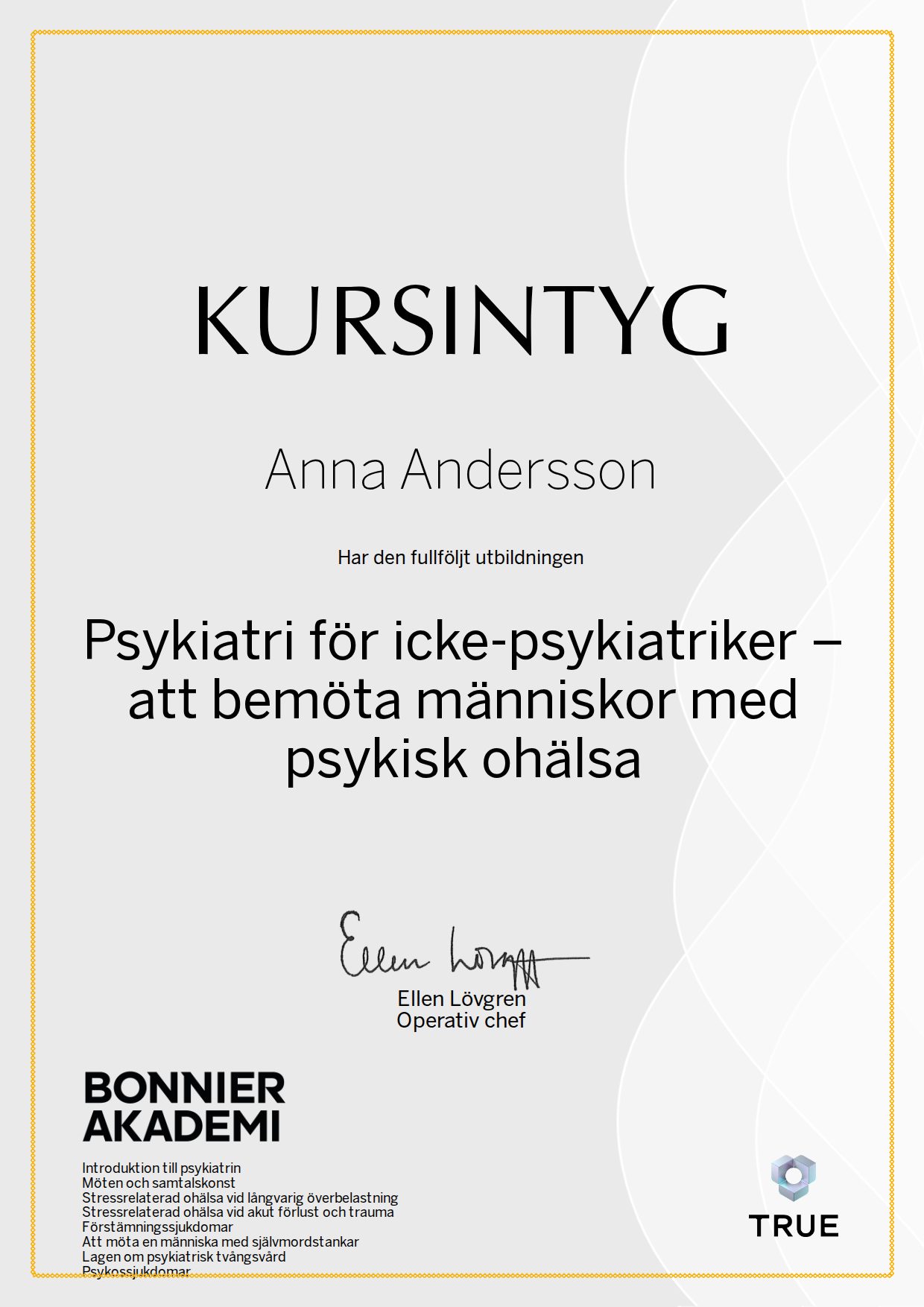
When you complete the course, Bonnier Akademi issues your certificate. Your name, the course content and the issue date are encrypted and secured on blockchain, so it cannot be changed, and anyone can check that it is genuine.
100% Verifiable certificates Secured on blockchain
 Bonnier Akademi under the brandsDagens Samhälle UtbildningDagens Medicin Utbildning