The course teaches you the Boolean logic behind automated systems, and the control and monitoring of automated process equipment. You gain knowledge of sequence programming, hardware configuration and how PLC systems are built according to the IEC 61131-3 standard. The course is part of TUC's YH program for maintenance technicians and gives you the tools to fix faults in automated process equipment. You also learn to install and program simpler HMI panels and to use counters, timers and conversion instructions.
Duration: 6 weeks
Language: Swedish
Level: Intermediate
CSN-eligible
Time commitment: Equivalent to about 6 weeks of full-time study
The course is about automated systems and the Boolean logic behind them. The course also includes control and monitoring of automated process equipment, sequence programming and hardware configuration. The course also covers how PLC systems are built and how they are used in industrial automation. The course should give the knowledge required for the future professional role in PLC programming, hardware configuration, and control and monitoring in order to fix faults in automated process equipment, and to apply programming for a PLC system according to IEC 61131-3. The course should also give enough knowledge to apply counters, timers and conversion instructions in real models and to install and program simpler HMI panels.
The course is about automated systems and the Boolean logic behind them. The course also includes control and monitoring of automated process equipment, sequence programming and hardware configuration. The course also covers how PLC systems are built and how they are used in industrial automation. The course should give the knowledge required for the future professional role in PLC programming, hardware configuration, and control and monitoring in order to fix faults in automated process equipment, and to apply programming for a PLC system according to IEC 61131-3. The course should also give enough knowledge to apply counters, timers and conversion instructions in real models and to install and program simpler HMI panels.
What you will learn
What you learn.
You understand the role of Boolean logic in automated systems
You can do sequence programming and hardware configuration of automated process equipment
You can program a PLC system according to IEC 61131-3
You can apply counters, timers and conversion instructions in real models
You can install and program simpler HMI panels
You can fix faults in automated process equipment through control and monitoring
Curriculum
How the course is built.
Boolean logic and automated systems
The basics of the logic that controls automated systems.
Control and monitoring
Monitoring and control of automated process equipment.
Sequence programming and hardware configuration
Practical work with sequence programs and hardware configuration.
PLC according to IEC 61131-3
Programming PLC systems according to an international standard.
Counters, timers and conversion instructions
Application in real models and processes.
HMI panels
Installation and programming of simpler HMI panels.
Target audience
Who is this for?
Students on TUC's YH program for maintenance technicians who want to learn PLC and HMI programming.
What "verified" means here
Verified credential.
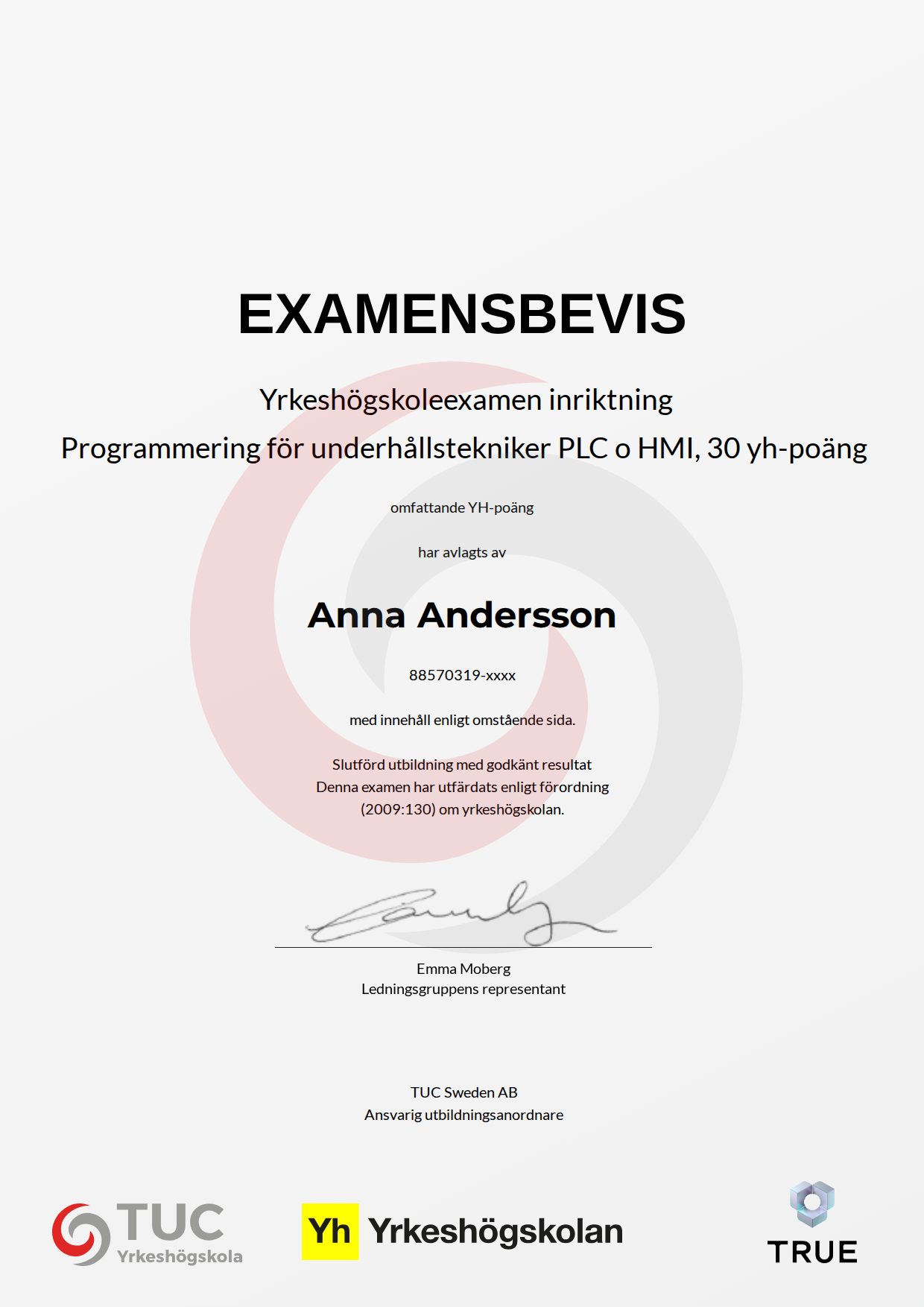
When you complete the course, TUC Yrkeshögskola issues your certificate. Your name, the course content and the issue date are encrypted and secured on blockchain, so it cannot be changed, and anyone can check that it is genuine.
100% Verifiable certificates Secured on blockchain