Partnering is an established method of collaboration between developer and contractor. Today alliance contracts are also emerging as a new form of collaboration. This course is about how to create the best legal conditions for collaborative contracts. You will learn what should be regulated in a partnering agreement, how the agreement is designed based on the division into phases, what alliance contracts are and how alliance contracts differ from partnering. The course mixes theory with practical, real-life examples.
Format: On site
Language: Swedish
Request info
Want to know more before you sign up?
Send a short question and we will forward it directly to the provider.
We forward your question to Bonnier Akademi. No spam, no third parties.
About the course.
Partnering is an established method of collaboration between developer and contractor. Today alliance contracts are also emerging as a new form of collaboration. This course is about how to create the best legal conditions for collaborative contracts. You will learn what should be regulated in a partnering agreement, how the agreement is designed based on the division into phases, what alliance contracts are and how alliance contracts differ from partnering. The course mixes theory with practical, real-life examples.
COURSE OBJECTIVES:
That you as a participant gain
- A basic to in-depth understanding of partnering and alliancing: what characterises each model, their differences and when each is appropriate
- Concrete tools and questions for considerations before the contract and before each phase in partnering, and before entering into and negotiating alliance contracts
- Knowledge of which issues and terms are essential to regulate in partnering and alliance contracts, including forms of remuneration, incentives, liability, transparency and handling of changes
What you will learn
What you learn.
When it is appropriate to use partnering or alliance contracts
How a partnering contract should be designed: formulating and regulating contract terms on scope, time, remuneration, contract documents, liability and transparency in procurement and purchasing work
What is important to consider in partnering in the design and estimating phase (Phase 1)
What is important to consider in partnering in the execution and production phase (Phase 2)
How to succeed with collaboration, meeting structure, transparency and joint decision-making in collaborative projects
What characterises alliance contracts and which conditions are required for them to work
How risks, liability and profits are shared in alliance contracts according to the agreements on the market
Insight into international standards for guidance before entering into alliance contracts
Curriculum
How the course is built.
09.00 Welcome and introduction
09.10 Forms of contract, forms of procurement and collaboration
We start the day by going through important concepts and the differences between them to put partnering and alliancing in context.
- Briefly on applicable legislation and the Swedish standard contracts in the construction contracting field
- Forms of contract, forms of procurement and collaboration as concepts and phenomena
- What partnering means and when partnering is appropriate
10.30 Phase 1: the design and estimating phase in partnering
During the first phase of a partnering project, design is usually carried out in consultation between the parties and the basis for the product or building is developed. In this session we go through:
- Initial choices, for example when the contractor should be engaged and which other actors should take part
- How to design a partnering contract
- Terms and issues concerning scope, time and remuneration in Phase 1
11.30 Phase 2: the execution and production phase in partnering
During this phase the contract work is carried out in accordance with the contract that has been drawn up and the documents produced during Phase 1. In this session we go through:
- What is required to move on to Phase 2
- Essential contract terms for Phase 2, including contract documents, liability, forms of meetings, times and transparency in procurement and purchasing work
13.00 Phase 2: the execution and production phase in partnering (continued)
- Continued review of questions concerning financial models (incentives), meeting structure, project management and the key people you need to bring with you into Phase 2 of the project
13:30 Alliance contracts: what, when and why
- Background and history of the emergence of alliance contracts
- Characteristics of alliance contracts compared with other construction and collaboration contracts
- When it is appropriate to use alliance contracts
- Overview of international terms for alliance contracts
- Central terms of alliance contracts and differences from partnering
- The alliance contracts available on the Swedish market today and the differences from partnering agreements
- Group discussion and joint reflection on the differences between partnering agreements and alliance contracts, the choice of contract, etc.
15.15 Alliance contracts: what, when and why (continued)
16.00 Payment terms and incentive models
- Review of different payment models for partnering agreements
- Incentive and bonus models as a positive driving force for achieving the goals set for the project
16.30 Summary and time for questions
Target audience
Who is this for?
You who are a client, developer, property developer, project manager, contractor or consultant in the building, civil engineering and property sector, and who take part in procurement, contract negotiation or the execution of projects with in-depth collaboration.
What "verified" means here
Verified credential.
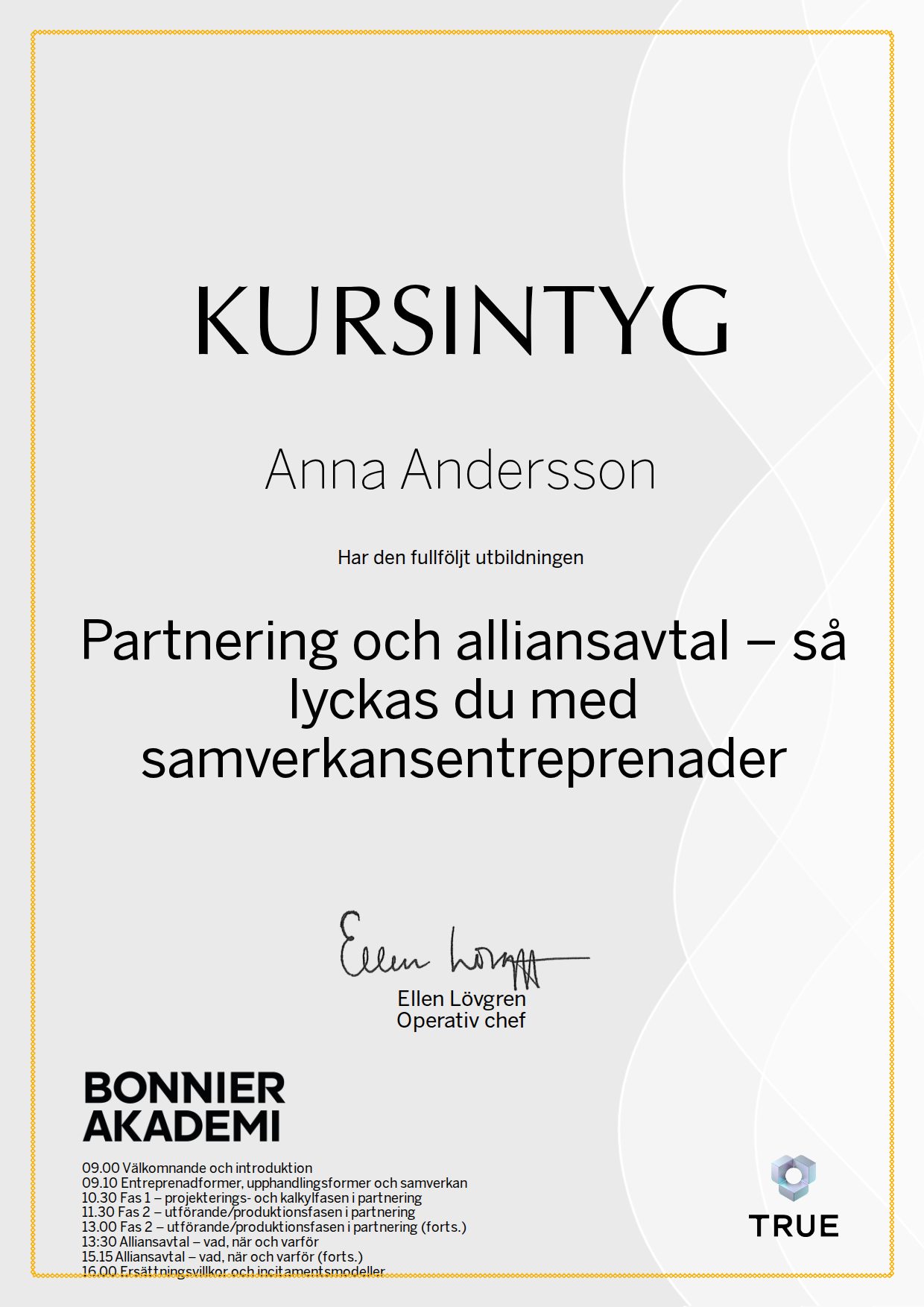
When you complete the course, Bonnier Akademi issues your certificate. Your name, the course content and the issue date are encrypted and secured on blockchain, so it cannot be changed, and anyone can check that it is genuine.
100% Verifiable certificates Secured on blockchain