Request info
Want to know more before you sign up?
Send a short question and we will forward it directly to the provider.
We forward your question to Xenter - Botkyrka. No spam, no third parties.
Send a short question and we will forward it directly to the provider.
We forward your question to Xenter - Botkyrka. No spam, no third parties.
After completing the programme, the student should have knowledge of/in 1. Health and medical care administration. Knowledge of the laws, statutes and agreements that regulate health and medical care in Sweden, and familiarity with EU rules and rules for patients coming from countries outside the EU. 2. Medical terminology and the use of medical and Swedish language in healthcare for high patient safety. 3. Use of medical English. Useful expressions for communicating with patients and relatives in the English language. Relevant medical terms and expressions, and the wording and layout of documents. Is familiar with relevant professional literature in the field. 4. Anatomy and pathology. The structure and function of the human body. Common somatic and mental illnesses and the connections between causes, symptoms, diagnosis and treatment for common diseases in different organ systems. Disease-causing microorganisms, different routes of infection and treatment measures. Basic pharmacological concepts and treatment options. The most common neuropsychiatric conditions and different treatment options. 5. Drug forms, prescription handling and current pharmaceutical legislation. 6. Functions in the TakeCare medical records system and layout rules for different documents according to the current standard, as well as systematic document design. Correct touch typing. Knowledge of information sources in the field of healthcare documentation. 7. Workplace ergonomics. 8. Work psychology: group relations and the importance of the individual for a good working climate. 9. The administrator's role in the organisation and its flows. 10. The possibility of streamlining and planning that can affect the work situation and results in a positive direction. 11. Knowledge of the labour market parties, the significance of collective agreements and employment contracts, and the more important labour laws. Rules on calculating withholding tax, pay deviations. Different computerised payroll systems. 12. Knowledge of modern technology for communication, networks and peripheral equipment. The Office suite, database functions, and data confidentiality and data security. 13. Knowledge of the regulations governing diagnosis coding and DRG grouping. Ethical issues that can arise in coding and the importance of impartiality and objectivity. 14. Knowledge of the purpose and goals of the national e-health work. Web editing software. The TakeCare medical records system from an e-health perspective. The tasks of a local IT coordinator in healthcare organisations, and information security. After completing the programme, the student should have the skills to 1.Electronic medical records management with associated medical terminology. Independently be able to take responsibility for medical records management in TakeCare. Write efficiently and accurately with correct touch typing. Operational and system responsibility in patient administration systems. 2. Classification of diseases and healthcare procedures. 3. Searches for, understands, applies and summarises, orally and in writing, information in professional literature, trade journals, brochures and handbooks. Be able to seek knowledge in the professional field in order to actively take part in oral negotiations, meetings and information sessions in the English language. In writing, from dictation or drafts, produce documents in the professional field, e.g. certificates, referrals and medical record notes. The language is adapted to the recipient and free of language errors. 4. Statistical processing, budgeting and financial planning. Show an understanding of relevant economic concepts, be able to produce statistics and use statistical models. Account for the financial conditions in public and private healthcare respectively and describe the interaction between different stakeholders. Be able to explain the differences between different company forms. Budget, calculate profitability and do bookkeeping. Describe how improvement and follow-up can increase capacity and efficiency in a healthcare organisation. 5. Account for the purpose and goals of the national e-health work. Use web editing software to create web pages with appropriate content Handle information in a secure way. 6. Express themselves correctly in speech and writing. Structure, summarise and present information material orally and in writing in a linguistically appropriate way suited to the circumstances. Analyse an argument, design messages and choose a suitable medium, depending on purpose and recipient. Apply terminology and basic rules for meetings and be able to prepare for, take part in and document such meetings. Evaluate and use different information sources. Plan and carry out digital meetings. 7. Account for the structure of the labour market and for labour laws and rules. Apply simpler calculation bases in payroll calculation and register pay deviations in a computerised payroll system. 8. Account for the purpose and goals of the national e-health work. Use web editing software to create web pages with appropriate content. 9. Development and change work in healthcare administration (for example Lean Production).
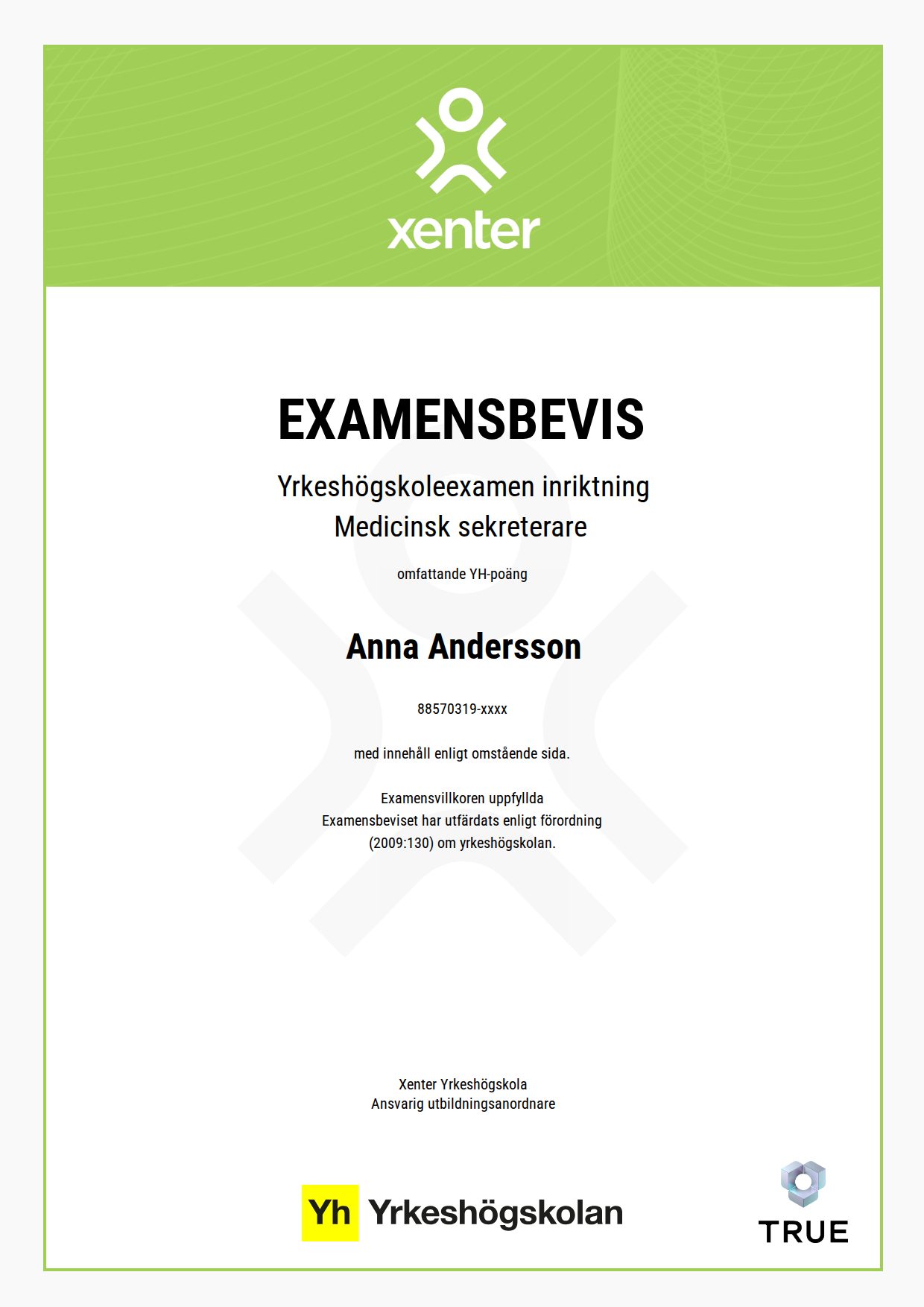
When you complete the course, Xenter - Botkyrka issues your certificate. Your name, the course content and the issue date are encrypted and secured on blockchain, so it cannot be changed, and anyone can check that it is genuine.
Sample Credential with placeholder data. Each credential is issued with the recipient’s details and is verifiable with the provider.