Companies, municipalities and regions that own properties and report under the Swedish Accounting Standards Board's (Bokföringsnämnden) K3 rules, the Council for Municipal Accounting (Rådet för kommunal redovisning), the Swedish National Financial Management Authority's (Ekonomistyrningsverket) rules or international accounting standards must apply component depreciation to property, plant and equipment. From 2026, housing cooperatives and companies with at least 75 % property-related turnover are also covered by the requirement. During this course you will learn how properties can be divided into components, which regulations apply and how to simplify your component depreciation.
Format: On site
Language: Swedish
Request info
Want to know more before you sign up?
Send a short question and we will forward it directly to the provider.
We forward your question to Bonnier Akademi. No spam, no third parties.
About the course.
Companies, municipalities and regions that own properties and report under the Swedish Accounting Standards Board's (Bokföringsnämnden) K3 rules, the Council for Municipal Accounting (Rådet för kommunal redovisning), the Swedish National Financial Management Authority's (Ekonomistyrningsverket) rules or international accounting standards must apply component depreciation to property, plant and equipment. From 2026, housing cooperatives and companies with at least 75 % property-related turnover are also covered by the requirement. During this course you will learn how properties can be divided into components, which regulations apply and how to simplify your component depreciation.
What you will learn
What you learn.
The aim of the course is for participants to gain an understanding of how properties can be divided into components when applying the component depreciation rules. The course takes the K3 framework as its starting point. In addition, the course aims to create an understanding of where the line is drawn between maintenance cost and investment. Participants will also gain an understanding of how a transition can be made from accounts prepared under rules that do not require component depreciation to rules that do.
Curriculum
How the course is built.
How properties can be divided into components
How the line between maintenance cost and investment is drawn
Which rules govern the distinction between maintenance cost and investment
How applying the component method can affect depreciation periods and depreciation costs for different types of buildings and property-related assets
What distinguishes the component method from the previously applied performance-enhancement approach when classifying an expense as a maintenance cost or an investment
Transition to component depreciation in the accounts
What the accounting rules require of the fixed asset register
Revaluations and impairments when applying the component method
Impact on reported net operating income when applying the component method
Target audience
Who is this for?
Finance professionals, technicians, accounting consultants and auditors who work in the property sector or with clients in this sector. Also those working in municipalities, regions and central government with operations that involve property.
What "verified" means here
Verified credential.
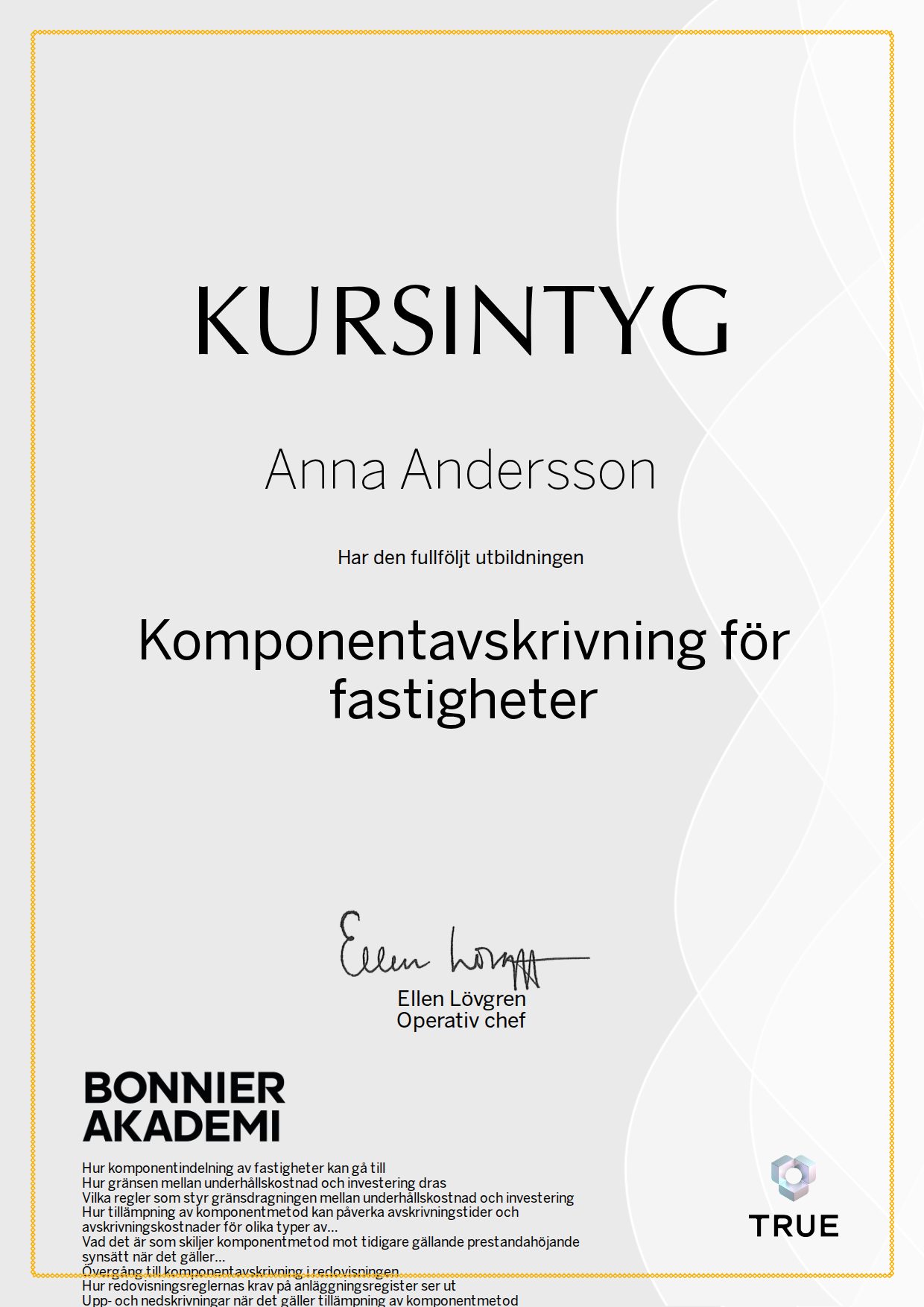
When you complete the course, Bonnier Akademi issues your certificate. Your name, the course content and the issue date are encrypted and secured on blockchain, so it cannot be changed, and anyone can check that it is genuine.
100% Verifiable certificates Secured on blockchain