Climate scenario analysis is a powerful tool for assessing how different climate changes can affect a business. In this course you will learn how to carry out a climate scenario analysis step by step to identify which risks a company faces and what financial consequences they may have. Besides meeting the requirements in ESRS, climate scenario analysis helps identify new opportunities for the business model and strategy.
Format: On site
Language: Swedish
Request info
Want to know more before you sign up?
Send a short question and we will forward it directly to the provider.
We forward your question to Bonnier Akademi. No spam, no third parties.
About the course.
Climate scenario analysis is a powerful tool for assessing how different climate changes can affect a business. In this course you will learn how to carry out a climate scenario analysis step by step to identify which risks a company faces and what financial consequences they may have. Besides meeting the requirements in ESRS, climate scenario analysis helps identify new opportunities for the business model and strategy.
As a participant you will get a concrete step-by-step guide for how a climate scenario analysis can be carried out. The guide follows the requirements in ESRS but can also be used by companies that are not covered by CSRD.
COURSE OBJECTIVES
That you as a participant gain:
- A clear understanding of what a climate scenario analysis is, how it is carried out and which requirements apply under ESRS (based on the TCFD recommendations)
- The ability to identify, analyse and quantify both physical and transition-related climate risks and their impact on the business
- Tools to integrate the results into the organisation's strategy and strengthen the resilience and long-term sustainability of the business model
What you will learn
What you learn.
How to carry out a climate scenario analysis step by step
Which requirements apply under ESRS and how the scenario analysis supports compliance with them
How to choose the right IPCC climate scenarios to use in your climate scenario analysis
How to identify and analyse physical climate threats, such as floods and drought, and transition-related risks, such as new regulations and technological development
How AI can be used to make the work of identifying relevant risks and opportunities more efficient
How to quantify risks and opportunities and assess their financial impact on the business
How to evaluate a business's resilience to the identified risks
How the results of the climate scenario analysis can be integrated into strategy work, risk management and decision-making
Curriculum
How the course is built.
09.00 Welcome and introduction to the course
The day's agenda and expectations of the course
09.30 Background to climate scenario analysis
- What is a climate scenario?
- Good examples of climate scenario analyses
- Which requirements apply under ESRS, based on the TCFD recommendations
- How a climate scenario analysis supports compliance with ESRS and which disclosure requirements it helps fulfil
- Definitions of key concepts under ESRS: physical risks, transition risks and opportunities, exposure, vulnerability and resilience
10.00 Climate scenario analysis as a strategic tool
- How the scenario analysis creates business value through risk reduction and investment opportunities
- How climate scenarios can be integrated into ordinary strategy work
- Introduction of a business case template that supports you in justifying the need for a climate scenario analysis for your organisation
10.30 Step 1: Preparing for a climate scenario analysis
- Introduction of a step-by-step guide to carrying out a climate scenario analysis
- Collecting existing information and company data and assessing the current situation
- Identifying stakeholders (internal and external)
11.00 Step 2: Identifying exposure
Exposure takes into account all conceivable risks based on geography and industry. This session covers:
- How to choose relevant IPCC climate scenarios to analyse, which types of climate risks the scenarios should highlight and how to choose relevant time horizons (short, medium and long)
- How you can use AI to help identify relevant risks and opportunities
- How to identify exposure to physical climate risks (for example floods, drought and heatwaves)
- How to identify exposure to transition-related risks and opportunities (for example new regulations, technological development or changed customer behaviour)
13.00 Step 2: Identifying exposure (continued)
13.30 Step 3: Identifying vulnerability
Vulnerability takes into account the actual financial impact on the business. This session covers:
- How you can use AI to find material for estimating the development curve of risks and opportunities for different scenarios and industries
- Methods for quantifying the identified risks and understanding the financial effects and the business's vulnerability to these risks
- Methods for quantifying transition risks and opportunities
15.00 Step 4: Analysing the resilience of the business model and business strategy
- How to evaluate the business's resilience to the identified risks
- How the risk reduction strategy can be strengthened
- Identifying and analysing measures to manage the identified risks and opportunities
- How the results of the climate scenario analysis can be integrated into the overall business strategy
- Resilience in strategy and business model: best practice
16.15 Summary and time for questions
Target audience
Who is this for?
You who work with sustainability, risk, strategy or finance in the private or public sector. You may, for example, work as:
- Environmental, sustainability or CSR manager
- Finance manager/CFO, IR manager
- Risk manager
- Management team and board
What "verified" means here
Verified credential.
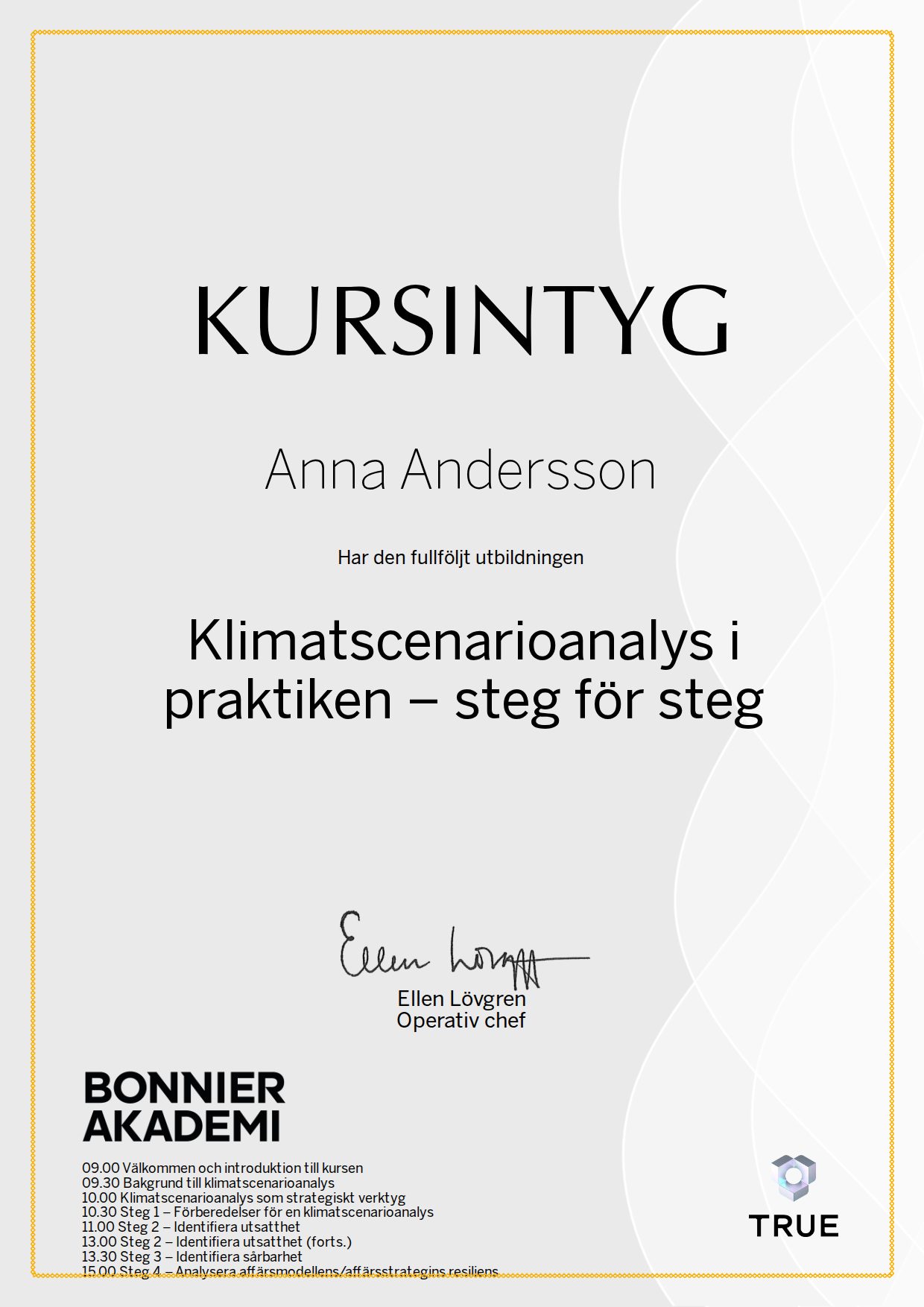
When you complete the course, Bonnier Akademi issues your certificate. Your name, the course content and the issue date are encrypted and secured on blockchain, so it cannot be changed, and anyone can check that it is genuine.
100% Verifiable certificates Secured on blockchain