Request info
Want to know more before you sign up?
Send a short question and we will forward it directly to the provider.
We forward your question to Nackademin. No spam, no third parties.
Send a short question and we will forward it directly to the provider.
We forward your question to Nackademin. No spam, no third parties.
Occupational roles Occupational role 1: Business Intelligence analyst Occupational role 2: Data analyst Occupational role 3: IT consultant, Business Intelligence Occupational role 4: Junior data scientist The graduate has knowledge of… - How ETL (Extract, Transform, Load) is used in organizations to make decisions concerning the organization - How Business Intelligence can develop an organization through various business and operational processes - How different forms of statistics and data analysis can be used to analyze events, the future and risks for companies - Tools for decision data management and how they are used to make strategic business decisions - Machine learning and how machine learning methods are used in an organization - Laws and ethical aspects of data management and how both of these areas can affect a long-term business strategy - How BI solutions interact with IoT (Internet of Things) - SQL and its relationship to different tools, and how SQL is used to create various forms of dialect-based database management tools - Big Data and how large stores of data are handled, structured and stored, as well as different ways to visualize data - Business Intelligence-related programming languages The graduate has the skills to… - Based on the needs of an organization or a project, formulate solutions and create, format and use SQL for this purpose 2.2 Develop and manage cloud solutions - Model databases - Collect, migrate and refine data based on organization-specific needs - Identify an organization's needs and, based on these, create solutions in Apache Hadoop. - Select, combine, visualize and communicate data - Work with, create and communicate solutions using statistics, programming and the R programming language - Identify and develop KPIs for an organization - Develop organization-specific applications using object-oriented programming - Interpret and write requirement specifications for BI projects The graduate has the competence to… - Analyze data in order to make strategic business decisions - Integrate and combine data based on a specific target group and for a specific organization or business - Based on requirement specifications, plan, formulate and decide on analyses in BI-related projects 3.4 Develop strategies for handling, storing and refining Big Data in order to adapt the content to a specific organization - Guide colleagues in, among other things, decision support, ethical considerations in data management and cross-departmental BI projects. - Design technical solutions and/or systems with intelligent behavior. (E.g. Watson) - Adapt the form of data analysis to specific requirements or situations in an organization - Adapt the visualization of data that is specific to an organization, group or area to its target audience.
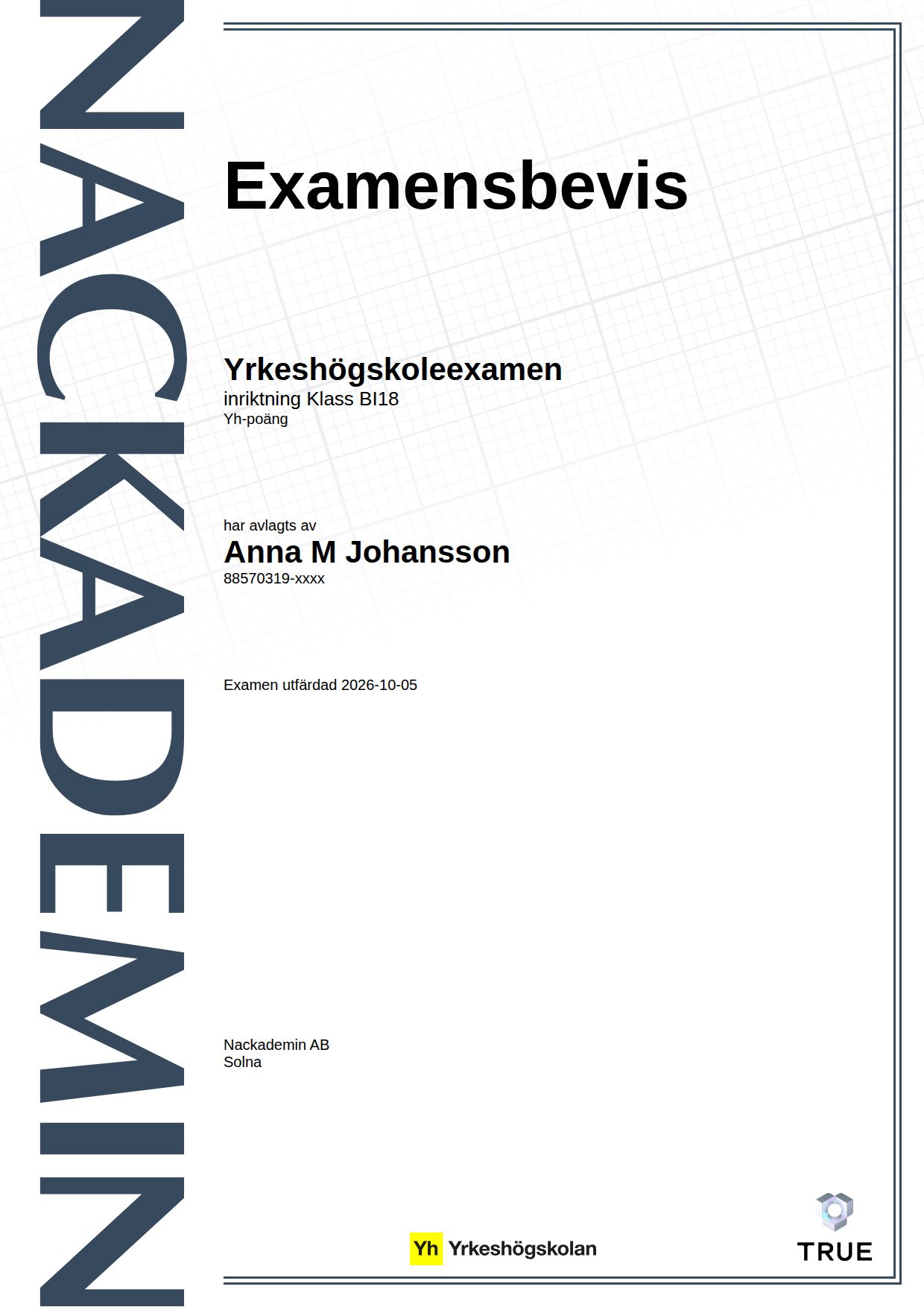
When you complete the course, Nackademin issues your certificate. Your name, the course content and the issue date are encrypted and secured on blockchain, so it cannot be changed, and anyone can check that it is genuine.
Sample Credential with placeholder data. Each credential is issued with the recipient’s details and is verifiable with the provider.