This course is aimed at asset management advisers, private bankers and others interested in asset management. You will learn how portfolio theory works, both in theory and in practice, how you can evaluate different investment alternatives and how to put together optimal portfolios of funds and individual securities. We go through how you can measure the risks in a fund, evaluate a fund's return and how the prices of shares and bonds are calculated. You will also learn different investment strategies and how it is possible to reduce the risks in a portfolio without lowering the expected return.
Format: On site
Language: Swedish
Request info
Want to know more before you sign up?
Send a short question and we will forward it directly to the provider.
We forward your question to Bonnier Akademi. No spam, no third parties.
About the course.
This course is aimed at asset management advisers, private bankers and others interested in asset management. You will learn how portfolio theory works, both in theory and in practice, how you can evaluate different investment alternatives and how to put together optimal portfolios of funds and individual securities. We go through how you can measure the risks in a fund, evaluate a fund's return and how the prices of shares and bonds are calculated. You will also learn different investment strategies and how it is possible to reduce the risks in a portfolio without lowering the expected return.
Besides theoretical knowledge of how portfolio theory works and a better understanding of different concepts, an important part of the course is working with real-life cases and exercises in which you apply these theories. Among other things, in an Excel model that simulates how the different characteristics of the assets co-vary with each other. This gives you an understanding of how the risk and the expected return in a portfolio can be affected by choosing and weighting the portfolio's assets.
COURSE OBJECTIVES:
This course aims to give you as a participant knowledge of different investment strategies, how to measure risks, calculate returns and thereby create optimised portfolios for your clients or yourself.
What you will learn
What you learn.
Different investment strategies, what distinguishes them and how they can be used in different contexts
How the price of a security is calculated
Risk measures for funds and individual securities
How you can evaluate a fund using both hard and soft key figures
Modern portfolio theory
Basic market psychology
Important concepts in asset management
Optimising a portfolio yourself in an Excel model
Curriculum
How the course is built.
Introduction to portfolio theory
In this session we go through the most important concepts when putting together a securities portfolio and why diversification of risk is so important:
Standard deviation
The normal distribution
Covariance and the correlation coefficient
Crash Correlations
Diversification
The 5-10-40 rule
Modern portfolio theory
In this session we go through the basics of portfolio theory, that is, how to put together securities portfolios optimally based on risk and return:
The efficient frontier and how to maximise return relative to risk
Optimal portfolios
The price of a security
In this session we go through different valuation methods and what determines the price of a share and a bond:
Different valuation methods for shares, for example P/E, the Dividend Discount Model and Gordon's formula
The value of a bond
How to calculate what required return you should have based on the risk you take (the CAPM formula)
Risk measures
In this session we go through different ways of measuring the risks of a security. The measures and key figures we go through are:
Standard deviation and volatility
Value at Risk (VaR)
Maximum Drawdown
Beta
Duration
Credit risk: High Yield and Investment grade
We go through how you can help a discretionary client in Wealth Management/Private Banking define their mandate in terms of risk level
Concepts in asset management
Here we go through some terms that are common in asset management so that you can more easily understand what a fund manager is talking about:
Strategic vs tactical position
Bottom up vs Top down
Fundamental vs Technical analysis
Alpha vs Beta exposure
Momentum vs Mean reverting
Share lending / short selling / Covered Call
Investment strategies
In this session we go through different investment strategies:
Static, reactive and anticipatory are different ways of making decisions
Index management compared with ordinary active management
Smart Beta, that is, rule-based strategies
Different hedge fund strategies
Investment strategies with special themes, for example demographics and sustainability
Active fixed income management, how does it work?
Different measures for evaluating funds
In this session we go through different ways of evaluating funds. Have they dared to believe in their ideas and pursued active management? Have they succeeded? The key figures we go through are:
Tracking Error
Active Share
Jensen's alpha
Sharpe ratio
Information ratio
Treynor ratio
Are markets efficient?
This session is about the eternal question: is it really possible to beat the index or the market over time? We go through the following:
EMH: the Efficient Market Hypothesis
Could it be chance that a fund manager beats the index 15 years in a row?
Market psychology (Behavioural finance) has gained increasing influence in recent years and has also been rewarded with a Nobel Prize. It is about the fact that we are not always so rational when we make investment decisions.
Overconfidence, anchoring, home-bias etc
Macroeconomics as a forecast
Interpreting business cycle signals and monetary policy
Indicators of the strength of the economy
How should we interpret the central banks?
What goals do the central banks have and what tools do they have to get there?
What can the slope of the yield curve tell us?
Which assets usually perform best in different phases of the business cycle?
Investment clock
Trends we see in asset management
AI, fintech and robo-advisers
Alpha/Beta separation
Smart Beta
Climate-smart funds
Interactive portfolio optimisation in Excel
We use an Excel model to practise an intuitive understanding of portfolio theory
Creating added value
How do you choose the right risk level?
Managing the client's and your own expectations
Target audience
Who is this for?
Wealth advisers, investment advisers in private banking, wealth management and others who work with or are interested in asset management.
What "verified" means here
Verified credential.
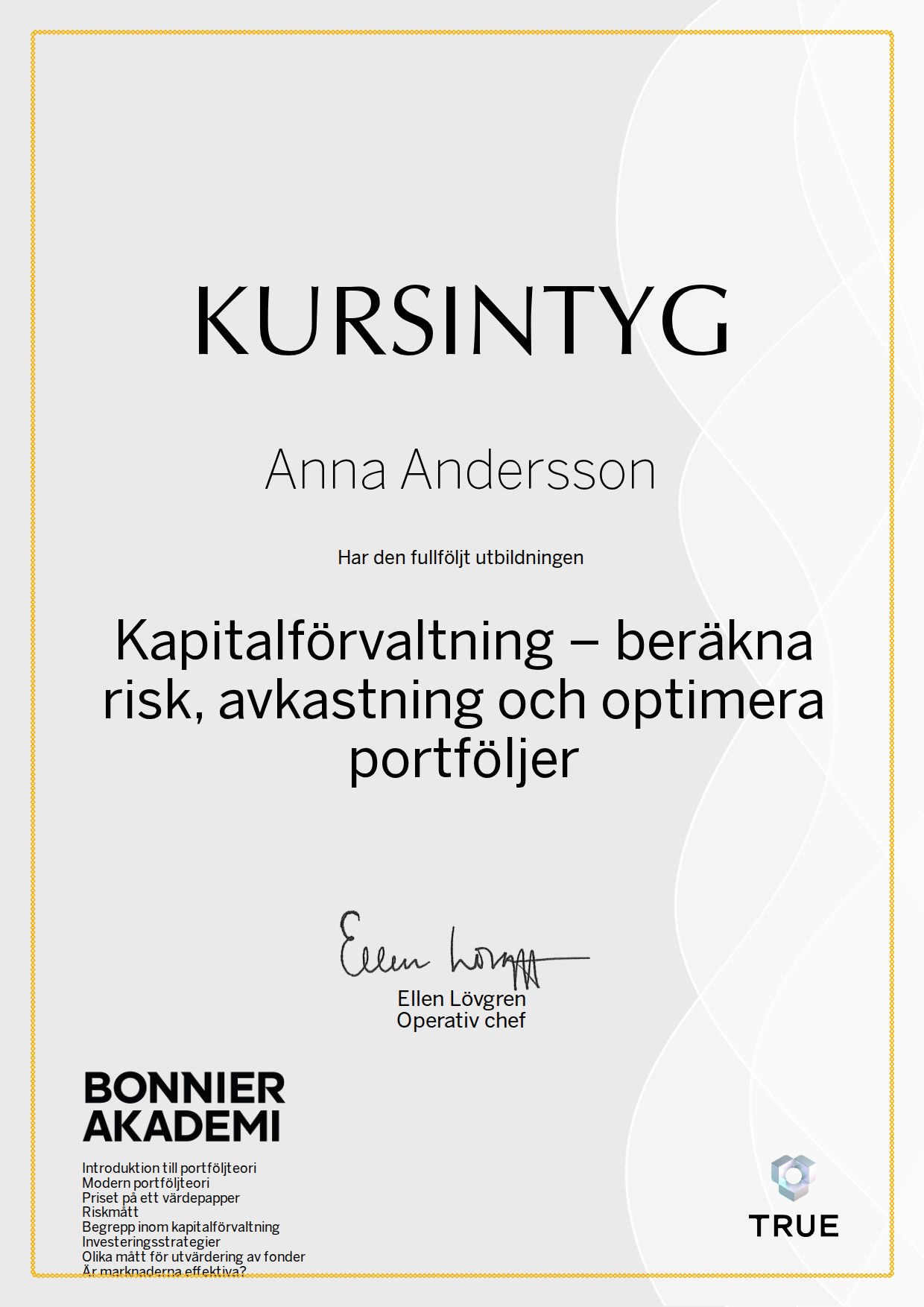
When you complete the course, Bonnier Akademi issues your certificate. Your name, the course content and the issue date are encrypted and secured on blockchain, so it cannot be changed, and anyone can check that it is genuine.
100% Verifiable certificates Secured on blockchain
 Bonnier Akademi under the brandsDi AkademiFinansmarknadenPensioner & förmåner