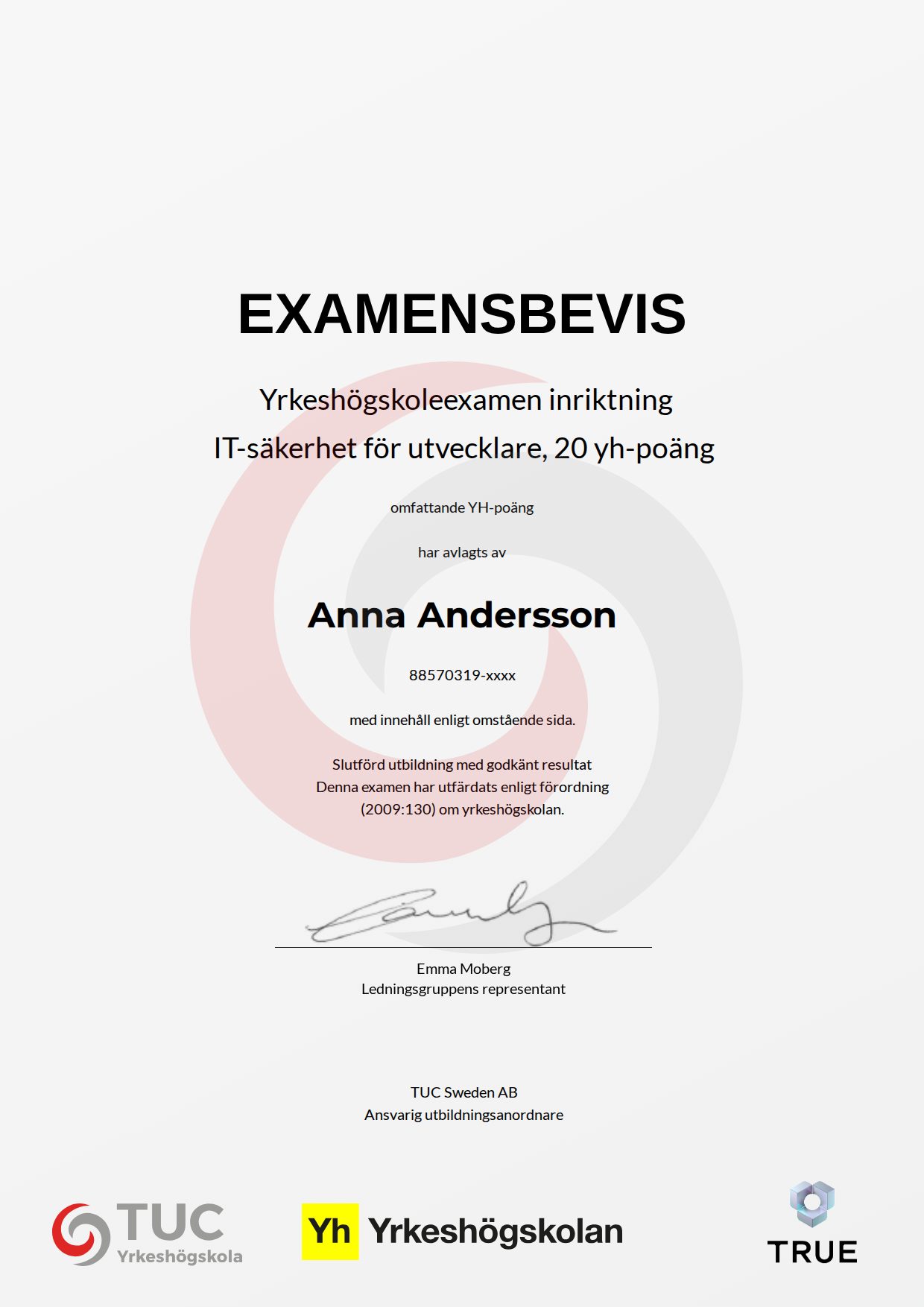
Part of the YH programme System Developer .NET at TUC Yrkeshögskola. This course cannot be applied for on its own. Programme code: SYNE24LIN.
IT Security for Developers gives you basic knowledge of security in the development and operation of systems. You learn about risk management, vulnerabilities, authentication and continuity, and how to build IT security functions into what you develop. The course covers common attack techniques such as XSS, SQL injections, social engineering and brute force, and how to prevent and handle a hacked site. The course is part of TUC's YH programme in systems development.
Duration: 3 weeks
Language: Swedish
Level: Advanced
CSN-eligible
Time commitment: 15 YH credits, approx. 3 weeks of full-time study
The purpose of the course is to give the students basic knowledge of security in development and operations. The students gain knowledge of risk management, vulnerabilities, authentication, continuity and IT security functions. The course also gives the students knowledge of basic techniques for unauthorised access to the system and how to handle XSS, SQL injections, social engineering and brute force. The goal of the course is to give the students knowledge of how to write secure code and counter intrusions and vulnerabilities.
The purpose of the course is to give the students basic knowledge of security in development and operations. The students gain knowledge of risk management, vulnerabilities, authentication, continuity and IT security functions. The course also gives the students knowledge of basic techniques for unauthorised access to the system and how to handle XSS, SQL injections, social engineering and brute force. The goal of the course is to give the students knowledge of how to write secure code and counter intrusions and vulnerabilities.
What you will learn
What you learn.
Can identify common vulnerabilities and risks in web applications
Has knowledge of authentication and how secure login flows are built
Can explain attack techniques such as XSS, SQL injection, social engineering and brute force
Can prevent and handle a hacked website
Has basic knowledge of risk management and continuity planning for IT systems
Curriculum
How the course is built.
Risk management and vulnerabilities
Basic concepts in IT security, risk assessment and common vulnerabilities.
Authentication and continuity
Methods for secure authentication and how to ensure operational continuity.
Attack techniques
An overview of XSS, SQL injections, social engineering and brute force.
Handling intrusions
How to prevent unauthorised access and what to do when a site has been hacked.
Target audience
Who is this for?
The course is aimed at students in systems development who want to learn to build more secure applications and understand basic threats to web and system security.
What "verified" means here
Verified credential.
When you complete the course, TUC Yrkeshögskola issues your certificate. Your name, the course content and the issue date are encrypted and secured on blockchain, so it cannot be changed, and anyone can check that it is genuine.
100% Verifiable certificates Secured on blockchain