Request info
Want to know more before you sign up?
Send a short question and we will forward it directly to the provider.
We forward your question to STI - Stockholms Tekniska Institut. No spam, no third parties.
Send a short question and we will forward it directly to the provider.
We forward your question to STI - Stockholms Tekniska Institut. No spam, no third parties.
After completing the programme, the student should have knowledge of/in 1. The ecosystem, concepts, trends, opportunities, challenges and technologies in IoT and adjacent IT areas 2. The structure and architecture of IoT systems, data storage, memory management, microprocessors, sensors, peripheral units and components, and their function, limitations and how they interact 3. C/C++ programming 4. Programming in compiled and/or interpreted languages 5. Version control 6. Development environments, editors, compilers and linkers 7. Object-oriented programming 8. UML 9. Automation systems in industry and property in relation to IoT solutions After completing the programme, the student should have the skills to 1. Search for, use and critically review information in Swedish and English about IoT and what is needed to solve the task 2. Write, read, structure, analyse, document and comment source code 3. Plan, carry out and identify resources to carry out software development for an IoT context or embedded systems efficiently 4. Find, discuss, fix and prevent syntax errors, runtime errors and programming logic errors 5. Solve complex problems from an IT security perspective After completing the programme, the student should have the competences to 1. Independently process content in IoT development that leads to further learning and professional development 2. Take responsibility, assess, act independently and collaborate in IoT projects 3. Take responsibility and independently develop an efficient system solution and software for IoT systems to solve a problem based on a requirements specification 4. Monitor IoT development and complete assigned IoT projects 5. Evaluate solutions to development problems in IoT systems against established quality requirements and standards, and propose improvements
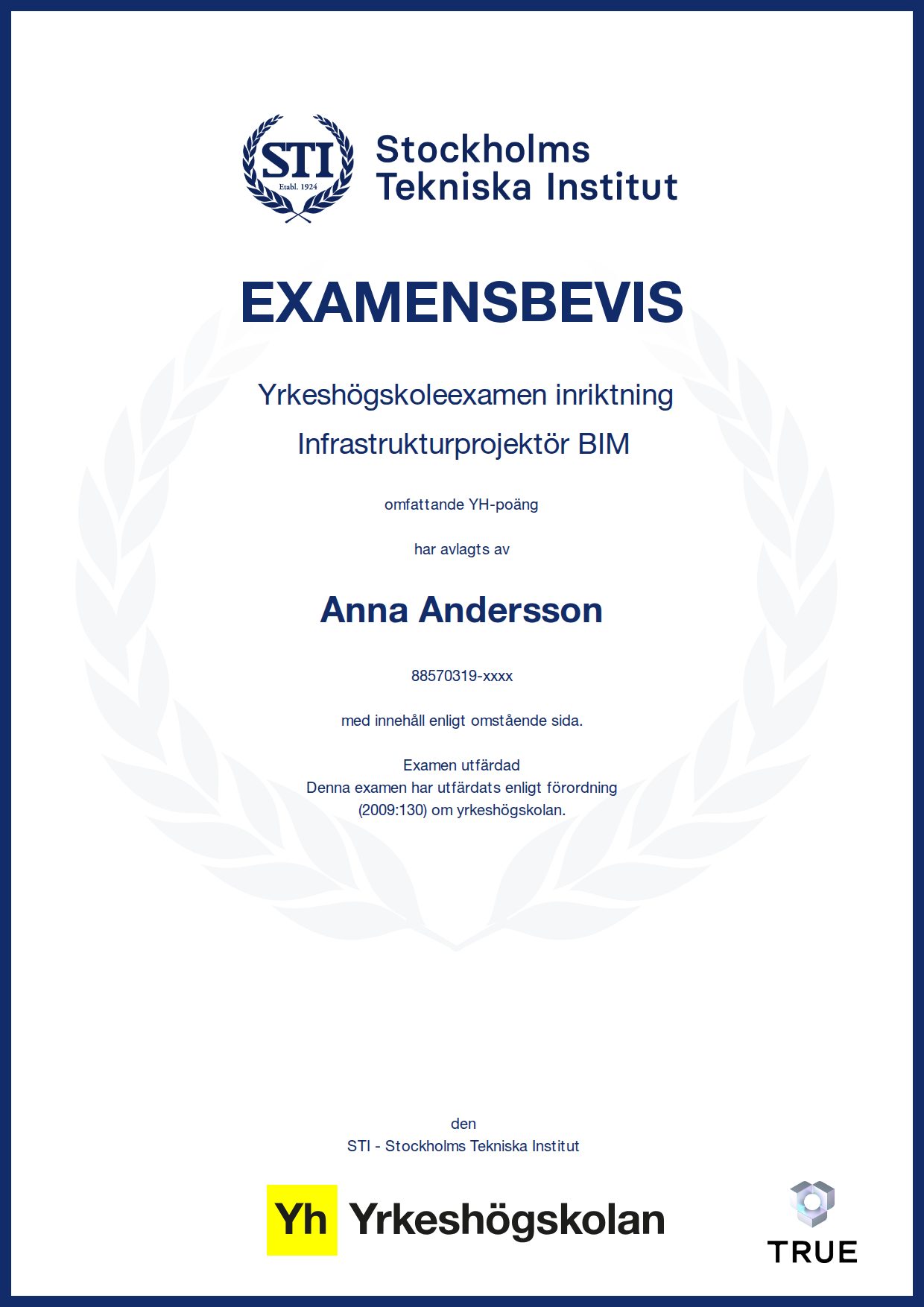
When you complete the course, STI - Stockholms Tekniska Institut issues your certificate. Your name, the course content and the issue date are encrypted and secured on blockchain, so it cannot be changed, and anyone can check that it is genuine.
Sample Credential with placeholder data. Each credential is issued with the recipient’s details and is verifiable with the provider.