This course aims to give you concrete methods and tools that make you a better negotiator in everything from procurements, construction contracts and rent negotiations to land acquisitions, project collaborations and business development. We go through how to optimise your chances of success in the different phases of a negotiation and how you can analyse the other party, formulate arguments and use body language.
Format: On site
Language: Swedish
Request info
Want to know more before you sign up?
Send a short question and we will forward it directly to the provider.
We forward your question to Bonnier Akademi. No spam, no third parties.
About the course.
This course aims to give you concrete methods and tools that make you a better negotiator in everything from procurements, construction contracts and rent negotiations to land acquisitions, project collaborations and business development. We go through how to optimise your chances of success in the different phases of a negotiation and how you can analyse the other party, formulate arguments and use body language.
Negotiation is fundamentally about how we humans work and make our decisions. That is why negotiation techniques are applicable in most communicative situations in construction and property, where many stakeholders, high values and critical moments often shape the dialogue. Psychology, influence, communication, rhetoric and conflict management are some of the central parts of negotiation technique. Whether it is a contract for a new build, a discussion with a subcontractor or an agreement on a property acquisition, you can use these skills effectively.
COURSE OBJECTIVES:
As a participant you will gain knowledge, insights and tools that make you more confident, clearer and more effective in your negotiations in construction and property. After the course you should be able to make better deals and build good relationships.
What you will learn
What you learn.
Decision psychology and what governs and influences your own and others' decisions
The four phases of negotiation and how you can act in the different phases: 1) Preparation, 2) Information exchange, 3) Discussion phase and 4) Closing
10 principles of influence from social psychology that govern most of our decisions and how to use them strategically in negotiations about, for example, contracts, deliveries or rent levels
How to carry out a needs analysis to pin down what both you and the other party want to get out of the negotiation in order to find shared solutions
How and when you should make concessions
Building and formulating effective messages and arguments
Body language: using your own and reading others' in everything from site meetings to complex business negotiations
How to succeed with bidding and pricing in negotiations
Curriculum
How the course is built.
Welcome and presentation
You are welcomed and we introduce the day.
Basics and needs exercise
We go through basic mindsets and how to carry out a needs analysis that creates solutions where both parties are satisfied. Through an exercise linked to industry-specific examples you learn to pin down what the other party and you yourself want to get out of the negotiation.
Influence
10 psychological principles that govern most of our decisions, and how to use them strategically in negotiations about, for example, contracts, deliveries or rent levels. Through these you understand how your own decision process works and how you can influence others' decisions.
Influence: exercise
Through group discussion and an exercise based on your own and the other participants' experiences, you learn to use the psychology of influence effectively and practically.
Influence in depth
We deepen our understanding of influence and learn to build strong arguments and clear messages.
The phases of negotiation
What is most important in each phase and how should you act?
1. Preparation: examples from the industry, how to prepare a meeting with a landowner or a building contractor
2. Information exchange: What are we going to negotiate about? How do we find common ground?
3. The discussion phase: Terms, needs and allocation. How do you handle, for example, price adjustments or additional work?
4. Closing: How to achieve a clear and effective close.
Strategies and techniques in negotiation
We go through techniques for concessions, handling unclear mandates and other challenges typical of construction and property negotiations.
Role-play exercise with checklist
A role-play exercise lets you practise in reality. We will not be acting, just working with certain information and conditions and negotiating around them. You receive a checklist that helps you in future negotiations.
Rhetoric
How to strengthen your message through language and wording, relevant in, for example, rent negotiations, project collaborations or discussions with subcontractors.
Wording and argumentation exercises
You practise formulating a short and convincing message, something you will benefit from in e-mails, meetings and oral negotiations.
Prospect theory
We learn how Daniel Kahneman's Nobel Prize-winning theory is used to improve your negotiation results, for example in pricing or handling uncertainties in projects.
Body language and communication exercise
You learn to use and interpret body language, an important tool in everything from site meetings to complex business negotiations. We deepen our knowledge of mirroring and other non-verbal techniques.
Summary
We tie the day together and discuss concrete lessons.
Target audience
Who is this for?
Everyone whose role in the construction and property sector involves negotiations, for example:
- Project managers
- Contractors
- Property developers
- Purchasers
- Site supervisors
- Developers
- Property managers
- Managers and decision makers
What "verified" means here
Verified credential.
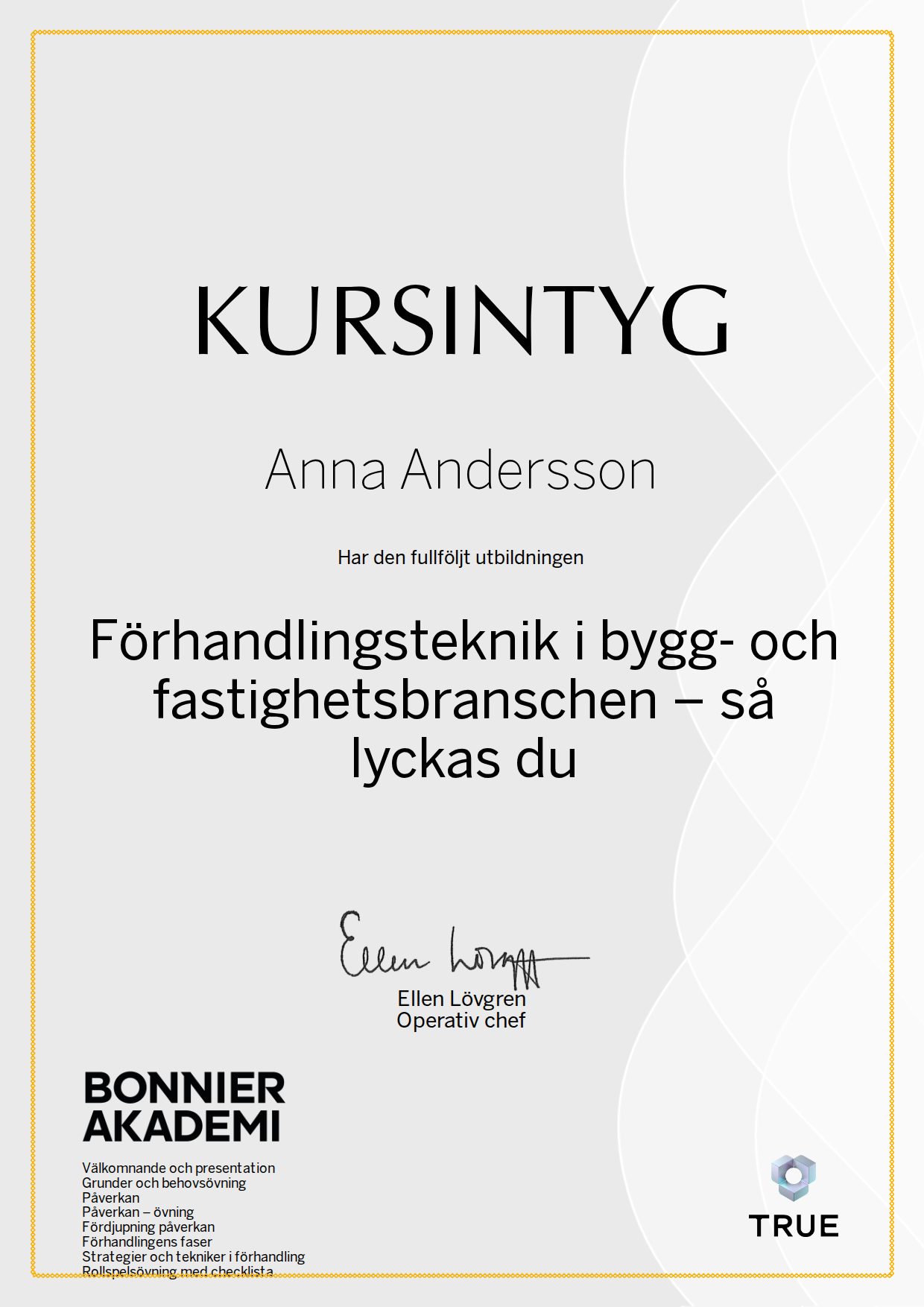
When you complete the course, Bonnier Akademi issues your certificate. Your name, the course content and the issue date are encrypted and secured on blockchain, so it cannot be changed, and anyone can check that it is genuine.
100% Verifiable certificates Secured on blockchain
 Bonnier Akademi under the brandsFastighetsnytt AkademiByggindustrin Akademi