Request info
Want to know more before you sign up?
Send a short question and we will forward it directly to the provider.
We forward your question to Campus Nyköping. No spam, no third parties.
Send a short question and we will forward it directly to the provider.
We forward your question to Campus Nyköping. No spam, no third parties.
After completing the programme the student should have knowledge of/in 1. laws, ordinances, regulations and standards relevant to the professional role 2. work environment and safety issues at roads, in tunnels, during hot work, and work at height 3. how an optical fibre works, its function as a light guide; possibilities and limitations 4. fibre concepts and terms, understanding and describing them in Swedish and English 5. cables, splice closures, racks, sleeves, connectors and enclosures 6. the different types of fibre splices in use, strippers, measuring instruments, splicers, cleavers and chemicals 7. the importance of cleanliness when measuring and terminating 8. cost and quality aspects for the network's users and owners 9. consequences and measures in the event of traffic outages 10. new technology being developed in the fibre industry, for example IoT, 5g, smart city 11. project planning for correct and cost-effective contracting work After completing the programme the student should have the skills to 1. interpret and handle work documents, network documentation and drawings 2. lay cable by direct burial, pulling, blowing, flushing and tensioning 3. fusion-splice and splice optical fibre in new installations or repairs and perform leak tests on splice closures 4. terminate installations and cross-connect racks 5. measure attenuation on fibre and splices with OTDR (optical time-domain reflectometer) and light source and power meter 6. ensure a good work environment with regard to personal safety 7. quality-assure the work carried out 8. understand and apply manuals and communicate orally using the industry's technical terms in both English and Swedish After completing the programme the student should have the competence to 1. work safely and correctly on their own in the optical infrastructure 2. analyse, handle and when needed revise work documents and drawings 3. plan and complete assignments and projects, meet deadlines and minimise costs 4. work in an environmentally aware and sustainable way according to the industry's quality and environmental systems 5. interpret and analyse measurements during troubleshooting to choose the right fault-correction action 6. work with a professional approach, good service mindset and a clear customer focus 7. judge whether their own competence is sufficient to carry out the task or whether further knowledge needs to be acquired. To see which parts have been completed, see the certificate of education.
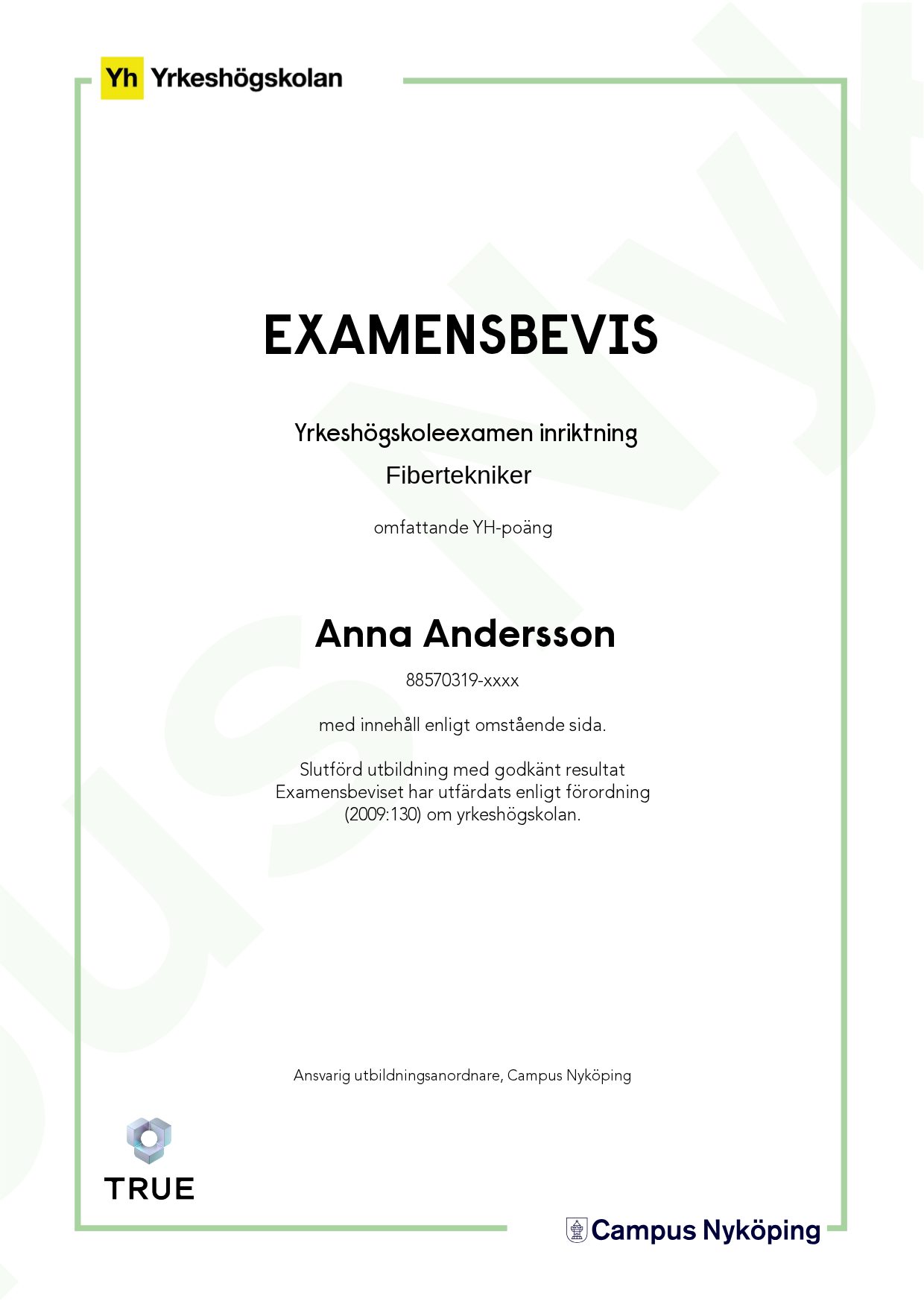
When you complete the course, Campus Nyköping issues your certificate. Your name, the course content and the issue date are encrypted and secured on blockchain, so it cannot be changed, and anyone can check that it is genuine.
Sample Credential with placeholder data. Each credential is issued with the recipient’s details and is verifiable with the provider.