This ESG course aims to give you an understanding of how sustainability requirements and trends affect actors in the financial sector. You will learn how financial companies are affected by regulations such as CSRD, the EU Taxonomy and the Disclosure Regulation (SFDR), and how best to apply the legislation in practice. We also go through how to set up criteria for sustainable investments, develop investment strategies and carry out ESG analysis.
Format: On site
Language: Swedish
Request info
Want to know more before you sign up?
Send a short question and we will forward it directly to the provider.
We forward your question to Bonnier Akademi. No spam, no third parties.
About the course.
This ESG course aims to give you an understanding of how sustainability requirements and trends affect actors in the financial sector. You will learn how financial companies are affected by regulations such as CSRD, the EU Taxonomy and the Disclosure Regulation (SFDR), and how best to apply the legislation in practice. We also go through how to set up criteria for sustainable investments, develop investment strategies and carry out ESG analysis.
COURSE OBJECTIVES:
As a participant you will gain:
- An understanding of how the market for sustainable and responsible investments has changed in recent years, and basic knowledge of different strategies for sustainable and responsible investments
- Basic knowledge of EU sustainability legislation and of ESG frameworks and concepts
- In-depth knowledge of how ESG is applied in practice by financial companies and investors
What you will learn
What you learn.
How ESG regulations such as the EU Taxonomy, SFDR, CSRD/ESRS, IFRS S1/S2 and TCFD affect financial companies
Carrying out ESG analyses in practice, including methodology, materiality and the link to business models
How ESG is integrated into investment decisions
How to carry out ESG due diligence
How to set up criteria for sustainable investments
Developing investment strategies
Developing and implementing an ESG strategy and governance in holdings and portfolio companies
Curriculum
How the course is built.
09.00 Welcome and introduction
09.15 ESG in the financial market: trends and drivers
- Developments in sustainable investments
- Different ESG-related investment strategies and approaches
- The meaning of the EU action plan on sustainable finance
10.15 Regulations and practical application
- Overview of central regulations and frameworks (the EU Taxonomy, SFDR, CSRD/ESRS, IFRS S1/S2, TCFD) and how they fit together
- Practical application for investors: how regulations affect investment strategies, classification of investments, PAI indicators and reporting requirements
- Common challenges in implementation (data availability, interpretations, proportionality)
- Case examples: how the regulations affect investment decisions and portfolio monitoring
13.00 ESG analysis
- Basic methodology for ESG analysis, including screening and risk and opportunity analysis.
- Using scoring models and setting up criteria for sustainable investments
- The principle of materiality (including double materiality) and how both qualitative and quantitative data are used in the analysis
- The meaning of E, S and G, with practical examples linked to different business models, sectors and stakeholder groups
14.00 ESG in investment decisions and investment strategy
- Designing an ESG-related investment strategy
- How ESG data is integrated into financial analysis and valuation (for example the effect on cash flows, risk premiums and multiples)
- Practical examples of how to carry out ESG due diligence
15.00 ESG strategy and governance in holdings and portfolio companies
- How to develop an ESG strategy, including priorities, goals, KPIs and action plans
- Approaches to governance, implementation and follow-up of the ESG strategy
16.30 Summary of the day
Target audience
Who is this for?
Professionals in the financial sector or holding companies who work with, for example, ESG issues, asset management, investment strategies, advisory, risk management or Investor Relations.
What "verified" means here
Verified credential.
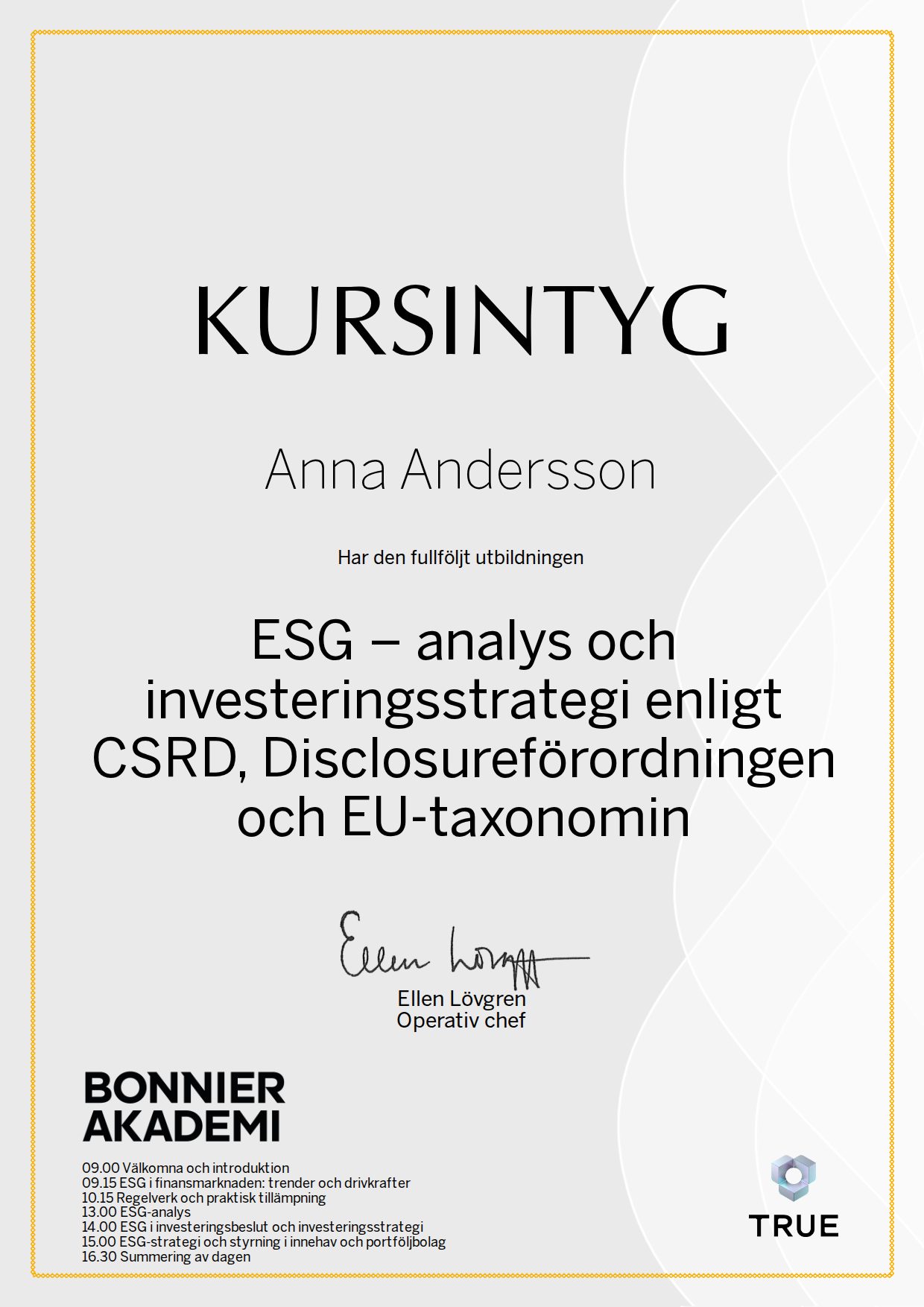
When you complete the course, Bonnier Akademi issues your certificate. Your name, the course content and the issue date are encrypted and secured on blockchain, so it cannot be changed, and anyone can check that it is genuine.
100% Verifiable certificates Secured on blockchain
 Bonnier Akademi under the brandsAktuell Hållbarhet UtbildningDi AkademiFinansmarknaden