Request info
Want to know more before you sign up?
Send a short question and we will forward it directly to the provider.
We forward your question to Lernia Utbildning. No spam, no third parties.
Send a short question and we will forward it directly to the provider.
We forward your question to Lernia Utbildning. No spam, no third parties.
After completing the programme, the student shall have knowledge about/in: 1. Specialised knowledge of renewable electricity generation, the design and function of power generation plants, troubleshooting in electrical and electronic systems, the design and function of electrical machines, energy conversion, HVCD technology, line types, line routing, grid dimensioning, transformer substations, switchgear, rules and standards in the electrical field, and electrical safety (ESA). 2. Knowledge and an overview of adjacent occupational and competence areas such as solar power, wind power, nuclear power and hydropower. 3. In-depth knowledge of Swedish legislation on electricity and electrical power, work environment and safety, project logistics, industry-specific documentation techniques, AutoCAD focused on electrical design, and the applicability of PLC systems in electrical engineering 4. In addition, for higher vocational education programmes that meet the training requirements for full authorisation in electrical installation, the student shall demonstrate specialised knowledge: - of the applicable rules and standards for electrical installations, - of how different materials or choices of material can affect high-voltage installations from a safety perspective, - of how electrical high-voltage installations and electrical equipment are constructed, - of electromagnetic compatibility and its significance for the functionality of installations and equipment After completing the programme, the student shall have the skills to: 1. Plan, carry out, and identify, formulate, analyse and solve problems and perform complex tasks in strength calculations, calculations for building power lines, switchgear and transformer substations, carry out design calculations, draw up wiring diagrams, carry out electrical work safely from an electrical safety perspective, use electrical measuring instruments, analyse electrical measurement values, troubleshoot in electrical and electronic systems and propose a measure/solution, and apply AutoCAD focused on electrical design 2. Solve complex problems in electrical power in the role of electrical power engineer. 3. Communicate commitments and solutions in the above areas in Swedish as well as one other language. 4. In addition, for higher vocational education programmes that meet the training requirements for full authorisation in electrical installation, the student shall be able to: - carry out and plan electrical installations in high-voltage installations and identify resources to carry out specialised tasks, - solve complex problems that may arise in different types of electrical installations, - carry out calculations and dimensioning applied in electrical installations in high-voltage installations, and prepare documentation of these, - carry out inspection before commissioning, - carry out measurements to verify the electrical properties, - prepare drawings and circuit diagrams with associated documentation, - communicate smaller commitments, solutions and instructions in at least one foreign language by interpreting and explaining manuals and following instructions on drawings and tools. After completing the programme, the student shall have the competence to: 1. Independently process theoretical and practical information and methods in industry-related projects, taking into account relevant social, ethical and scientific aspects. 2. Monitor and apply specialised knowledge for development in design and planning according to EBR, electricity distribution with both HVDC and HVAC technology, draw up contract documents, prepare industry-related profitability assessments, describe in detail different power generation plants, their design and function, describe and be well versed in how electrical power is transmitted, describe and be well versed in how electrical power is routed, describe and be well versed in how energy conversion takes place, describe and be well versed in the design, function and areas of use of electrical machines. 3. Take responsibility for leading the development of individuals and groups in work within the above areas. 4. In addition, for higher vocational education programmes that meet the training requirements for full authorisation in electrical installation, the student shall be able to demonstrate: - that the student can independently develop and handle the knowledge and skills required for electrical installation work in high-voltage installations and the fixed connection and disconnection of electrical equipment, and monitor rules and standards that change over time, - the ability to complete projects by assessing whether their own competence is sufficient to carry out a particular electrical installation job or whether further learning is needed before the work begins.
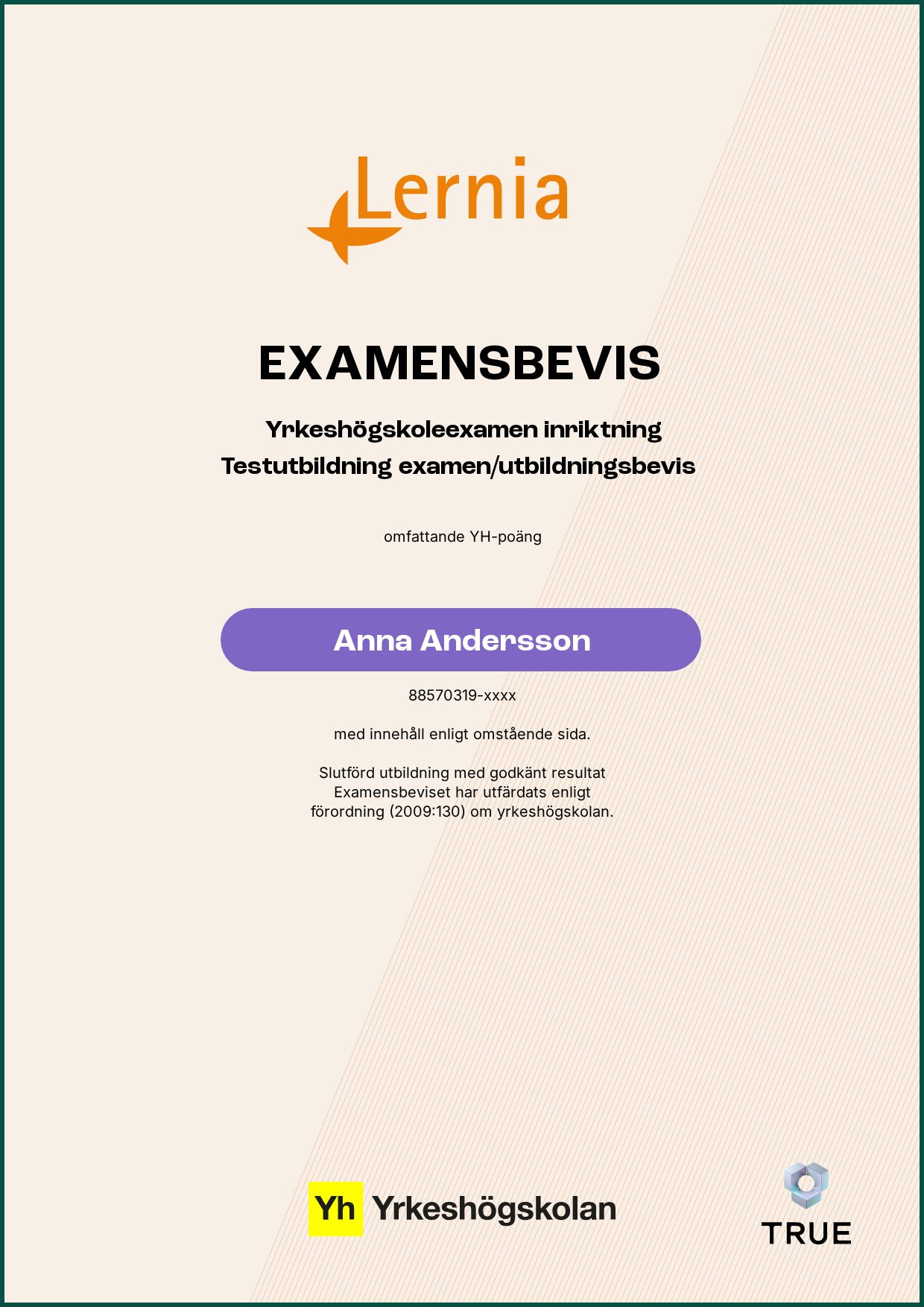
When you complete the course, Lernia Utbildning issues your certificate. Your name, the course content and the issue date are encrypted and secured on blockchain, so it cannot be changed, and anyone can check that it is genuine.
Sample Credential with placeholder data. Each credential is issued with the recipient’s details and is verifiable with the provider.