Construction

Process Leader in Sustainability Diploma: Succeeding with Complex Development Processes.

By
Bonnier Akademi logotyp
Bonnier Akademi
under the brandsAktuell Hållbarhet UtbildningDagens Samhälle Utbildning
Verified provider of education

Being a process leader in sustainability places high demands on leadership, the ability to drive change and knowledge of sustainable development. This course aims to strengthen your ability to lead complex development processes while building on your systems understanding of sustainability. Among other things, you will learn tools and methods to engage and mobilise others, handle goal conflicts and drive sustainability changes.

Format: Hybrid
Language: Swedish
Request info

Want to know more before you sign up?

Send a short question and we will forward it directly to the provider.

About the course.

Being a process leader in sustainability places high demands on leadership, the ability to drive change and knowledge of sustainable development. This course aims to strengthen your ability to lead complex development processes while building on your systems understanding of sustainability. Among other things, you will learn tools and methods to engage and mobilise others, handle goal conflicts and drive sustainability changes.

The process leader often works across sectors and then lacks a formal decision-making mandate over the individuals and organisations involved. Skill in getting others to grow and contribute is decisive there. The process leader's role is to gradually guide the work so that it becomes efficient and produces good results. Fixed process maps or routine descriptions rarely work then. The course therefore focuses on building your capacity for a more exploratory way of working with solutions adapted to the situation. The course mixes theoretical foundations with practical exercises based on the participants' own cases and gives you the opportunity to share experiences with others in the same role and expand your network. COURSE OBJECTIVES: As a participant you will: - Develop your ability to lead complex processes so that you achieve results - Develop your systems understanding to be able to work for greater sustainability - Strengthen your ability to take and be given as much room for action as change requires - Develop your ability to work with target images at different levels: for the core business, for your process and for yourself PRACTICAL ARRANGEMENTS: The course runs over four days spread across three sessions over a few months: - Days 1 & 2: In person at the course venue with a joint dinner on day 1 - Day 3: Half day online in Zoom - Day 4: In person at the course venue Work on your own case, taken from your daily work, is a decisive part of the course. It is therefore a requirement that you bring your own case and set aside time to work on it between the sessions. You will receive a template for describing your case, which you send in no later than one week before the course starts. A diploma is awarded to all participants who have attended all course days and completed all homework assignments.

What you will learn

What you learn.

  • Tools and methods for leading complex processes in sustainability
  • Leading across sectors, between functions and organisations
  • Sustainable development from a systems perspective
  • How to get the resources required for change and increase your room for action
  • Methods, ground rules and structures for work groups that create results
  • Organisational psychology in change: what happens in an organisation during a change process
  • How you can link sustainability to the business or the organisation's main mission
  • Problem solving when things move slowly or stall, when conflicts arise or when the work loses focus
Curriculum

How the course is built.

  1. Introduction to the course

    Presentation of participants and course leaders Review of the course structure and requirements for the diploma

  2. Introduction to sustainability

    Drivers of sustainable value creation Three dimensions Sustainability principles

  3. Introduction to sustainability, cont.

    WBCSD, World Business Council for Sustainable Development Agenda 2030 and the systems perspective Three levels of sustainable action

  4. Process leadership: leading people

    Concepts and definitions Leading across sectors, between functions and organisations Understanding the whole: systems understanding as the key to sustainable development About the course's focus on complex processes and what distinguishes them from other processes

  5. Presentation of cases

    As an important part of the course we will work with both fictional and real cases: The course leaders present fictional cases Presentation of the participants' own cases, in groups of four

  6. Handling complex challenges within and between organisations

    Back-casting as a method for finding the way forward Exercise

  7. Rear-view mirror

    Reflections on yesterday's exercise

  8. Handling complex challenges within and between organisations

    Governance and tools for leading change in complex challenges The shared view model: target image, expectations, contributions and ground rules

  9. People's role in change processes

    How individuals are affected by change and methods for meeting individuals in change work Motivation and commitment Working with behavioural change linked to sustainability

  10. Organisational psychology in change

    What happens in an organisation during a change process Governance methods in change, organising and tools Management's role in getting the resources needed and increasing your own room for action Power and influence

  11. Working in groups, group dynamics and how to handle them

    The influence of group composition How groupthink and conformity work Methods, ground rules and structures as a way of getting functional groups that create results

  12. Homework: work on your own case

    Formulate your own goal for next time Go through which tools/methods you plan to use in your case to make progress back home.

  13. Review and presentation of the homework

    The course leaders have compiled different ways of approaching the participants' own cases

  14. Work on your own cases

  15. Presentation and discussion in plenary

    Problem solving, room for action, motivation and commitment, obtaining resources

  16. Choosing in-depth topics for day 4

    Group discussion and decision

  17. Review and presentation of the homework

    The course leaders have compiled different ways of approaching the participants' own cases

  18. Presentation of experiences linked to your own cases

    Success factors Obstacles / problem solving Strategies

  19. How to argue for sustainability at work

    For and against sustainability: an exercise in arguing for sustainability at work

  20. How to link sustainability to the business or the organisation's main mission

    Examples from different organisations Evidence for sustainability and profitability

  21. Ways to take and be given as much room for action and resources as change requires

    Mobilising employees and management Balance between the assignment and the room for action Strategic networks as a tool

  22. In-depth work

    Takes place in the areas chosen on day 3, with examples to clarify the chosen topics

  23. Summary

    A short recap of methods, models and tools

Target audience

Who is this for?

You who work with sustainable development in complex development or innovation processes in, for example, a network, municipality, region, government agency, project organisation or company, and who are expected to bring about change within your own organisation or in collaboration with others.

What "verified" means here

Verified credential.

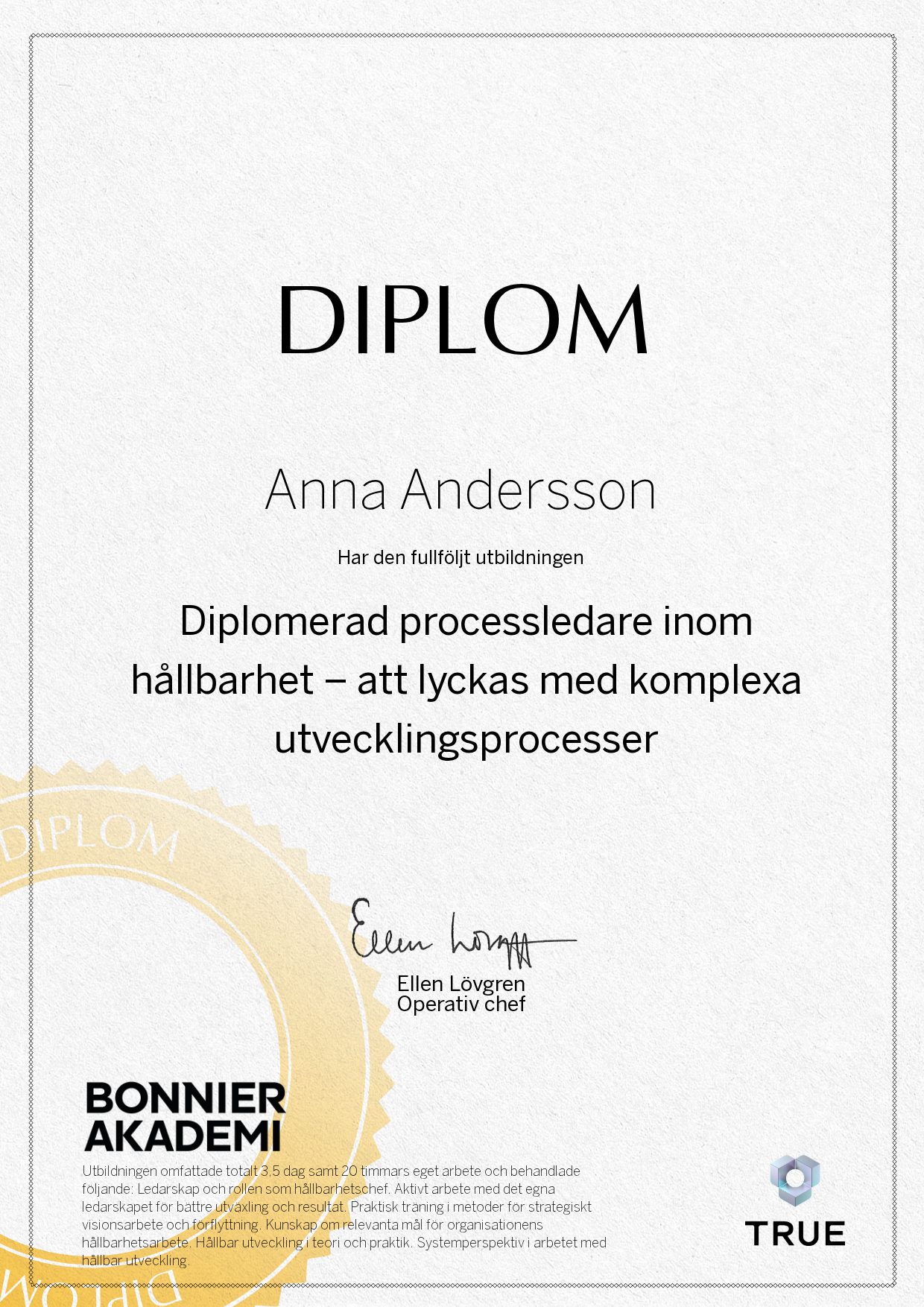
When you complete the course, Bonnier Akademi issues your certificate. Your name, the course content and the issue date are encrypted and secured on blockchain, so it cannot be changed, and anyone can check that it is genuine.

100% Verifiable certificates Secured on blockchain

Sample Credential with placeholder data. Each credential is issued with the recipient’s details and is verifiable with the provider.