Being a process leader places high demands on leadership and the ability to drive improvement work. This course aims to strengthen your ability to lead and develop processes in the public sector. Among other things, you will learn methods and tools to map, analyse and improve processes such as decision, budget and recruitment processes. During the course you have the opportunity to work on your own processes to create more efficient workflows in your organisation right away.
Format: On site
Language: Swedish
Request info
Want to know more before you sign up?
Send a short question and we will forward it directly to the provider.
We forward your question to Bonnier Akademi. No spam, no third parties.
About the course.
Being a process leader places high demands on leadership and the ability to drive improvement work. This course aims to strengthen your ability to lead and develop processes in the public sector. Among other things, you will learn methods and tools to map, analyse and improve processes such as decision, budget and recruitment processes. During the course you have the opportunity to work on your own processes to create more efficient workflows in your organisation right away.
COURSE OBJECTIVES:
As a participant you will gain:
- A deeper understanding of process leadership and its application
- Knowledge of how to map, analyse and improve processes
- The ability to create a long-term strategy for change and continuous improvement within the organisation
What you will learn
What you learn.
What process leadership involves and what responsibility you have as a process leader
Tools and methods for creating and developing processes
How to carry out a stakeholder analysis to identify needs and expectations when developing a process
Mapping existing processes
Identifying and solving problems in processes and prioritising areas for improvement
How to measure and follow up processes with a focus on cost, lead time and quality
Concrete examples of successful process development and critical success factors
Curriculum
How the course is built.
Welcome and introduction
Presentation of participants and course leaders
Presentation of the course structure and objectives
Discussion: Which processes do you work with today?
Introduction to process leadership
What is a process? Basic concepts and definitions
The role of the process in the organisation
Discussion: How processes create value and link to the organisation's goals
Process structure and governance
What process leadership involves and what responsibility you have as a process leader
The difference between a process and a project
Discussion: What the processes look like in the participants' organisations
Creating and developing processes
Introduction to assignment analysis: clarifying your assignment as a process leader
Course case part 1: Create an assignment analysis and discuss the results
The SMART method (Specific, Measurable, Accepted, Realistic and Time-bound) for formulating goals
Course case part 2: Formulate a goal for the process using the SMART method
Practical examples and reflection on process development
Examples of successful process development
Discussion: Identify critical success factors in process work
Reflection: How can this be applied in your organisation?
Summary and close of day 1
Reflections and summary of the day's content
Questions and closing words
Summary of day 1
Reflections and discussions from the previous day
Target group and stakeholders
Understanding your stakeholders depending on which process we are going to develop
How to carry out a stakeholder analysis step by step
Course case part 3: Carry out a stakeholder analysis and discuss the results
A model for process development
A review of a traditional five-step process model: Start, analyse the current state, solve problems, secure quality and improve
Mapping existing processes: methods and documentation
Course case part 4: Map a process and discuss the results
Identifying and solving problems in processes
Identify problems: why it is a problem and which actions are needed to solve it
Course case part 5: Analyse problems and areas for improvement
Define and prioritise solutions
Measuring and following up processes
What should be measured (for example cost, lead time and quality) and how to do it
Course case part 6: Measure and follow up a revised process
Summary and close
Reflection on and evaluation of the course
Questions and closing words
Target audience
Who is this for?
You who work in the public sector in areas such as project management, process leadership or operational development, or who want to create more efficient workflows in your organisation. The course is particularly relevant for managers, team leaders and employees with responsibility for improvement work or operational development.
What "verified" means here
Verified credential.
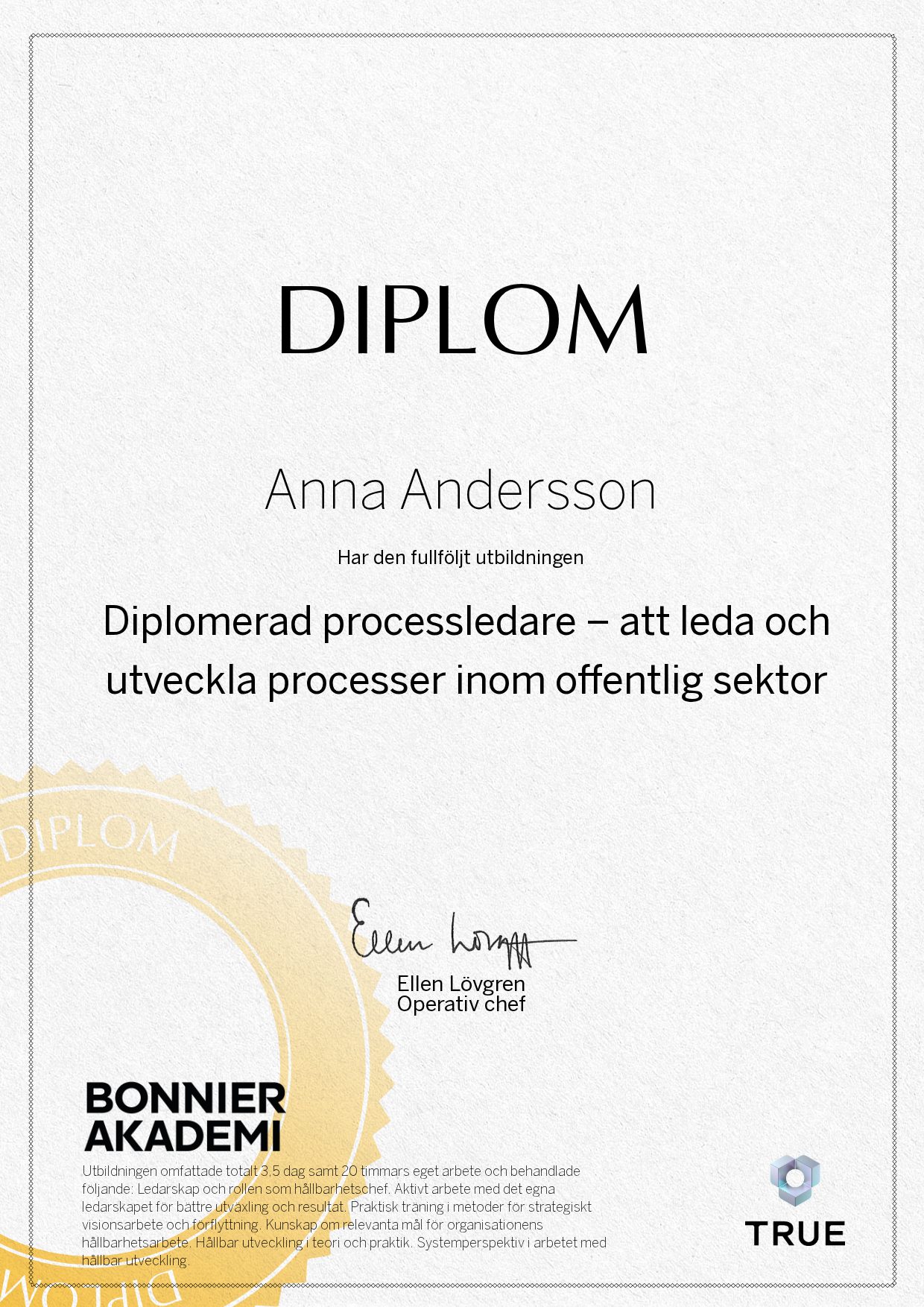
When you complete the course, Bonnier Akademi issues your certificate. Your name, the course content and the issue date are encrypted and secured on blockchain, so it cannot be changed, and anyone can check that it is genuine.
100% Verifiable certificates Secured on blockchain
 Bonnier Akademi under the brandsDagens Samhälle UtbildningDagens Medicin Utbildning