The role of Customer Relationship Manager or Loyalty Manager places high demands on both up-to-date knowledge and the ability to drive issues externally and internally. This course aims to strengthen you in your role and give you a holistic perspective on customer relationship work. You will learn to optimise loyalty and profitability by focusing on existing customers, getting to know their behaviour, segmenting and creating differentiated offers and loyalty programmes. We go through how to work with data-driven customer insight, value segmentation and increasing relevance in customer encounters through omnichannel, marketing automation and AI.
Send a short question and we will forward it directly to the provider.
We forward your question to Bonnier Akademi. No spam, no third parties.
The role of Customer Relationship Manager or Loyalty Manager places high demands on both up-to-date knowledge and the ability to drive issues externally and internally. This course aims to strengthen you in your role and give you a holistic perspective on customer relationship work. You will learn to optimise loyalty and profitability by focusing on existing customers, getting to know their behaviour, segmenting and creating differentiated offers and loyalty programmes. We go through how to work with data-driven customer insight, value segmentation and increasing relevance in customer encounters through omnichannel, marketing automation and AI.
Digitalisation, globalisation and rapid technological development have shifted power from companies to customers. Customer loyalty is falling, and new customer behaviours and expectations of you as a supplier have emerged in a digital world. It has never been more important than now to understand your customers and strengthen your existing customer relationships by working in a more customer- and data-driven way. This course is about how you can work strategically with CRM in a data-driven world and increase customer loyalty through customer insight, personalisation, omnichannel, marketing automation and loyalty programmes. COURSE MODULES: 1. Trends and concepts in CRM, CX and customer loyalty - Definitions and concepts in CRM, CX and customer loyalty - The customer relationships of the future: personal, sustainable, value-creating - Best practice: how the companies with the world's most loyal customers work 2. Customer-centric value segmentation - How to identify your "royals & loyals", the 20 percent of customers who often account for 80 percent of your sales - How you can stop offering "everything to everyone" and instead handle customers based on customer-centric value segmentation with different offers and loyalty concepts - Different types of loyalty concepts and activities for different types of customers 3. Goals and KPIs - Shifting the focus in marketing and sales from your "product portfolio" to your "customer portfolio" - Setting key ratios and KPIs to follow up CRM and customer loyalty work and to measure how financially strong your customer relationships are in the long term - How to map customers' drivers and measure satisfaction and loyalty - How to calculate Customer Lifetime Value (CLV), Retention rate/churn, NPS, customer flows and "duration" 4. The customer life cycle and customer journeys - How to define your model for the customer life cycle and customer journeys - How to retain customers over time through micro-segmentation and personalisation - Going from uncoordinated ad hoc activities to process-based and automated customer dialogue 5. Omnichannel, marketing automation, loyalty tech, predictive analytics and AI - Going from single-channel to multi- and omni-channel - What an ecosystem can look like and what you need in terms of IT support and platforms - Examples of how omnichannel, marketing automation and personalisation are used in different industries - How you can work with predictive analytics and AI to predict customer behaviour, and which data is needed 6. Organisation and success factors - Organisational challenges and collaboration between departments internally - Roles, competencies and ways of working required to succeed
- Introduction to the course - Goals, purpose and expectations
- Definitions and concepts in CRM, CX and customer loyalty - How you can work with emotional and behavioural loyalty: combining X-data (experience data) and O-data (operational data) to understand loyalty and profitability - Digitalisation, automation and personalisation of customer communication - Customer loyalty and customers' expectations: new drivers to understand (proactive service, transparency and sustainability) - How to map customer satisfaction and loyalty - The companies with the world's most loyal customers and what distinguishes them - How companies generally work with CRM today: taking the temperature
We go through a method for finding out why, what and how you can work with CRM and loyalty. - The four different parts of working strategically with CRM and CX: - 1) Value segmentation and customer strategy: segmenting customers based on loyalty and profitability to define different customer groups - 2) The customer life cycle and customer journeys: developing a customer life cycle model to differentiate customer handling depending on which customer journey and which phase the customer is in - 3) Omnichannel marketing automation: creating an ecosystem where the channels are connected and communication and customer handling are seamless across channels - 4) Predictive analytics and AI: how you can use predictive analytics to predict customer behaviour
- Shifting the focus of the work by concentrating on the "customer portfolio" instead of the "product portfolio" - Which key ratios measure how financially strong your customer relationships are in the long term - How to value the customer base financially - How a five percent increase in retention rate (repurchase rate) can increase profit by 25-95 percent - How to calculate Customer Lifetime Value (CLV), Retention rate/churn, NPS, customer flows and "duration", and whether your most profitable segments are also the most loyal - An exercise in calculating to identify your company's greatest potential for improving your CLV
- 20 percent of customers often account for 80 percent of revenue and most of your future sales; here is how you identify them - Working with differentiated offers: a review of different forms of loyalty concepts and activities - The importance of qualitative customer insights in combination with quantitative ones: are your most profitable customers the most satisfied? - How to create a clear customer strategy with handling of different segments - Working with differentiated offers: a review of different forms of loyalty concepts and activities - What the loyalty concepts of the future look like
We apply the day's lessons and work on a case in groups with a presentation
- The difference between the customer life cycle and customer journeys and how to handle them together - Examples of how different companies work - Methodology for the customer life cycle and how to handle customers in the different phases - How to retain customers over time through micro-segmentation and personalisation - How to go from uncoordinated ad hoc activities to process-based and automated customer dialogue - How to combine the use of value segmentation and the customer life cycle
- Technology for handling tailored customer communication and personalisation - From single-channel to multi- and omni-channel - The benefits of using inbound marketing - Loyalty tech for managing loyalty programmes - What an ecosystem can look like and what you need in terms of IT support and platforms - How you can work with predictive analytics and AI, and which data is needed - Examples of how omnichannel and marketing automation are used in different industries - What to consider when choosing a supplier of a marketing automation system
- Organisational challenges and collaboration between departments internally - Roles, competencies and ways of working required to succeed
You who want to improve your work with CRM and customer loyalty and gain an overall understanding of how different perspectives fit together, for example: - Marketing managers and marketers - CRM and loyalty managers - CRM analysts - Customer experience managers - Customer insight roles - Marketing automation experts
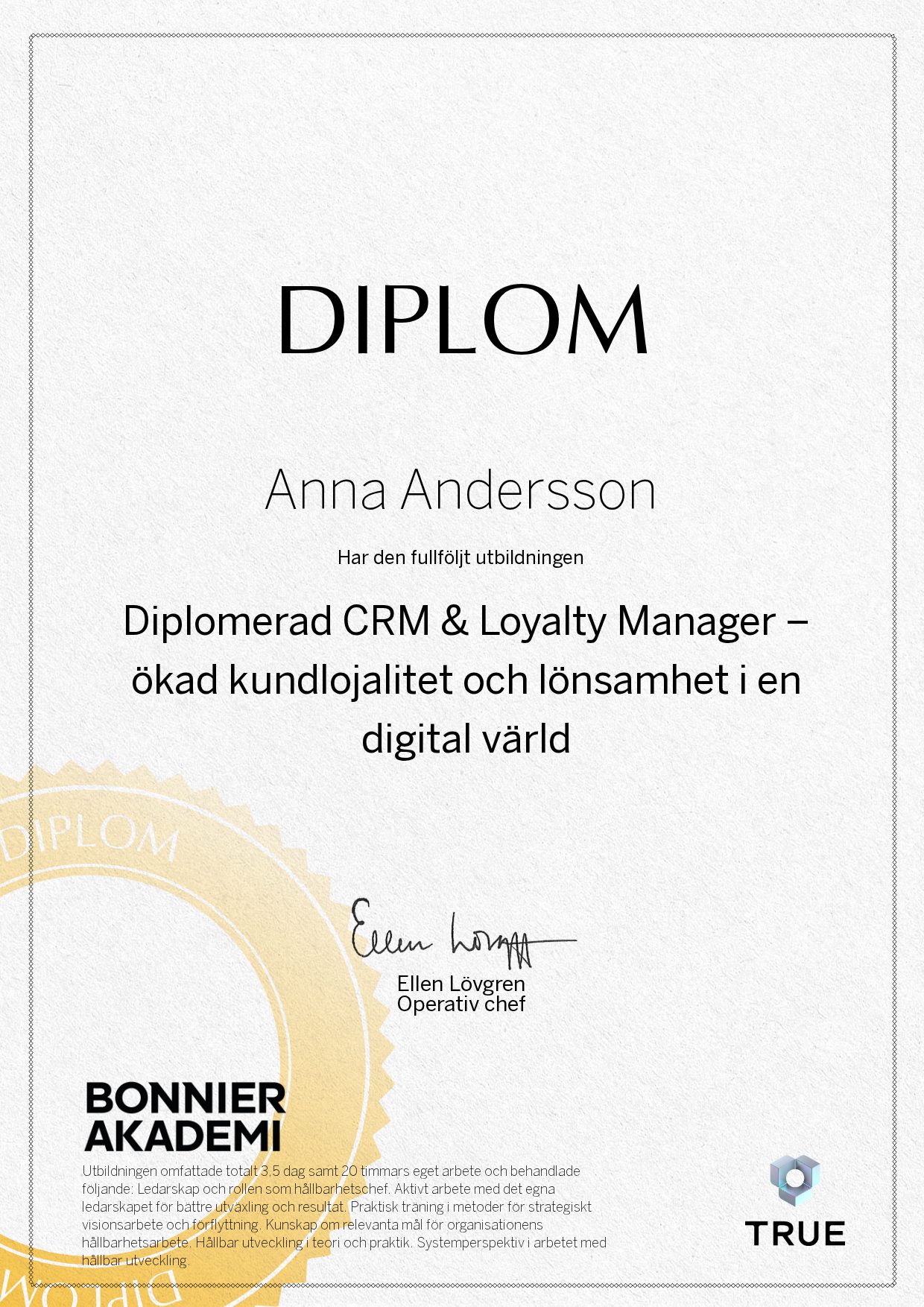
When you complete the course, Bonnier Akademi issues your certificate. Your name, the course content and the issue date are encrypted and secured on blockchain, so it cannot be changed, and anyone can check that it is genuine.
Sample Credential with placeholder data. Each credential is issued with the recipient’s details and is verifiable with the provider.