The EU's sustainability reporting standards (ESRS) are being revised, but they still require extensive work from the companies concerned. This two-day course gives you a comprehensive grasp of CSRD and the proposed/revised standards. Among other things, you will learn how to carry out a double materiality assessment, write general disclosures and report material topics. You will also learn how ESRS can be used strategically for greater business value, whether or not your organisation is covered by the legal requirements.
Format: On site
Language: Swedish
Request info
Want to know more before you sign up?
Send a short question and we will forward it directly to the provider.
We forward your question to Bonnier Akademi. No spam, no third parties.
About the course.
The EU's sustainability reporting standards (ESRS) are being revised, but they still require extensive work from the companies concerned. This two-day course gives you a comprehensive grasp of CSRD and the proposed/revised standards. Among other things, you will learn how to carry out a double materiality assessment, write general disclosures and report material topics. You will also learn how ESRS can be used strategically for greater business value, whether or not your organisation is covered by the legal requirements.
The course is based on the final proposal for revised sustainability reporting standards (ESRS) that Efrag presented at the beginning of December 2025 and that the European Commission is expected to adopt. The course is aimed at companies that must report under ESRS as part of their annual report and those that choose to do so voluntarily. It suits both you who have not reported under ESRS before and you who want to update yourself on the revised framework.
What you will learn
What you learn.
Good knowledge of CSRD, the changes the directive brings compared with previous directives and a clear picture of the current situation (Omnibus, "stop-the-clock", relief measures and simplified/revised ESRS)
Good knowledge of the proposed/revised new mandatory sustainability reporting standards (ESRS), and how to report under them
An understanding of which steps your organisation needs to take to carry out the reporting
Curriculum
How the course is built.
CSRD in practice and implementation in Swedish law
Who is covered by CSRD and how this is governed by the Annual Accounts Act
What needs to be included in the report
Requirements for review by an auditor
Links to other frameworks and reporting requirements, such as GRI, the EU Taxonomy, the OECD due diligence guidance, SASB, TCFD and GHG
ESRS: how to report under the revised standards
What the proposed/revised reporting standards, ESRS, mean for reporting companies
The structure and content of the standards and how to report under them
Double materiality in practice
The increased importance of the materiality assessment through CSRD, what it means that it must be carried out according to the principle of double materiality (how the business affects its surroundings and how the surroundings affect the business) and how these requirements have changed
How to carry out a double materiality assessment step by step
The role of stakeholders and common pitfalls
General disclosures (ESRS 2)
Which information must be provided about the business, governance, material topics and how they were identified
How the general disclosures in ESRS 2 interact with the topical standards
Reporting material topics
The disclosure requirements for policies, targets, actions and metrics
General requirements under ESRS 2 and requirements in the topical standards
Ways to decide which information to provide based on the double materiality assessment
Mandatory requirements, phase-in and relief
What is mandatory, which omissions are allowed and the phase-in provisions ("smart planning" over the first years)
The SME track in the value chain
VSME at an overview level and how this standard can be used to obtain information from suppliers and other business partners
Your action plan
How to turn the course content into a concrete plan in your organisation
Target audience
Who is this for?
Everyone who needs to understand CSRD and ESRS and the new requirements they place on companies' sustainability reporting. The course is for companies that must, or voluntarily want to, report under ESRS. It suits both you who have not reported under ESRS before and you who want to update yourself on the revised framework.
What "verified" means here
Verified credential.
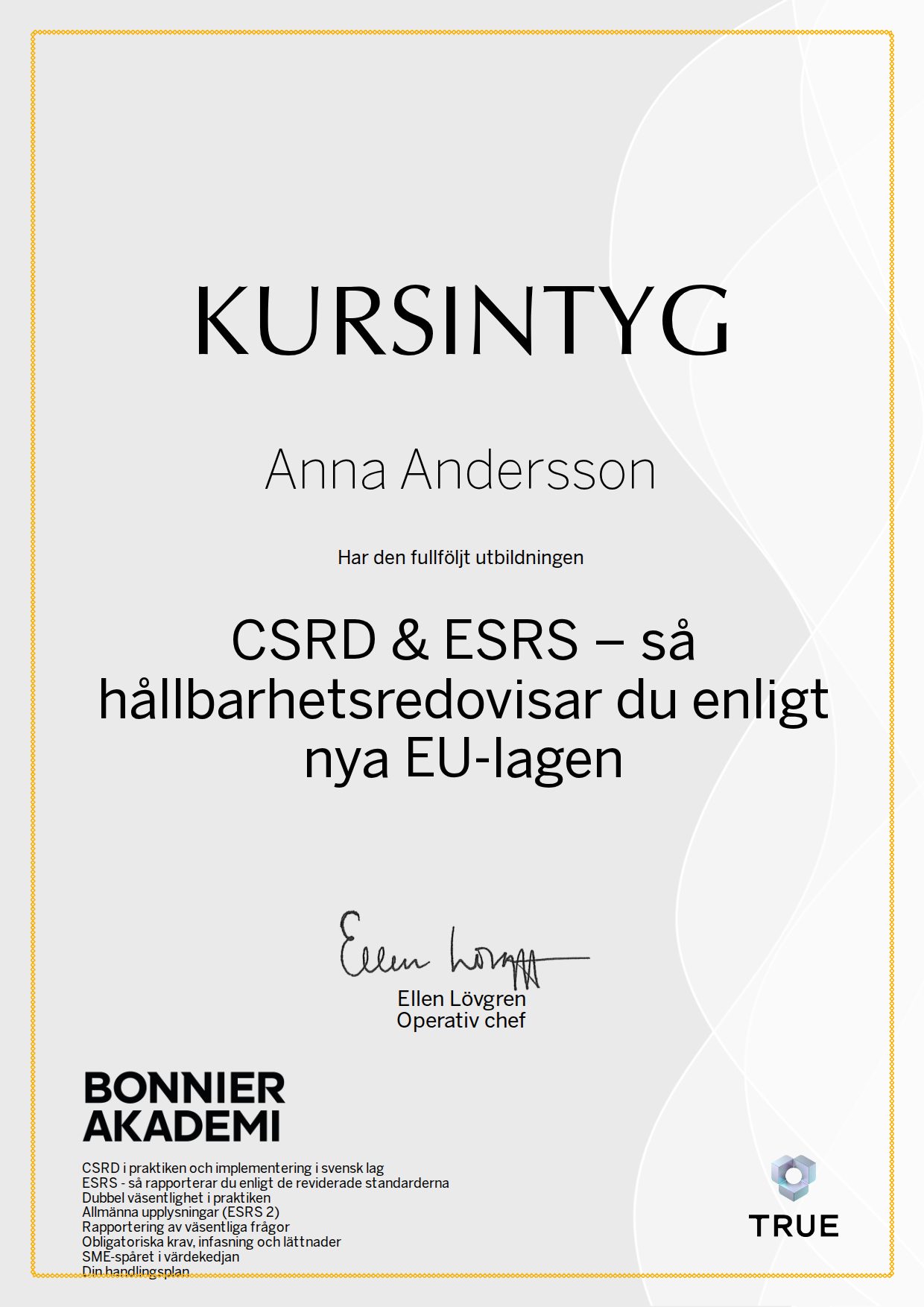
When you complete the course, Bonnier Akademi issues your certificate. Your name, the course content and the issue date are encrypted and secured on blockchain, so it cannot be changed, and anyone can check that it is genuine.
100% Verifiable certificates Secured on blockchain
 Bonnier Akademi under the brandsAktuell Hållbarhet UtbildningDi AkademiFinansmarknaden