This certification course is for you who want to become really sharp at valuing private companies according to all the rules of the art. The course combines theory, practice and real cases to give you a solid toolbox. We start from finance theory and the recognised guidelines of The International Private Equity and Venture Capital Valuations (IPEV), but land in how buyers, investors, auditors and funds actually reason in practice. After completing the course and passing the exam you receive a certificate confirming your competence according to the international market standard.
Format: On site
Language: Swedish
Request info
Want to know more before you sign up?
Send a short question and we will forward it directly to the provider.
We forward your question to Bonnier Akademi. No spam, no third parties.
About the course.
This certification course is for you who want to become really sharp at valuing private companies according to all the rules of the art. The course combines theory, practice and real cases to give you a solid toolbox. We start from finance theory and the recognised guidelines of The International Private Equity and Venture Capital Valuations (IPEV), but land in how buyers, investors, auditors and funds actually reason in practice. After completing the course and passing the exam you receive a certificate confirming your competence according to the international market standard.
Unlisted companies play an increasingly important role in the economic ecosystem, both as investment assets and as targets for corporate transactions. But valuing these companies is something entirely different from valuing listed shares. It requires an understanding of methodology, regulations and the compromises of reality.
The course includes exercises, spreadsheets and scenarios that you can take straight into your daily work.
CERTIFICATION
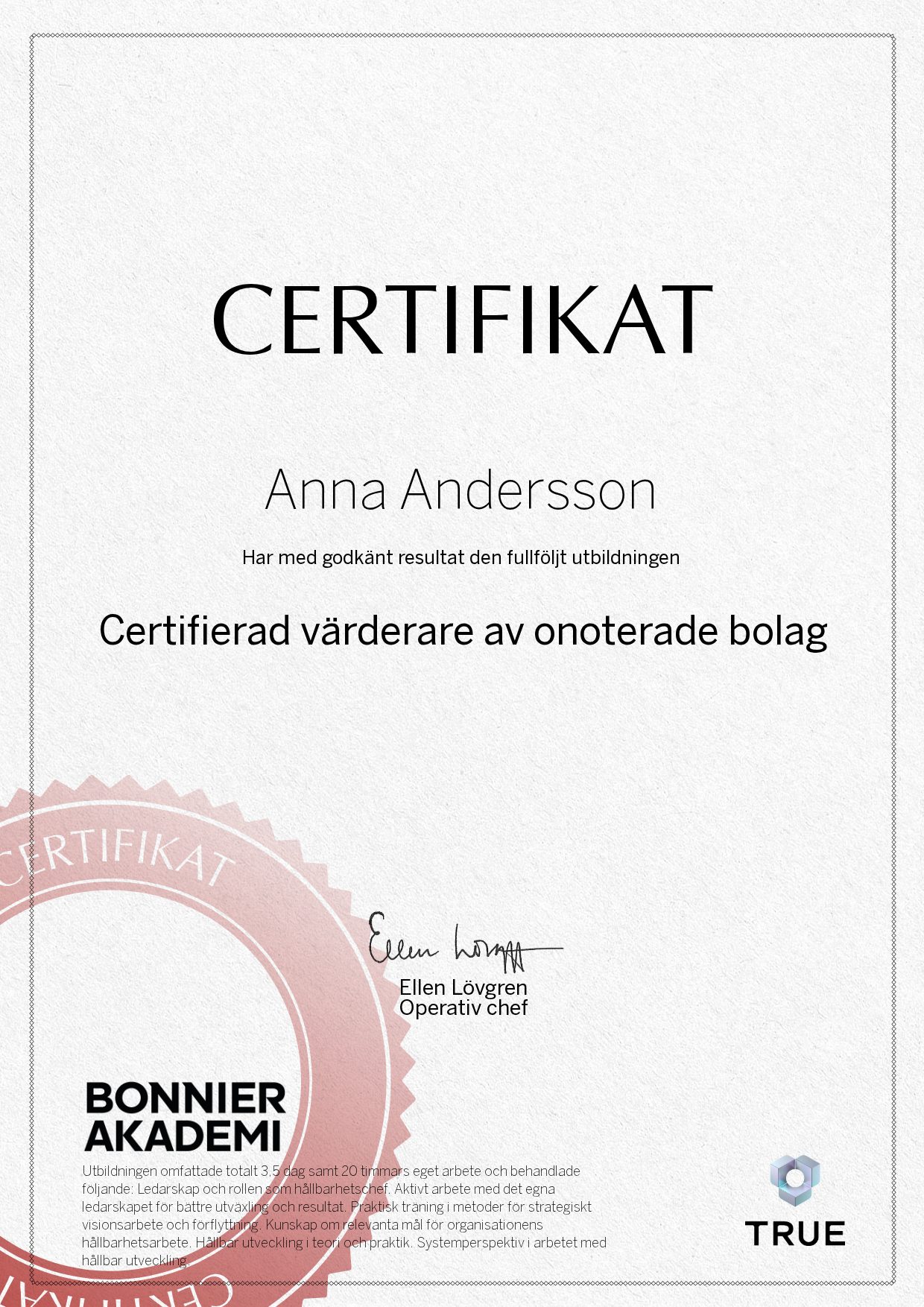
After completing the course you can take an exam, and with a pass you receive a certification confirming that you have the knowledge required to analyse, understand and value unlisted companies, according to international standards and practical market logic.
What you will learn
What you learn.
Understanding IPEV's (The International Private Equity and Venture Capital Valuation) guidelines for valuing private companies
Analysing the balance sheets and income statements of unlisted companies
Building and evaluating a business plan with financial logic
Choosing and applying the right valuation method in the right situation
Understanding how LBO (leveraged buyout) structures affect the valuation
Choosing the right comparable companies for relative valuation (unlisted transactions, public comparable companies, comparable rounds) and arguing for their pros and cons
How investors reason about value, risk and potential
Curriculum
How the course is built.
DAY 1
09.00 Breakfast and introduction
- Welcome, introductions and a review of the course structure
09.30 Regulations, guidelines and finance theory
- Which accepted finance theories and methods exist
- What is IPEV, and how does it affect your valuation?
- The difference between value and price in an illiquid market
10.15 Coffee
10.30 Income statement and balance sheet
- A deep dive into the balance sheet and income statement
- Working capital, cash flows and adjustments ("Quality of earnings")
- Case: create and interpret a financial databook
12.00 Lunch
13.00 Business plan and forecasts
- How to build a credible business plan
- Growth assumptions, cost drivers and scenario planning
- Case study in Excel: model a business plan
15.00 Coffee break
15.30 Cases and exercises
- Group exercise: scrutinise a company, identify risks, create key ratios
17.00 The course day ends
DAY 2
09.00 Cash flow valuations (DCF and LBO)
- Build block by block: FCF, terminal value, discount rate
- CAPM, risk premiums and adjustment for illiquidity
- Practical case: value a company with DCF
- Exercise: Everyone values a company using the DCF method
- What is an LBO and how does it affect value?
- Sensitivity analysis and financing structure
- Case: build a simple LBO model
10.00 Coffee
10.15 Cash flow valuations (DCF and LBO), continued
12.00 Lunch
13.00 Market valuations (multiple valuation and transactions)
- Introduction to stock market multiples, comparable transactions and comparable rounds
- How does the selection process for comparable companies work? What does IPEV require?
- How to interpret multiples for unlisted companies. What is the difference between different multiples (ARR, Revenue, EBITDA, EBIT etc.)
- How to choose between backward-looking and forward-looking multiples
- How to think when valuing a company on an ongoing basis (monthly or quarterly) compared with valuing a company on a single occasion
- Case: We value a company together
- Exercise: All participants carry out a valuation and argue for their selected companies
- Examples of real transactions
14.30 Coffee break
14.45 Enterprise value and equity value
- The bridge between enterprise value and equity value
- What working capital is and how to normalise for it
- What Capex is and how to normalise for it
- How to handle different share classes: we build a simple waterfall
- The difference between locked box and completion accounts
- Case: We look at a real transaction
- Exercise: All participants receive a balance sheet and build the bridge between enterprise value and equity value
16.00 Summary and instructions for the certification exam
16.30 The course ends
Target audience
Who is this for?
You who work with investments, auditing, accounting, M&A, corporate finance, business development or are a board member of a growth company. For example investment managers, CFOs, controllers, auditors, advisers or lawyers.
What "verified" means here
Verified credential.
When you complete the course, Bonnier Akademi issues your certificate. Your name, the course content and the issue date are encrypted and secured on blockchain, so it cannot be changed, and anyone can check that it is genuine.
100% Verifiable certificates Secured on blockchain