Welcome to our certified board course, which aims to give you the knowledge and tools to develop and create value in companies in a professional way. The course gives you the knowledge you need for corporate governance under the Swedish Companies Act and best practice. There is a strong focus on the board's role and responsibilities, strategy issues, governance of the CEO and control of the business. You will learn how to structure board work, work with governing documents and the formal responsibilities of a board member. Knowledge you can use directly after the course at your next board meeting.
Format: On site
Language: Swedish
Request info
Want to know more before you sign up?
Send a short question and we will forward it directly to the provider.
We forward your question to Bonnier Akademi. No spam, no third parties.
About the course.
Welcome to our certified board course, which aims to give you the knowledge and tools to develop and create value in companies in a professional way. The course gives you the knowledge you need for corporate governance under the Swedish Companies Act and best practice. There is a strong focus on the board's role and responsibilities, strategy issues, governance of the CEO and control of the business. You will learn how to structure board work, work with governing documents and the formal responsibilities of a board member. Knowledge you can use directly after the course at your next board meeting.
THE COURSE COVERS THE FOLLOWING MODULES:
1. The basics of corporate governance
The Swedish model of corporate governance: the division of roles between owners, board and CEO.
2. The board's formal responsibilities
The formal responsibilities under the Swedish Companies Act and other legislation, and liability insurance.
3. The composition of the board
How the board is appointed in large and small companies, what owners and the nomination committee should consider when composing the board, and what requirements can be placed on a chair.
4. What a board should work on
Which areas a board should work on, and what applies under law and good practice.
5. Practical board work
Based on the legislation, we go through how a board can work to make its work as effective as possible.
The knowledge from the course should be directly applicable in practice. In addition to thorough digital course material, you receive tools, checklists, templates and the physical book "Vägledning till god styrelsesed" (Guide to good board practice).
CERTIFICATION
The course is run in collaboration with Styrelseakademien. After completing the course you can take an exam, and with a pass you receive a certification as a board member from Styrelseakademien called "Rätt fokus i styrelsearbetet" (The right focus in board work). The course content and the certification are approved by ECODA, European Confederation of Directors Associations.
Curriculum
How the course is built.
Day 1
08.30 Breakfast
09.00 Welcome and introduction
- Presentation of the course leaders and participants
- Presentation of the course and the methodology
09.30 The basics of corporate governance
- The basics of the Swedish Companies Act
- The Swedish model of corporate governance
- The division of roles between owners, board, CEO and auditor
- Corporate governance in other countries
- The Swedish Corporate Governance Code
10.15 Coffee
10.30 The basics of corporate governance, continued
- Governing documents in a limited company
- Shareholders' agreement
- Owner directives
- Articles of association
- The board's rules of procedure
- CEO instructions
- Reporting instructions
- Annual general meeting and extraordinary general meeting
12.00 Lunch
13.00 The basics of corporate governance, continued
14.00 The composition of the board
- How is the board appointed?
- Employee representatives on the board
- The number of members and deputies
- The nomination committee and its work
- The role of the chair
- Alternative ways to start up board work
- Remuneration of board members
- How long can a board assignment be?
- How does a board assignment end?
15.00 Coffee break
15.15 The composition of the board, continued
17.15 Summary with time for questions
17.30 End of day 1
Day 2
08.30 The board's formal responsibilities
- The concept of "discharge from liability"
- Unlawful forms of value transfer
- Liability for capital deficiency: the control balance sheet
- The Tax Procedures Act
- Liability insurance
10.15 Coffee
10.30 What a board should work on
- The board's main tasks under the Swedish Companies Act
- The board's tasks according to good practice
- Strategy work
- Sustainability on the board agenda
- Risk, control and governance
12.00 Lunch
13.00 What a board should work on
- Governance of the CEO
- Information the board is responsible for
15.00 Coffee break
15.15 Practical board work
- Planning the board year
- The basic model for board meetings
- Detailed planning of the board meeting
- The board material
- The notice of meeting
- Ethical rules and good practice at the board table
- The relationship between the chair and the CEO
- The relationship between the members and the CEO
- Board decisions
- The obligation to prepare matters
- Conflicts of interest
- Board minutes
- Board evaluation
16.30 Summary with time for questions
17.00 End of day 2
Target audience
Who is this for?
Board members, owners, CEOs and others who want knowledge of the conditions for professional board work and how it can be carried out.
What "verified" means here
Verified credential.
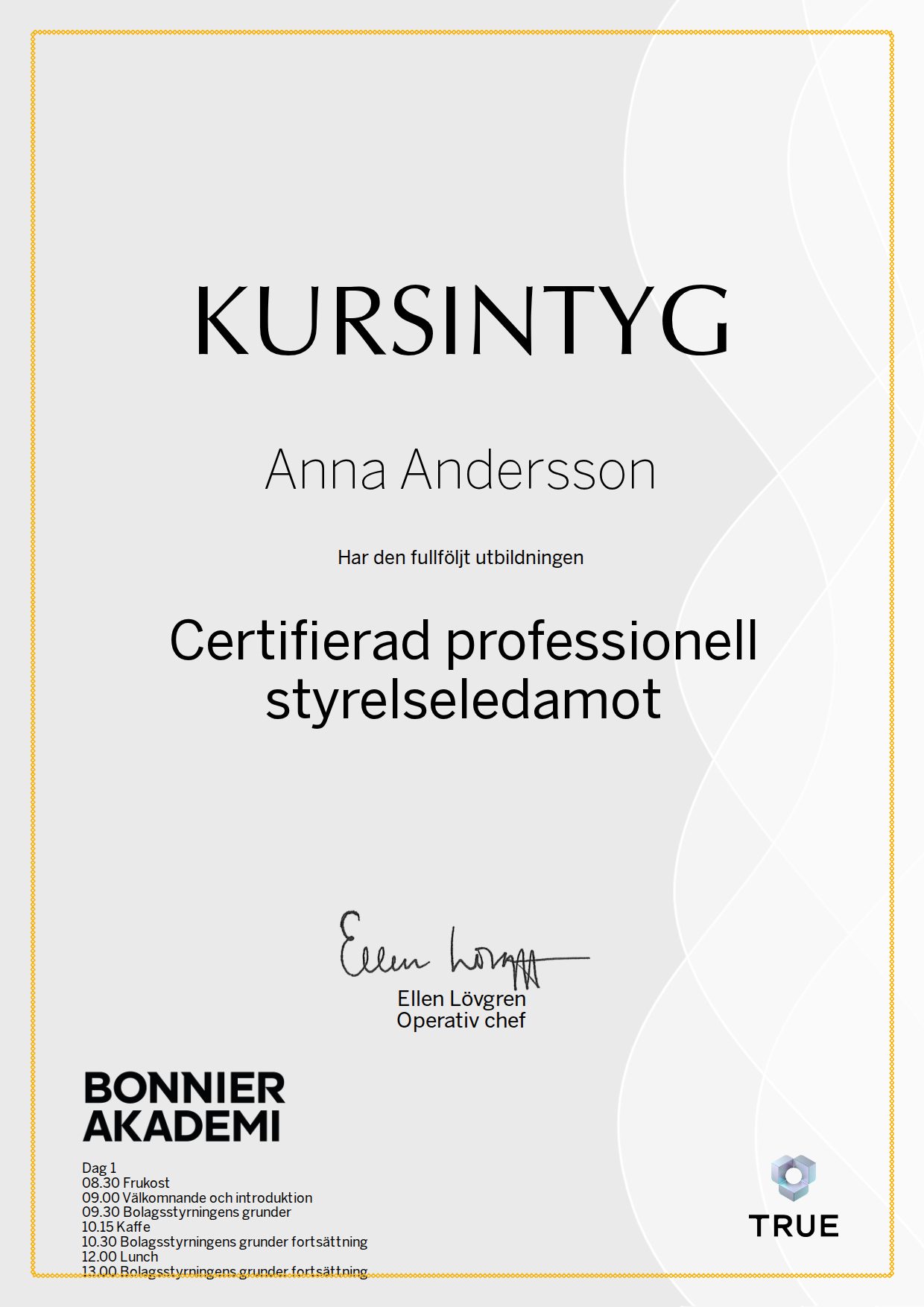
When you complete the course, Bonnier Akademi issues your certificate. Your name, the course content and the issue date are encrypted and secured on blockchain, so it cannot be changed, and anyone can check that it is genuine.
100% Verifiable certificates Secured on blockchain