The threat level against Sweden has risen, which places high demands on actors that perform vital societal functions to be able to act quickly and in a coordinated way in critical situations. This course gives you who are responsible for preparedness and security in business or the public sector practical tools to strengthen your organisation's ability to plan, prioritise and collaborate during heightened alert. Exercises based on escalating security situations make the content concrete and directly applicable.
Format: On site
Language: Swedish
Request info
Want to know more before you sign up?
Send a short question and we will forward it directly to the provider.
We forward your question to Bonnier Akademi. No spam, no third parties.
About the course.
The threat level against Sweden has risen, which places high demands on actors that perform vital societal functions to be able to act quickly and in a coordinated way in critical situations. This course gives you who are responsible for preparedness and security in business or the public sector practical tools to strengthen your organisation's ability to plan, prioritise and collaborate during heightened alert. Exercises based on escalating security situations make the content concrete and directly applicable.
Sweden's supply preparedness is being strengthened through increased funding and a new national strategy. The Swedish Civil Contingencies Agency (MSB) and the Swedish Armed Forces have drawn up joint starting points for total defence 2025-2030, which give greater clarity on how public and private organisations should plan and prioritise in the event of crisis or war. The government has also decided on two new preparedness sectors, while MSB has been given a strengthened coordinating role.
So a great deal has happened at the national and strategic level, and it now needs to be put into practice in the public sector and in business. This course is about how that is done in practice.
COURSE OBJECTIVES:
As a participant you will gain:
- The ability to assess, plan and carry out preparedness planning in your organisation
- In-depth knowledge of relevant statutes, the tasks and responsibilities of authorities, and the consequences of heightened alert and war
- Tools for preparedness planning and long-term capability development
- Discuss priorities and use of resources in a serious global situation
- Increase resilience both in peacetime crises and in everyday operations
What you will learn
What you learn.
How vital societal functions are maintained and what role your organisation has
Tools for drawing up a preparedness plan for the short and long term
How the private and public sectors can collaborate to strengthen resilience
Statutes and regulations for heightened alert that apply to public and private responsibility
How preparedness planning can be integrated with other planning and analysis, such as continuity planning, security protection analysis, and risk and vulnerability analysis
How to strengthen your organisation's preparedness capability through training and exercises, and how to create work processes to use that capability in the best way
Curriculum
How the course is built.
09.00 Introduction
- Presentation
- Threat picture, global situation and political direction
09.15 Basic conditions for preparedness planning
- The concepts of crisis preparedness, civil preparedness and total defence
- Statutes and regulations from the Instrument of Government to authorities' guidance
- The legislation for heightened alert provides flexibility
- Scenario exercise part 1: Grey zone issues, which measures are reasonable to take?
10.15 Coffee
10.30 Collaboration for stronger resilience
- New authority structure with preparedness sectors and clearer roles
- Public-private collaboration and business's entry points into total defence
- Use of business's technology development, production capacity and critical infrastructure
- Scenario exercise part 2: Sabotage, does it warrant raising the alert level?
11.30 How preparedness planning is integrated with other planning and analysis
- The relationship between preparedness planning and continuity planning, security protection analysis, and risk and vulnerability analysis
12.00 Lunch
13.00 Practical preparedness planning
- A model for capability development based on the current situation and level of ambition
- Creating capability (training, exercises) and using capability (work processes, organisation)
- Advice for coherent planning in the short and long term
- Link to supply preparedness: frameworks and starting points for operational planning
15.00 Coffee
15.15 Continuity in planning
- Scenario exercise part 3: Sweden is under attack, how do we maintain vital societal functions? What tasks does your organisation have?
- The current global situation, including experiences from Ukraine
- Success factors in preparedness planning
16.30-17.00 Summary and questions
Target audience
Who is this for?
Managers and officers in central administration, staff, planning units or security functions in companies, government agencies, regions or municipalities.
What "verified" means here
Verified credential.
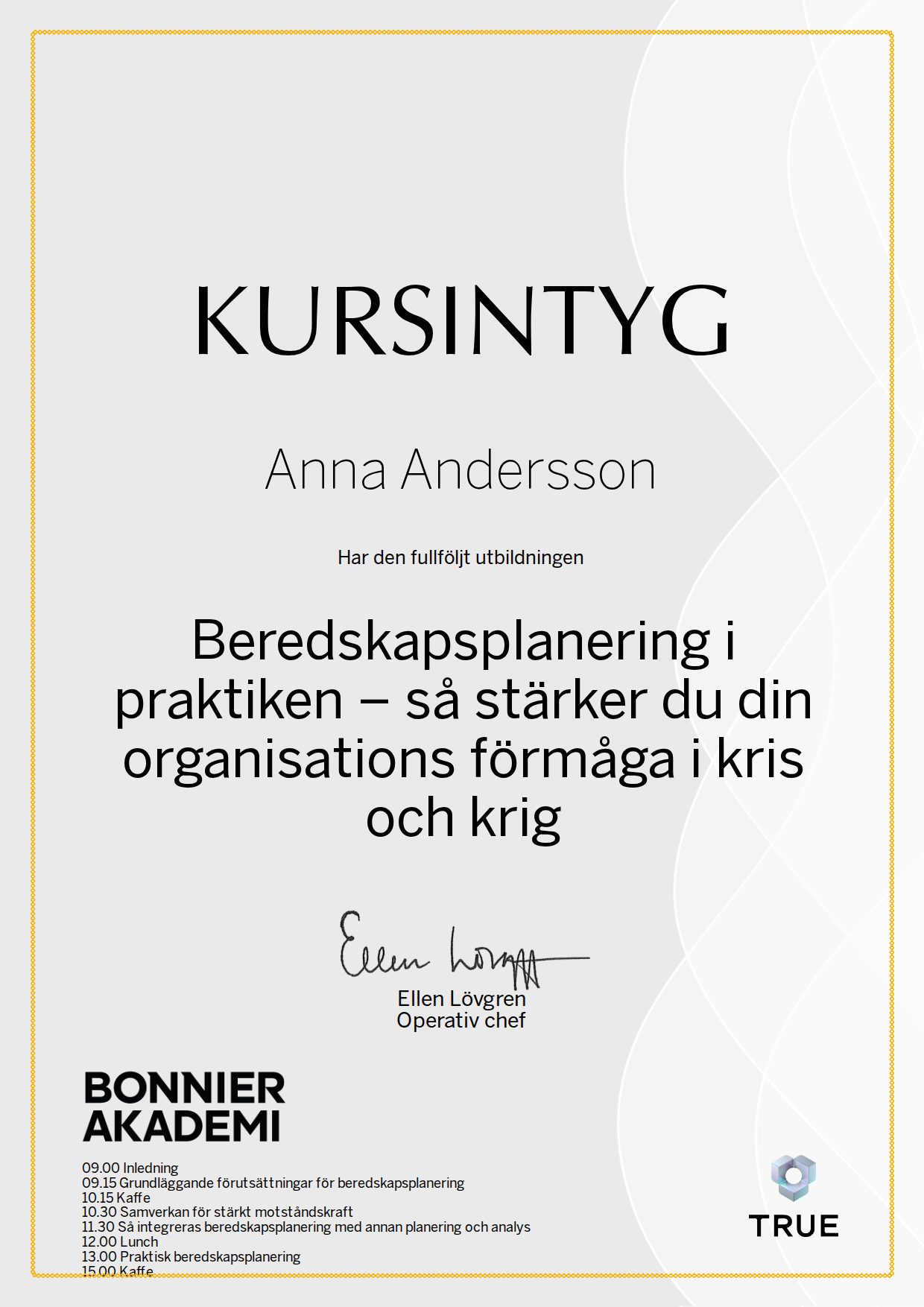
When you complete the course, Bonnier Akademi issues your certificate. Your name, the course content and the issue date are encrypted and secured on blockchain, so it cannot be changed, and anyone can check that it is genuine.
100% Verifiable certificates Secured on blockchain
 Bonnier Akademi under the brandsDagens Samhälle UtbildningDagens Medicin Utbildning