Leading managers requires skills and competencies that differ from leading employees. This course aims to strengthen you in your leadership and in your ability to achieve results through other leaders in a politically governed organisation. You gain a better understanding of the system and awareness of the conditions for governance and management at different levels of the organisation. There is a strong focus on tools and methods that make communication easier between different roles and managerial assignments, in order to give leadership impact at different levels.
Format: On site
Language: Swedish
Request info
Want to know more before you sign up?
Send a short question and we will forward it directly to the provider.
We forward your question to Bonnier Akademi. No spam, no third parties.
About the course.
Leading managers requires skills and competencies that differ from leading employees. This course aims to strengthen you in your leadership and in your ability to achieve results through other leaders in a politically governed organisation. You gain a better understanding of the system and awareness of the conditions for governance and management at different levels of the organisation. There is a strong focus on tools and methods that make communication easier between different roles and managerial assignments, in order to give leadership impact at different levels.
This course is about what to focus on to succeed in your assignment of leading through other managers: political skill, communication ability, being a role model, creating room for leadership, process leadership and the ability to navigate the public stage. You will learn to delegate assignments, follow up the managers you lead in their assignments and work with strategy development together with peer, subordinate and superior managers.
COURSE MODULES:
1. Leading through other managers
- How leadership differs between leading other managers and directly leading employees
- How you succeed in your role as a manager of other managers in governing and leading
- How leadership and the organisation's culture are connected
- How you in your role as manager can strengthen your managers in building trust, enabling prioritisation and simplifying governance and management
2. Leadership at different hierarchical levels
- the Leadership Pipeline theory
Based on Leadership Pipeline and the four management levels in the public sector, we go through the conditions for leadership at the different levels and what creates success:
1. Top manager (develops strategy for the whole organisation and is the link to the political level)
2. Function manager (usually responsible for a large, complex area)
3. Manager of managers (leads leaders and manages those who do different things and are at different strategic levels)
4. Manager of employees
3. Staff and line logic: the roles and conditions of different leadership functions
Differences between line logic (manager in the line) and staff logic (support to managers in, for example, finance, HR, communication) and how you can prevent conflicts between them through dialogue.
4. Your own leadership and your development plan
During the course you work with the course leaders on your own leadership and produce a development plan.
COURSE OBJECTIVES:
As a participant you will:
- Be strengthened in your leadership and in your ability to achieve results through other leaders
- Get tools and methods that make communication easier between different roles and managerial assignments, in order to give leadership impact at different levels
- Gain a better understanding of the system and awareness of the conditions for governance and management at different levels of the organisation
Curriculum
How the course is built.
Governing and leading as a manager in the public sector
Introduction to the Leadership Pipeline theory in the public sector
Four leadership levels:
Top manager: Develops strategy for the whole organisation and ensures that it is consistent, and not least is the link to the political level
Function manager: Managers reporting to the top manager. They usually have responsibility for a large, complex area with many different specialisms
Manager of managers: Leads leaders and manages those who do different things and are at different strategic levels
Manager of employees: Manager of a diversity of leaders with very different specific tasks
Employees: Here results are created through their own efforts and in collaboration with other employees
Factors that create coherent management chains in a politically governed organisation
Dialogue and reflection
Line logic (manager in the line) and staff logic (support/service to line managers)
This session is about how, through dialogue between line and staff, you can avoid conflicts and frustration and instead help others succeed in their different assignments.
My development plan
What do I want to develop in my leadership?
Coaching: in this session you have the opportunity to produce your own development plan and to enrich and support other participants.
Target audience
Who is this for?
Managers who lead other managers in a line or staff function, for example heads of administration and sector, CEOs of municipal companies, operations managers, department heads, area managers or chiefs of staff (HR, finance, communication and so on).
What "verified" means here
Verified credential.
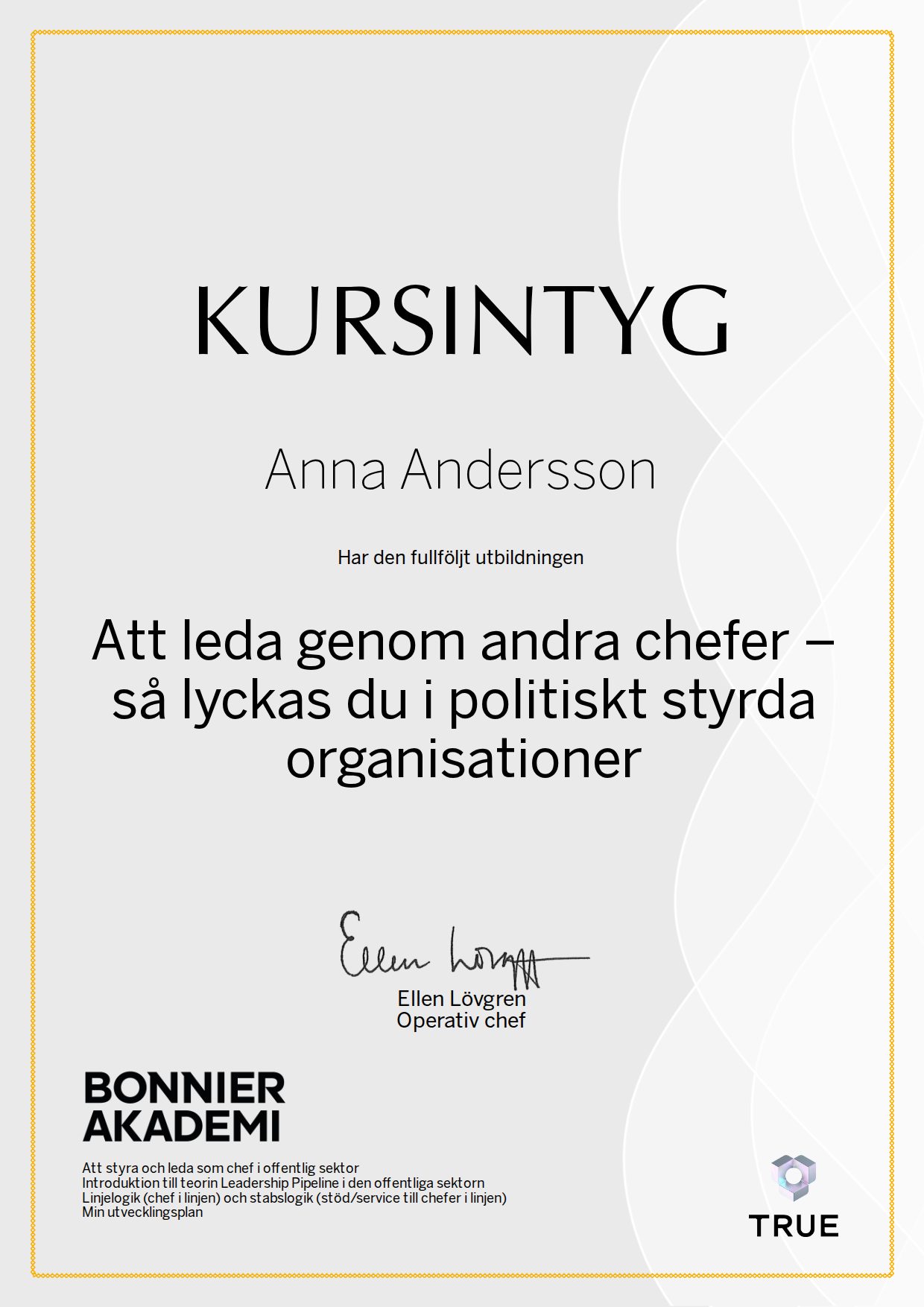
When you complete the course, Bonnier Akademi issues your certificate. Your name, the course content and the issue date are encrypted and secured on blockchain, so it cannot be changed, and anyone can check that it is genuine.
100% Verifiable certificates Secured on blockchain
 Bonnier Akademi under the brandsDagens Samhälle UtbildningDagens Medicin Utbildning