What is included in a contractor's original undertaking and what should be paid for as ÄTA work is one of the most common sources of dispute in construction contracts. This course aims to give you knowledge and understanding of the differences between different types of ÄTA work, and of how work should be classified and compensated. The goal is for you to understand the system and the purpose of the rules that determine what constitutes ÄTA work, so that you can apply them in situations that arise in your business.
Format: On site
Language: Swedish
Request info
Want to know more before you sign up?
Send a short question and we will forward it directly to the provider.
We forward your question to Bonnier Akademi. No spam, no third parties.
About the course.
What is included in a contractor's original undertaking and what should be paid for as ÄTA work is one of the most common sources of dispute in construction contracts. This course aims to give you knowledge and understanding of the differences between different types of ÄTA work, and of how work should be classified and compensated. The goal is for you to understand the system and the purpose of the rules that determine what constitutes ÄTA work, so that you can apply them in situations that arise in your business.
ÄTA work is an abbreviation of Ändringsarbeten, Tilläggsarbeten and Avgående arbeten (changed work, additional work and omitted work) and refers to work carried out in connection with the originally contracted work. ÄTA is the most important of the construction industry's rules for handling the unforeseen changes that often arise during construction projects. The rules are found in the standard contracts AB04 and ABT06.
Please note that you should bring the standard contracts (AB 04 and ABT 06) to the course to be able to follow it.
COURSE OBJECTIVES:
After the course you should understand the system and purpose of the rules that determine what constitutes ÄTA work, the formal requirements and the compensation rules, and be able to apply them in situations that arise in your business.
What you will learn
What you learn.
What ÄTA work is
What contract work is
Differences between ÄTA work and contract work
The difference between different types of ÄTA work
What constitutes changed work, additional work and omitted work
The formal requirements and the exceptions to them
How changes to the formal requirements work
When the contractor is entitled to compensation
How work should be classified
How ÄTA work is compensated
The difference between ÄTA work and, for example, hindrance, substantial disruption, acceleration and damages
Curriculum
How the course is built.
Differences between ÄTA work and contract work
Definition of what ÄTA work is.
What are the calculation assumptions, and what do the standard contracts say about the basis for the tender? What constitutes contract work under AB 04 and ABT 06, including the rules on each party's responsibility for information provided and technical solutions supplied.
Differences between ÄTA work and contract work (continued)
What constitutes changed work, additional work and omitted work respectively, and why does it matter?
What is meant by prescribed and equivalent ÄTA work?
How should work be classified?
Formal requirements for ÄTA work
Similarities and differences in the formal requirements (written order, notification and more) for ÄTA work, with a focus on:
Which formal requirements apply to prescribed and equivalent ÄTA work respectively, when AB 04 or ABT 06 applies.
How changes to the formal requirements in the contract's administrative provisions work.
When the contractor is entitled to compensation even if the formal requirements have not been met.
Compensation for ÄTA work
How different types of ÄTA work are compensated, with a focus on the difference between added and omitted work
ÄTA work and the boundary with other changes
Differences between ÄTA work and, for example, hindrance, substantial disruption, acceleration and damages.
Target audience
Who is this for?
You who work with building, civil engineering or installation contracts under AB 04 or ABT 06, whether on the client or the contractor side. For example property managers, property owners and developers, site managers, project managers and officials at construction companies.
What "verified" means here
Verified credential.
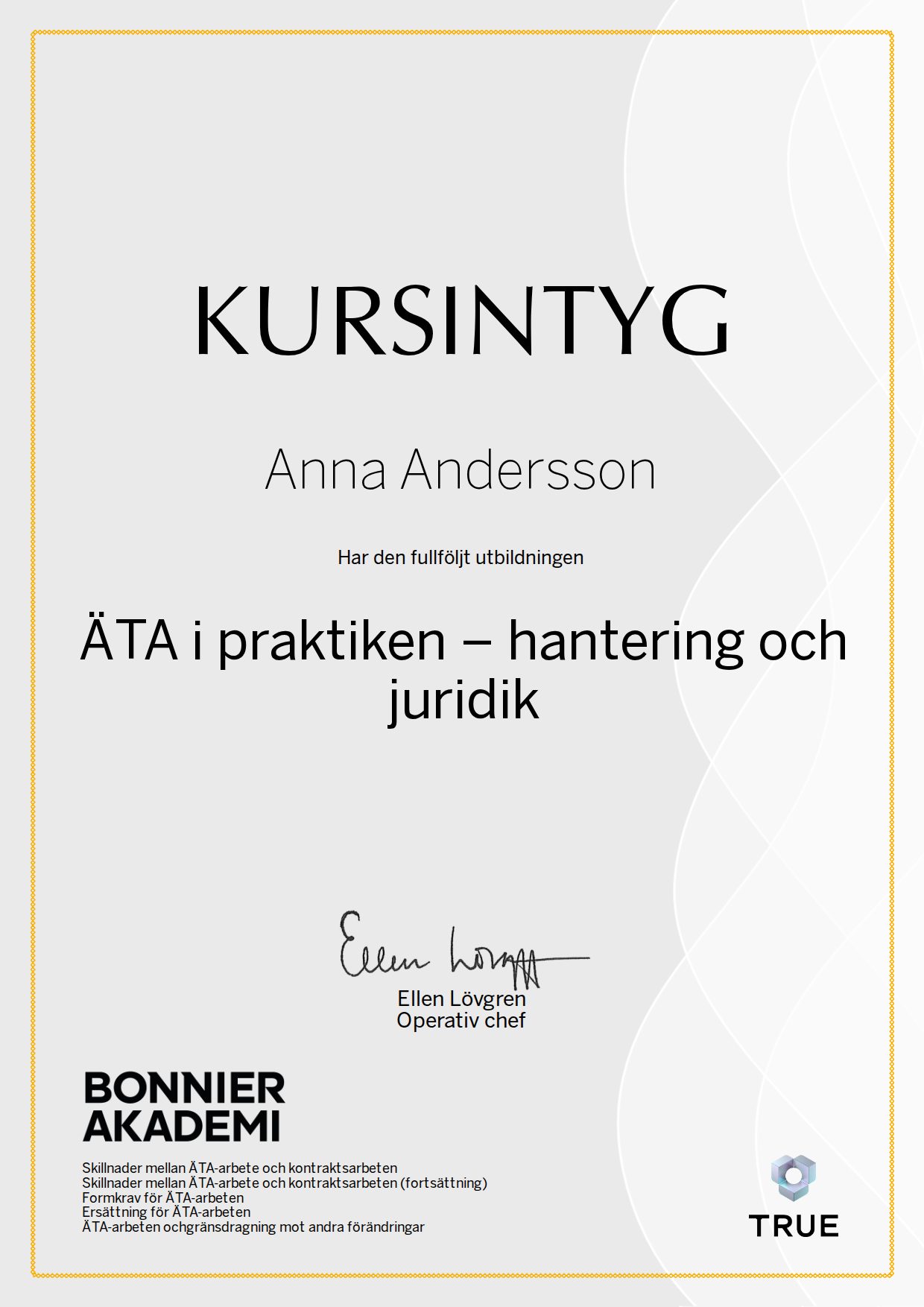
When you complete the course, Bonnier Akademi issues your certificate. Your name, the course content and the issue date are encrypted and secured on blockchain, so it cannot be changed, and anyone can check that it is genuine.
100% Verifiable certificates Secured on blockchain