AI is becoming an increasingly important tool in climate adaptation work, from risk analysis to strategic decision support. This course is about how to use AI as a concrete tool in combination with open data from, for example, SMHI and SCB. Among other things, you will learn how to identify risk zones, create climate assessments, analyse scenarios and formulate climate strategies. You will also learn how AI can be used to create and understand thematic maps.
Format: On site
Language: Swedish
Request info
Want to know more before you sign up?
Send a short question and we will forward it directly to the provider.
We forward your question to Bonnier Akademi. No spam, no third parties.
About the course.
AI is becoming an increasingly important tool in climate adaptation work, from risk analysis to strategic decision support. This course is about how to use AI as a concrete tool in combination with open data from, for example, SMHI and SCB. Among other things, you will learn how to identify risk zones, create climate assessments, analyse scenarios and formulate climate strategies. You will also learn how AI can be used to create and understand thematic maps.
During the course we use the paid version of ChatGPT. To access all features you need such an account when you take the course. More information is sent to booked participants one week before the course starts.
COURSE OBJECTIVES:
As a participant you will gain
- In-depth knowledge of how you can use generative AI as a powerful tool in climate adaptation and sustainability work
- An understanding of how to identify useful data sources and combine them with AI
- Develop skills in creating simple maps and visualisations with the help of AI
What you will learn
What you learn.
How generative AI can be used in climate adaptation and community development
How open data sources from, for example, SMHI, SCB, Copernicus (satellite data on environment, climate and land use) and NGP (Nationella geodataplattformen, the national geodata platform) can be used in combination with AI in climate work
How to create climate assessments in built environments using open data
How you can use AI as a tool to formulate climate strategies and decision support
How you can use AI to visualise data: opportunities and limitations
Creating maps with the help of AI and green infrastructure data
How AI can support sustainability-focused procurement, strategy work and change management
Ethical risks to consider when using AI for climate adaptation
Curriculum
How the course is built.
Introduction to AI for climate adaptation
What generative AI is and how it can be used in climate work to identify risk zones, analyse heat effects or illustrate green infrastructure in urban environments
How ChatGPT works, with examples of possible applications in municipalities and projects
Data, tools and applications
Introduction to SMHI, SCB, NGP (Nationella geodataplattformen, the national geodata platform) and Copernicus (the EU's Earth observation programme, which offers satellite data on environment, climate and land use)
How AI can process and reason about geographic data
AI for risk analysis and map support
How you, together with AI, can create input for climate assessments in built environments using SMHI data among other sources
How AI can support decisions and analyses by generating draft texts, visualisations and statistical summaries based on open data
Maps with AI: opportunities and limitations
How AI can be used to visualise data
Exercise: create thematic maps from green infrastructure data with the help of AI
Collaboration and decision support with AI
How to use AI as a tool to formulate climate strategies and decision support
How AI can help when preparing documentation for sustainability-focused procurements
How AI can analyse strategic scenarios and contribute draft texts for governing documents, action plans and collaboration documents between different actors
Prompt exercise: Generate input for climate adaptation plans and scenarios
Reflection: How can AI support collaboration between different administrations and organisations?
Future AI tools for sustainable development
What comes next? Adapt, evaluate and scale up
Group discussion and scenarios
Limitations and ethical risks in AI use
Target audience
Who is this for?
- Sustainability strategists
- Climate and environmental managers
- Planners and urban developers
- Officials in municipalities, regions and government agencies
- Consultants in environment, climate and community planning
What "verified" means here
Verified credential.
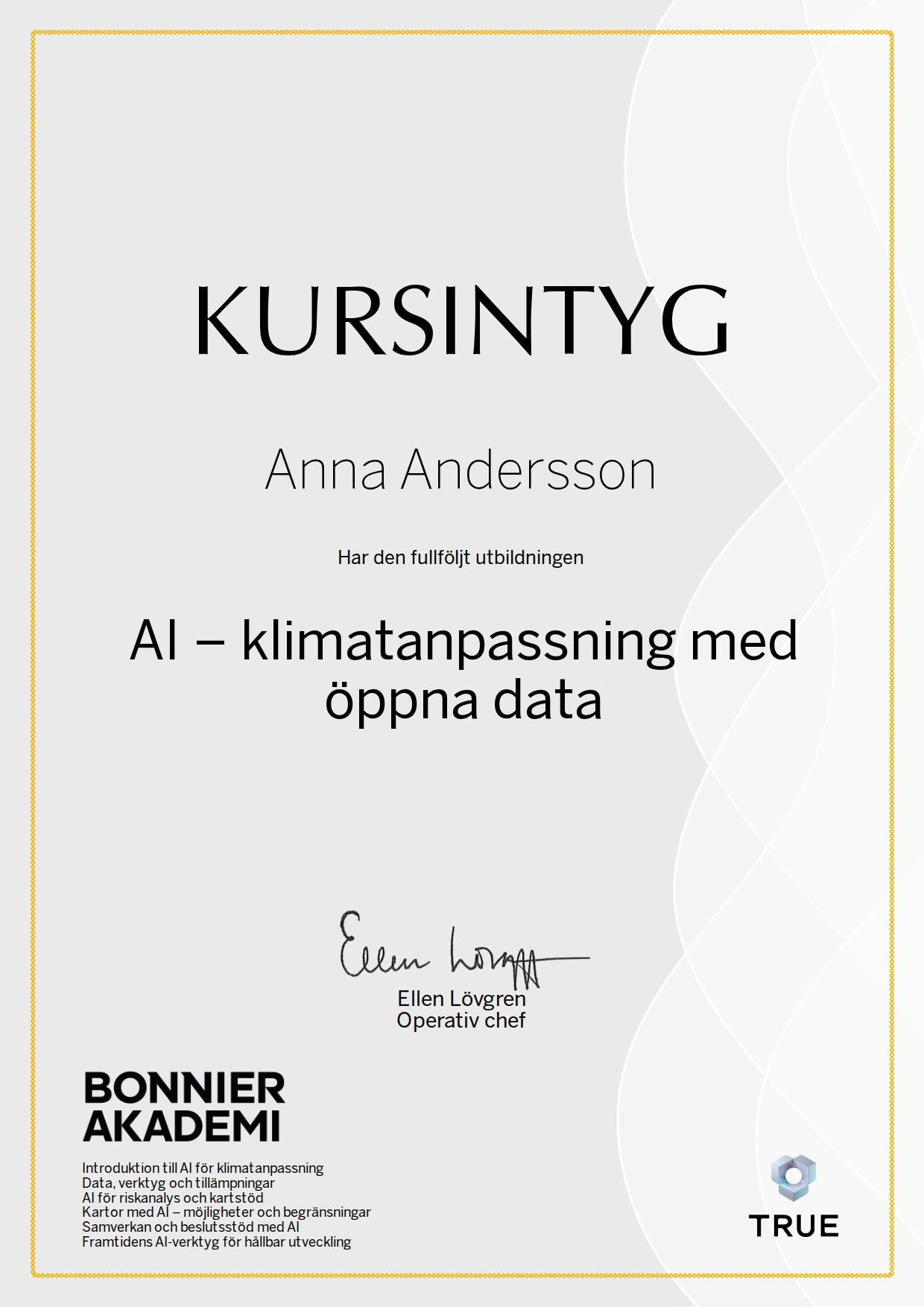
When you complete the course, Bonnier Akademi issues your certificate. Your name, the course content and the issue date are encrypted and secured on blockchain, so it cannot be changed, and anyone can check that it is genuine.
100% Verifiable certificates Secured on blockchain
 Bonnier Akademi under the brandsAktuell Hållbarhet UtbildningFastighetsnytt AkademiDagens Samhälle Utbildning