This course is about how AI can be used in healthcare to increase efficiency and patient safety, for example for diagnostics, medical record management and optimising patient flows. You will learn about concrete solutions and how they can be implemented in clinical practice. We also go through the conditions required for success, risks, the framework set by legislation and how to avoid common mistakes.
Format: On site
Language: Swedish
Request info
Want to know more before you sign up?
Send a short question and we will forward it directly to the provider.
We forward your question to Bonnier Akademi. No spam, no third parties.
About the course.
This course is about how AI can be used in healthcare to increase efficiency and patient safety, for example for diagnostics, medical record management and optimising patient flows. You will learn about concrete solutions and how they can be implemented in clinical practice. We also go through the conditions required for success, risks, the framework set by legislation and how to avoid common mistakes.
COURSE OBJECTIVES:
As a participant you will gain
- A deeper understanding of what AI is and how it can be used for more efficient and safer patient care
- Knowledge of current and upcoming AI tools and solutions for healthcare
- Knowledge of what to consider and which conditions are required to succeed with AI in healthcare
- Practical experience of using AI in a healthcare context
To take part in the exercises during the course you need an account with an AI service, for example Copilot or ChatGPT. Booked participants receive more information in the joining instructions one week before the course starts.
What you will learn
What you learn.
How AI can be used to create more efficient and safer patient care
How to use AI tools in practice in health and medical care
Tools and solutions that can be used for, for example, X-ray analysis, diagnostics, record keeping and business development
Which laws and ethical guidelines you must consider when implementing AI in healthcare, including the EU AI Act
How AI can be used in precision medicine
Risks and common pitfalls
Which conditions are required in your own organisation to succeed with AI
What you need to consider when using AI and health data
What is on the AI horizon: upcoming solutions and tools for healthcare
Curriculum
How the course is built.
Why AI is relevant to healthcare
What is AI?
What you need to consider regarding health data, for example cybersecurity, bias and generalisability
What AI can be used for in healthcare and how it is implemented
Applications and tools
Existing applications in healthcare administration and clinical practice, for example for diagnostics, X-ray analysis, business development and optimising patient flows
What AI can be used for and how it can contribute to efficiency and patient safety
AI linked to precision medicine, which aims to tailor treatment to each individual
Workshop
How large language models can be used in health and medical care and how they differ from each other. How can they be used safely? What techniques give good answers?
Workshop based on different scenarios:
- Keeping medically up to date
- Getting help from AI in development projects
- Creating digital solutions with the help of AI ("vibe coding")
What you need to consider to succeed with AI
The risks of AI in healthcare
Laws, regulations and ethical guidelines related to AI
Are you allowed to build and use your own AI?
Which conditions are required in your own organisation in terms of competence, data access, cultural conditions and IT infrastructure
Important actors and authorities and their roles
Current developments in AI for healthcare
Upcoming tools and solutions for healthcare
What research is focusing on
What do we see in the longer term?
Target audience
Who is this for?
Leaders, managers, business developers and other key people in healthcare who want to get to grips with AI in order to lead developments in their own organisation.
What "verified" means here
Verified credential.
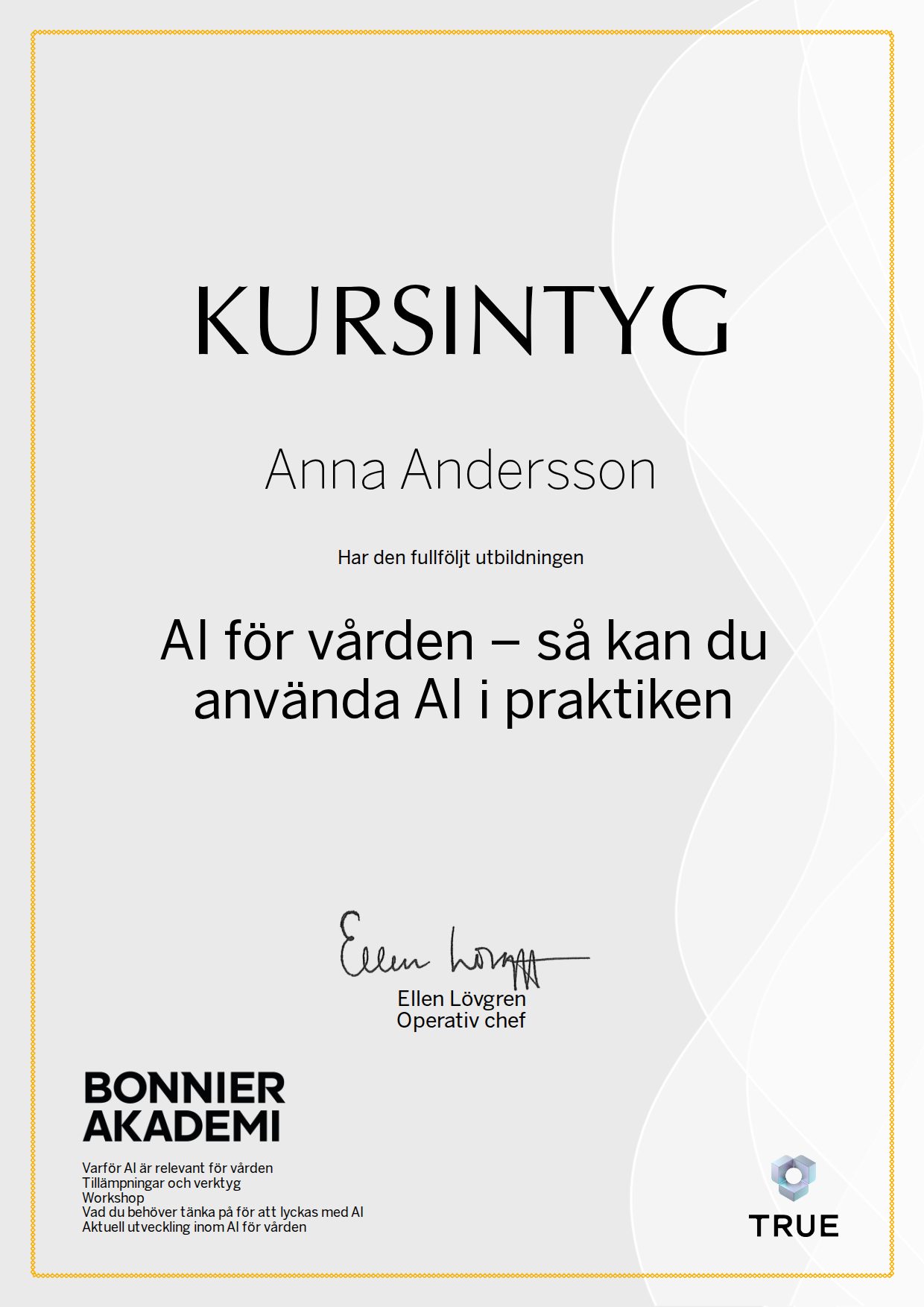
When you complete the course, Bonnier Akademi issues your certificate. Your name, the course content and the issue date are encrypted and secured on blockchain, so it cannot be changed, and anyone can check that it is genuine.
100% Verifiable certificates Secured on blockchain