You know procurement, now it is time to sharpen your work with AI. This course is about how you can use AI throughout the procurement process, from preliminary study and advertising to tender evaluation and contract follow-up. You will learn how AI can save time and strengthen the quality of the work while ensuring it is used safely, transparently and traceably.
Format: On site
Language: Swedish
Request info
Want to know more before you sign up?
Send a short question and we will forward it directly to the provider.
We forward your question to Bonnier Akademi. No spam, no third parties.
About the course.
You know procurement, now it is time to sharpen your work with AI. This course is about how you can use AI throughout the procurement process, from preliminary study and advertising to tender evaluation and contract follow-up. You will learn how AI can save time and strengthen the quality of the work while ensuring it is used safely, transparently and traceably.
COURSE OBJECTIVES:
As a participant you will gain
- Knowledge of how to use AI as support in the procurement process in a correct, transparent and traceable way that frees up time for other tasks
- An understanding of when AI may be used and how its use should be documented
- Tools and methods for building, improving and quality-assuring your own prompts
- Knowledge of how to identify risks, bias, ambiguities and gaps in documentation
What you will learn
What you learn.
Using AI as practical support throughout the procurement process, from preliminary study and advertising to evaluation and follow-up
How AI can be used to summarise, structure, compare and formulate documentation
Working safely, transparently and traceably with AI in procurement
A method for writing clear prompts that give better answers and are easier to quality-assure
The risks AI brings in the public sector, especially regarding transparency, data sources, documentation and human control
How to document prompts and AI results to create traceability and facilitate internal control
Curriculum
How the course is built.
09.00 Introduction
- Structure and goals of the day
- We set the frame for the course: AI as support in the work, not as a replacement for professional judgement
09:10 AI in procurement
- What has changed in recent years and why AI now affects almost the entire procurement process
- Opportunities and limitations, for example how AI can help structure information, spot ambiguities and save time
- Why results must always be reviewed by a human
09.30 AI in the procurement process
- How AI can be used in the preliminary study, advertising, tender evaluation and follow-up
- Using AI for everything except decision making: Let AI summarise, structure, compare and formulate while the assessment, prioritisation and decision remain with the procurement officer or the organisation
10.15 Coffee
10.30 Security, transparency and traceability
- Three basic questions every procurement officer should be able to ask: where does the information come from, are we allowed to use it in the tool, and how can we show afterwards how we worked
- What documentation requirements mean in practice: what should be saved or described so that the use can be followed up, understood and reviewed internally or externally
11.30 A method for writing better prompts
- A simple and useful method for giving AI better instructions in procurement work: need, input, output and criteria
- How to work in a structured way with purpose, documentation, desired result and quality requirements so that the answer becomes more relevant, accurate and easier to quality-assure
12.00 Lunch
13.00 Practical workshop 1: preliminary study and advertising
You will try using AI to summarise needs, produce follow-up questions, identify risks and suggest clearer wording in advertisement or requirement texts. The goal is to see how AI can contribute to better preparation and clearer documentation early in the process.
14.15 Practical workshop 2: evaluation and follow-up
How AI can be used to structure comparisons, spot possible added value, formulate follow-up protocols and create better control questions. The focus is on how AI can relieve the workload in analysis and structure without taking over the assessment itself.
15.00 Coffee break
15.15 Implementing AI in your own daily work
- What you can start with right away and what requires internal buy-in
- How a first traceable way of working can be built in the team
16.30-17.00 Summary / Time for questions / Close
We tie together the day's most important lessons, pick up participants' questions and clarify which steps are reasonable to take after the course.
Target audience
Who is this for?
Procurement officers, purchasers, category managers and others who work operationally with preparing, conducting and following up public procurements.
What "verified" means here
Verified credential.
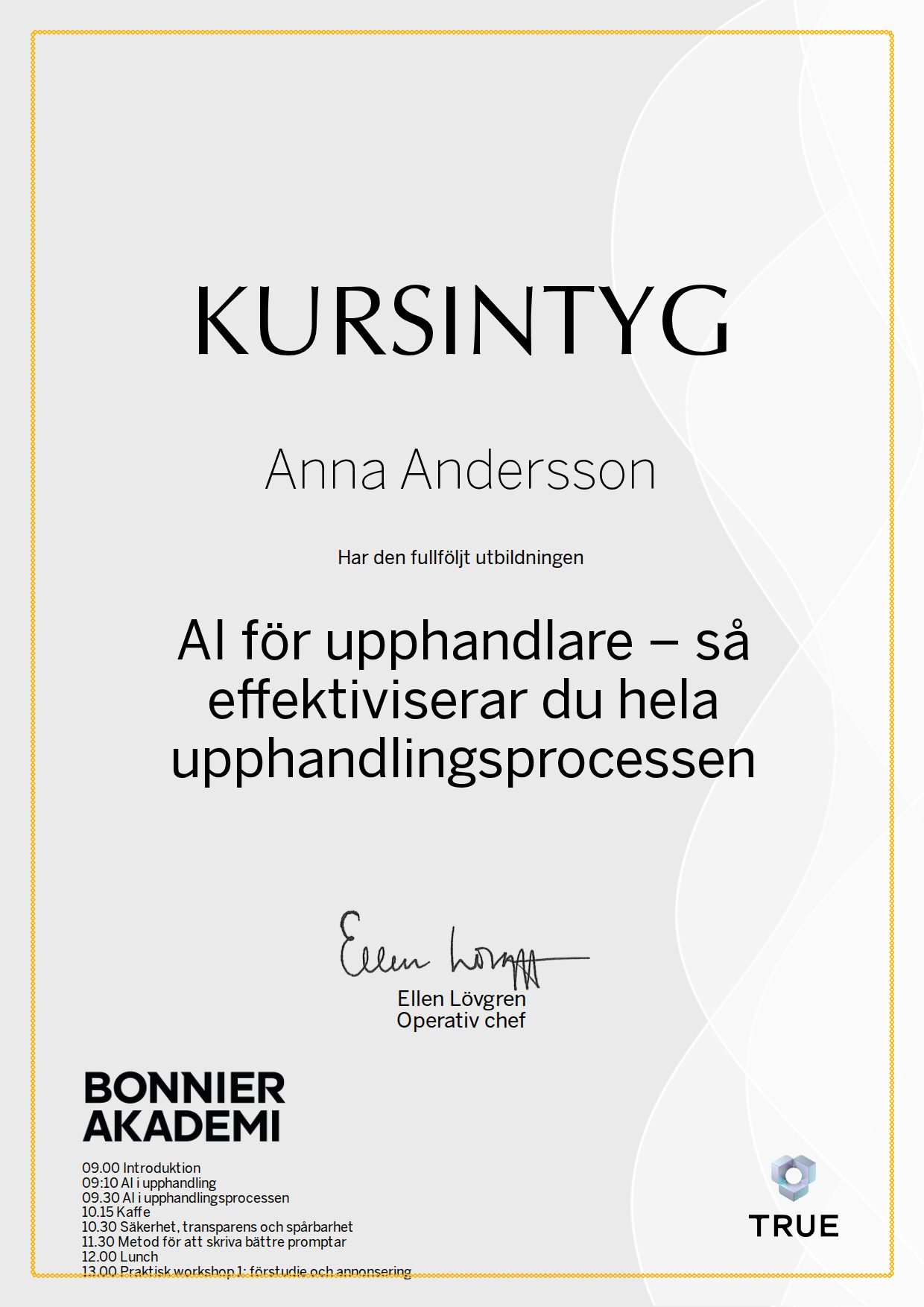
When you complete the course, Bonnier Akademi issues your certificate. Your name, the course content and the issue date are encrypted and secured on blockchain, so it cannot be changed, and anyone can check that it is genuine.
100% Verifiable certificates Secured on blockchain