This course is for you who want to understand how your organisation can harness the potential of AI. You will learn a proven methodology for AI mapping and how to map and identify workflows, processes and tasks that can be streamlined or automated with AI. Through strategic frameworks, practical examples and joint workshops you work with your own organisation, from current state analysis to priorities, governance and a concrete roadmap for AI transformation.
Format: On site
Language: Swedish
Request info
Want to know more before you sign up?
Send a short question and we will forward it directly to the provider.
We forward your question to Bonnier Akademi. No spam, no third parties.
About the course.
This course is for you who want to understand how your organisation can harness the potential of AI. You will learn a proven methodology for AI mapping and how to map and identify workflows, processes and tasks that can be streamlined or automated with AI. Through strategic frameworks, practical examples and joint workshops you work with your own organisation, from current state analysis to priorities, governance and a concrete roadmap for AI transformation.
COURSE OBJECTIVES:
As a participant you will gain:
- The ability to carry out a structured AI mapping and identify where AI creates value in the organisation, and where it should not be used.
- The competence to prioritise, structure and govern AI initiatives and turn identified opportunities into concrete and achievable actions.
- An understanding of how culture, ways of working, change management, risks and ethics affect sustainable and responsible AI adoption.
- The conditions to develop a realistic and well-anchored AI strategy with clear ownership, competence needs and a first structured roadmap linked to the organisation's goals.
What you will learn
What you learn.
Carry out an AI mapping to chart processes, roles, risks and opportunities
Identifying workflows, processes and tasks that can be streamlined, enhanced or automated with AI
Clarify where AI can create value in your organisation, and where it should not be used
Structure goals, priorities and governance for AI initiatives
How to go from an identified opportunity to a concrete and achievable AI initiative
Understand how culture, ways of working and change management affect AI adoption
Develop a realistic and well-anchored AI strategy linked to the organisation's goals
Identify competence needs, responsibility and ownership in the organisation
Understand risks, ethics and governance issues related to AI in the organisation
Formulating a first structured roadmap based on identified opportunities
Which organisational conditions need to be in place to turn the mapping into action
Curriculum
How the course is built.
DAY 1: Understanding and mapping AI in the organisation
09.00 Introduction: from traditional to AI-driven
- How organisations go from traditional ways of working to AI-driven ones
- The difference between isolated AI efforts and AI-driven ways of working
- Process and content for an AI strategy
10.15 Coffee
10.30 How other organisations have worked with AI
- How organisations have succeeded, and failed, with AI
- Examples of AI initiatives that have created concrete business value
- What distinguishes organisations that move forward from those that get stuck
12.00 Lunch
13.00 Method: mapping opportunities for AI in the organisation
- How to systematically investigate where AI can create value in the organisation
- Step by step: from identified opportunity to achievable AI initiative
- Examples of what the mapping can look like in different types of organisations
13.45 Workshop: Map opportunities in your organisation
- Identify workflows and tasks that can be streamlined or replaced with AI
- Make existing initiatives, manual work and bottlenecks visible
- Discuss where AI is relevant, and where it is not
15.00 Coffee break
15.15 Workshop: Business value, culture and organisational conditions
- Inspire and unite the organisation around your AI strategy
- Assess business value and realistic impact
- Identify organisational obstacles, cultural issues and change needs
- What it takes to move the organisation forward
16.30 Summary and reflection
- Key insights from the mapping
- What we take with us to day 2
17.00 Day 1 ends
DAY 2: Prioritise, structure and take the next step
09.00 Joint start and feedback
- A short reflection on day 1
- What became clear, and what remains to be solved?
09.30 From mapping to prioritised AI initiatives
- How to choose the right initiatives based on impact, feasibility and risk
- Choosing what not to do: why not everything should be done with AI
- Adapting to the organisation's size and maturity
10.15 Coffee
10.30 Structure, responsibility and conditions
- Roles, responsibility and ownership in AI work
- Internal competence, external partners and collaborations
- What needs to be in place to succeed
12.00 Lunch
13.00 Workshop: Prioritising and designing AI initiatives
- Formulate 2-4 concrete initiatives
- Define purpose, goals and expected impact
- Identify dependencies, risks and next steps
15.00 Coffee break
15.15 From initiative to roadmap
- Change in ways of working, roles and culture
- Follow-up, learning and adjustment: how AI work is kept alive in the organisation
16.30 Closing summary
- What participants take with them after the course
- Next steps after the course
17.00 The course ends
Target audience
Who is this for?
Decision makers and leaders who want to work more strategically and in a more structured way with AI, and who need to take a position on AI initiatives but lack a clear and coherent model for how the work should be organised and run.
No technical prior knowledge is required. The course focuses on leadership, organisation and strategy, rather than on prompting or the operational use of AI tools.
What "verified" means here
Verified credential.
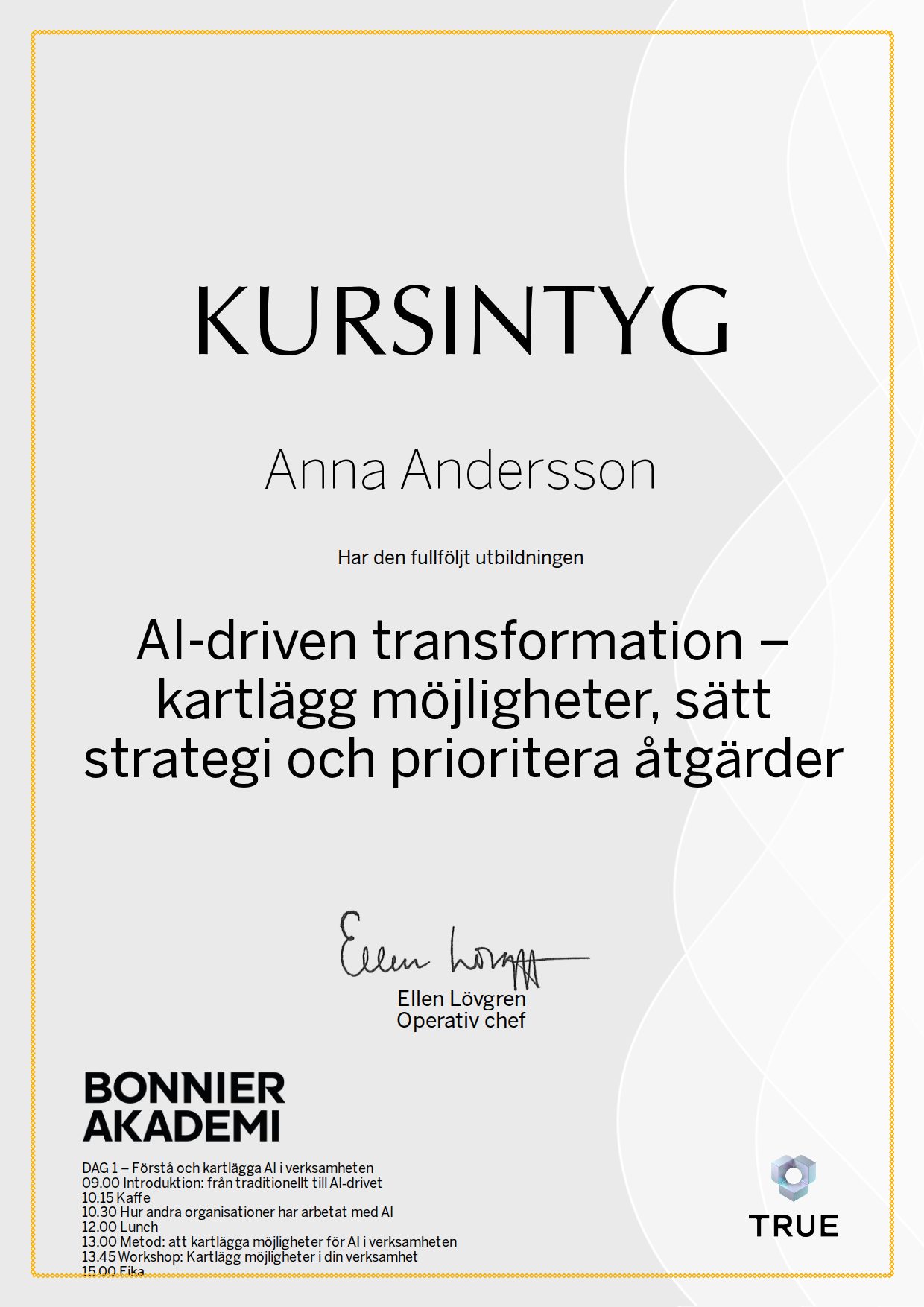
When you complete the course, Bonnier Akademi issues your certificate. Your name, the course content and the issue date are encrypted and secured on blockchain, so it cannot be changed, and anyone can check that it is genuine.
100% Verifiable certificates Secured on blockchain
 Bonnier Akademi under the brandsDi AkademiDagens Samhälle Utbildning